
A threat assessment team is a group of physical-security professionals who run a Threat, Vulnerability, and Risk Assessment (TVRA) of your facility. You receive a prioritized list of vulnerabilities and tailored mitigation options. Depending on scope, the work is either a rapid first-entry walk-through or a full assessment, and the first step is a short scoping call.
TL;DR:
- Hire an assessment after renovations, incidents, threat environment changes, special events, or insurance and regulatory pressure, when routine operations may miss new exposures.
- CISA’s SAFE model can produce an actionable report in under two hours, while full institutional reviews take longer for interviews, inspections, and analysis.
- Prepare floor plans, incident reports, camera and access inventories, policies, interviewees, IT contacts, and a site escort to shorten visits and sharpen findings.
- Expect an executive summary, documented vulnerabilities, a prioritized risk register, mitigation options, and an implementation roadmap; you can choose treatments to fit budget and operations.
- Require a written handoff connecting assessment findings to named guard posts, schedules, or procedures, with feedback loops to update the risk register.
Table of Contents
- What does a threat assessment team do during a TVRA?
- When should you hire a professional threat assessment team?
- How does the assessment process work, step by step?
- Who should take part in a threat assessment?
- What deliverables and timelines should you expect?
- How should you prepare your organization for an assessment?
- How do behavioral threat assessments complement physical assessments?
- What do successful threat assessment interventions look like?
- How do threat assessment teams coordinate with executive protection and guard services?
- What training and qualifications should team members have?
- Author perspective: why operational experience plus technology wins
- How can we help you with a threat assessment?
- FAQ
- Sources
What does a threat assessment team do during a TVRA?
A TVRA is a structured way to answer three questions: what could harm you, where are you exposed, and how much does it matter. The ASIS Security Risk Assessment Standard frames it as identifying assets, categorizing threats, pinpointing vulnerabilities in technical or personnel-based systems, and quantifying risk by weighing likelihood against potential impact on people, property, and information.
Threats generally fall into a few families:
- Criminal: burglary, theft, vandalism, assault, and intrusion after hours.
- Environmental: storms, flooding, fire, and other natural hazards that disrupt operations.
- Terrorist: deliberate attacks on people or places, most relevant for public venues and high-profile sites.
- Hybrid: events that cross categories, such as a cyber intrusion that disables door access.
Practitioners also separate vulnerabilities (access control gaps, maintenance failures, misconfigured systems) from risk itself, and they warn against fixating on a single countermeasure instead of checking that procedures, technology, and people work together.
Prioritization is the payoff. When likelihood and impact are weighed side by side, a rarely occurring but severe event can rank differently from a daily nuisance, and your budget goes where it counts.
When should you hire a professional threat assessment team?
Certain events make an outside assessment worth the investment:
- A new or renovated facility, where layouts, doors, and sight lines have changed.
- A special event, since crowds create exposures your normal operations never face. CISA’s guidance on protecting patrons at public gathering locations stresses vulnerability assessment and emergency planning to prioritize concerns.
- A recent incident, whether it was a break-in, a threat, or a near miss.
- A shift in the threat environment, such as a neighborhood change or a new tenant.
- Insurance or regulatory pressure to document your security posture.
The benefits are practical. Assessments help uncover weaknesses in security technologies and procedures, and they show where spending reduces risk and where it does not. Format matters too. CISA’s Security Assessment at First Entry (SAFE) model is built to produce an actionable report in under two hours, while a full institutional assessment is more extensive and multistep.
How does the assessment process work, step by step?
A credible assessment follows a repeatable workflow. Here is how our team runs it.
Scope and plan. We define objectives, name stakeholders, and agree on reference frameworks. ISO 31000 supplies the principles for identifying, analyzing, evaluating, and treating risk, adapted to your organization’s context. The PSP Body of Knowledge lays out the core tasks: develop a plan, identify critical assets, assess threats and hazards, quantify vulnerabilities, perform risk analysis, and design countermeasures.
Collect data. Good assessments draw on several inputs at once:
- Stakeholder interviews with the people who use the space daily.
- On-site observations at different times of day.
- Document review of policies, procedures, and incident history.
- External data such as local crime statistics.
- Technical audits of cameras, access control, alarms, and lighting.
Assess. We identify assets, analyze threats, test vulnerabilities, evaluate likelihood and impact, and rank the results.
Report and follow up. We discuss the assessment findings and possible next steps. We also recommend a review cadence, because a one-time snapshot ages quickly.
Pro Tip: Do not let anyone compress the data collection phase into a checklist exercise. Accurate findings need real time on site, and rushed assessments tend to miss the vulnerabilities that matter most.
Who should take part in a threat assessment?
No single department sees the whole building. CISA’s Security Planning Workbook recommends a diverse planning team, scaled down for smaller organizations, that includes security coordinators, facility operations, HR, and emergency management.
Internal participants:
- Facility manager: knows the building, its maintenance history, and its quirks.
- Security coordinator: owns current procedures and incident records.
- HR: speaks to personnel concerns, onboarding, and separations.
- Operations: explains workflows, shifts, and deliveries.
- IT and cyber: covers systems where physical and digital security overlap.
- Legal and compliance: flags regulatory duties and liability.
External specialists add what insiders cannot: physical security assessors, former law enforcement and military experts, CCTV and access-control integrators, and structural or design consultants. CISA’s Venue Guide for Security Enhancements also positions protective security advisors as partners. Pick one point of contact to schedule interviews and escort the team on site.
What deliverables and timelines should you expect?
Whatever the scope, a professional assessment should hand you tangible documents, not a verbal debrief:
- An executive summary written for decision-makers.
- A list of existing security strengths worth sustaining.
- A documented list of identified vulnerabilities.
- A prioritized risk register.
- Mitigation options and an implementation roadmap.
Timelines scale with the facility. A rapid SAFE-style reconnaissance can finish in under two hours and focus on immediate actions, while institutional TVRAs run longer because they involve more interviews, inspections, and analysis, as CISA describes.
Cost is handled openly. Mitigation options are typically voluntary and customized to your facility, so you choose treatments that match your risk tolerance, balancing budget against operational needs. If you want a deeper look at how layered measures get tested, see our guide to physical security layers, or read why we favor a customized security strategy over off-the-shelf packages.
How should you prepare your organization for an assessment?
Preparation shortens the visit and sharpens the findings. Work through this list before your team arrives:
- Gather documents: floor plans, incident reports, CCTV and system inventories, access-control rosters, and current policies and SOPs.
- Name your interviewees and make sure they know the conversation is coming.
- Assign a site escort with authority to open doors and answer questions.
- Line up IT contacts for any technical audit of cameras or networked systems.
- Write down scope and objectives, including areas that are off limits or especially sensitive.
- Confirm access and data-sharing arrangements so nobody is surprised on the day.
Pro Tip: Tell assessors about problems you already suspect, such as a door that never latches or a camera that drops offline. Those details point us to weaknesses faster than a blind walk-through.
If you want a more technical checklist of what gets examined, our security vulnerability assessment guide covers it.
How do behavioral threat assessments complement physical assessments?
A physical TVRA looks at doors, lighting, cameras, and procedures. A behavioral threat assessment focuses on concerns about a person’s behavior. The issues considered depend on the situation and the assessment approach. Neither replaces the other.
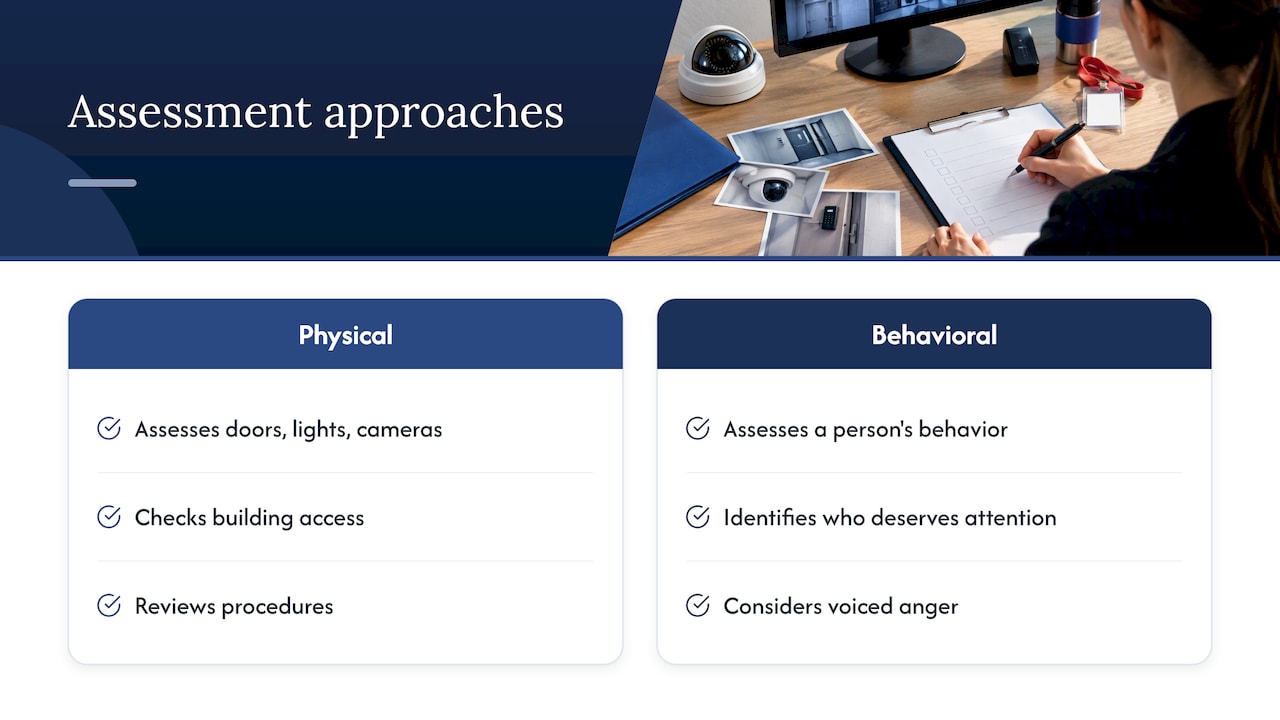
Think about how they interact. A terminated employee who has voiced anger is a behavioral concern, but whether that person can still enter the building, reach a loading dock, or use an old badge is a physical question. The behavioral side tells you who deserves attention. The physical side tells you what stands between that person and your people.
The process can vary by organization and situation. Ask the provider how concerns are reported, reviewed, and followed up. HR, legal, and security usually all have a seat.
A provider may consider whether findings from a behavioral review should inform access permissions, camera recommendations, or guard briefings. Hostile termination support and threat assessment services can be considered together when an organization is planning a separation. Organizations may find it useful to coordinate the physical risk register and behavioral process, while following their applicable privacy and information-sharing requirements.
What do successful threat assessment interventions look like?
Public case studies with named clients and measured outcomes are rare in this field, because good security work is quiet and confidential. What we can describe accurately are the patterns that recur when assessment findings are acted on.
The overlooked entry point. A first-entry walk-through often reveals something mundane: a side door propped open for convenience, a gate that does not latch, or a dark rear lot. These are examples of gaps that CISA’s first-entry model is designed to surface.
The event that needed a plan. A venue hosting a large gathering benefits from measures such as lighting, patrols, access control, and crowd management, cataloged in CISA’s venue guidance and scaled to venue size, budget, and threat environment.
The mismatched technology. An organization with cameras that record but are never reviewed gains little. Assessors recommend auditing systems and weighing the return on updates against the risk of leaving them alone, which often leads to remote monitoring or maintenance rather than new hardware.
In each pattern, the intervention works because findings were ranked, assigned an owner, and revisited. An assessment that sits in a drawer protects no one.
How do threat assessment teams coordinate with executive protection and guard services?
The assessment and the people who carry out protection should never operate as strangers. The assessment sets priorities. Guards, patrols, and executive protection agents put those priorities into daily practice.
Coordination usually covers several areas:
- Post orders and patrol routes are built from the risk register, so guards spend time at the locations the assessment ranked highest.
- Executive protection planning draws on the assessment of residences, offices, and travel routes, including advance work on venues and access points.
- Technology and people are matched. Remote monitoring can cover low-risk hours while on-site officers focus on high-impact areas, which is one way to manage cost without dropping coverage.
- Feedback loops carry what officers observe back to the assessment team, such as repeated tailgating or an unusual vehicle pattern, so the risk register stays current.
Because we deliver guard services, executive protection, Virtual Guard monitoring, and roving patrols alongside threat assessment, one team can write the recommendations and staff them. Whoever does the staffing, insist on a written handoff that connects each recommended measure to a named post, schedule, or procedure.
What training and qualifications should team members have?
There is no single qualification described here as a universal standard. When evaluating a provider, ask about relevant training and experience. The PSP Body of Knowledge outlines tasks and knowledge areas relevant to physical security assessment, including asset identification, threat assessment, vulnerability quantification, risk analysis, and countermeasure design.
When you vet a team, ask about:
- Framework fluency: can they explain how they apply the ASIS standard and ISO 31000 to your site?
- Operational background: law enforcement or military experience brings pattern recognition that classroom training alone does not.
- Technical competence: familiarity with CCTV, access control, and alarm systems, or a trusted integrator to audit them.
- Process discipline: a written method, documented deliverables, and a plan for follow-up reviews.
- Behavioral awareness: a working understanding of how concerning conduct is reported and handled, with HR and legal in the loop.
Ask providers about their assessors’ backgrounds and how they address technology integration. Ask any provider, us included, to walk you through a sample deliverable before you sign.
Author perspective: why operational experience plus technology wins
Plenty of assessments fail not because the analysis is wrong but because nobody can implement it. A recommendation informed by operational experience may be easier to adapt to real budgets, staffing, and day-to-day needs. Pair that experience with working knowledge of cameras, access control, and monitoring, and the advice may be more practical for a facility manager.
The other lesson is that security needs revisiting. Threats, staff, and buildings can change, so an older assessment may no longer reflect current conditions.
— Alston
How can we help you with a threat assessment?
We conduct threat assessments backed by guard services, CCTV integration, and Virtual Guard monitoring, so the recommendations we write are ones our team can help carry out. A consultation starts with scoping: your facility, your concerns, and the timeline that fits, either a rapid first-entry review or a full TVRA. We then outline the deliverables you would receive and the next steps.

Request a scoped consultation through our threat assessment and guard services page, and tell us what keeps you up at night.
FAQ
What is a threat assessment team in physical security?
It is a group of security professionals who evaluate threats, vulnerabilities, and risks at a facility. They deliver a prioritized list of weaknesses and mitigation options. The work is commonly structured as a TVRA, as described in the ASIS Security Risk Assessment Standard.
How long does a threat assessment take?
It depends on scope. A rapid model such as CISA’s SAFE assessment is designed to produce an actionable report in under two hours. A full institutional assessment takes longer because it involves more interviews, inspections, and analysis.
What is the difference between threat assessment and risk assessment?
A threat assessment focuses on what could cause harm and who or what might do it. A risk assessment goes further by weighing how likely each threat is against its potential impact. A TVRA combines threats, vulnerabilities, and risk in one process.
Who should be involved in the assessment?
Include a facility manager, a security coordinator, HR, operations, IT, and legal or compliance, plus outside specialists. CISA’s Security Planning Workbook recommends a diverse team scaled to your organization’s size.
Do I have to implement every recommendation?
No. Mitigation options are typically voluntary and tailored to your facility, so you can select treatments that fit your budget, operations, and risk tolerance, as CISA’s assessment guidance describes.