
A security vulnerability assessment is an on-site evaluation that finds exploitable weaknesses in your perimeter, access control, CCTV coverage, lighting, staffing and procedures, then hands you a prioritized plan for fixing them. The CISA Security Planning Workbook frames it as an analysis to determine the countermeasures needed to mitigate threats to your people, your facility and your events.
Three moves get you started. First, decide scope: one building, a campus, or a single event footprint. Second, build a short vendor checklist covering credentials, sample reports and insurance. Third, schedule the site visit, including at least one after-hours pass. The deliverable you’re paying for is a written, risk-ranked report, not a checklist with boxes ticked.
Key Takeaways
A physical security vulnerability assessment works because it converts subjective risk into scored, prioritized action items that executives and insurers can act on.
| Point | Details |
|---|---|
| Assess before you spend | Inspect perimeter, access control, CCTV, lighting and staffing at multiple times of day before budgeting fixes. |
| Score risks numerically | Use Threat times Vulnerability times Consequence or a 5×5 matrix to rank findings as Critical, High, Medium or Low. |
| Fix cheap wins first | Lighting, camera repositioning and access policy updates often close Critical gaps faster than new hardware. |
| Reassess on a schedule | Full reassessment every two to three years, annually for high-risk sites, and immediately after incidents. |
| Choose an integrated partner | Gsgicorp pairs the on-site assessment with implementation, including guard services and Virtual Guard remote monitoring. |
Table of Contents
- What Does a Security Vulnerability Assessment Actually Cover?
- How Does the On-Site Assessment Process Work?
- Which Mitigations Reduce Risk Fastest?
- How Do You Hire the Right Assessment Contractor?
- What’s in the Final Report, and When Should You Reassess?
- Why a Documented Process Beats a Gut-Feel Walkthrough
- Get a Site Visit Scheduled With a Team That Also Implements
- Useful Resources for Building Your Own Assessment Process
- Frequently Asked Questions
- Sources
What Does a Security Vulnerability Assessment Actually Cover?
Before an assessor sets foot on your property, you should know what’s getting inspected. Confirming scope up front keeps the visit efficient and keeps the eventual report focused on what matters to your operation.
The physical inspection typically spans five zones:
- Perimeter and approach zones: parking lot lighting, landscaping sightlines, bollards, fencing condition.
- Entry points and internal access: lock hardware, badge or key fob systems, and whether tailgating is realistically possible at busy doors.
- Electronic systems: CCTV camera coverage and footage retention windows, alarm monitoring response times, and backup power for critical systems.
- Operational patterns: staffing schedules, visitor sign-in procedures, delivery and contractor access protocols.
- Documentation on hand: floor plans, a list of key contacts, recent incident logs, and current policies plus any equipment warranties still in force.
Pro Tip: Pull your incident logs and your CCTV retention settings before the assessor arrives. Most facility managers discover their cameras are only retaining seven to fourteen days of footage, which is often too short a window to be useful after an actual incident.
How Does the On-Site Assessment Process Work?
A defensible assessment follows a structured sequence, not an assessor wandering the property with a clipboard. The process below draws on the eight-step Threat-Vulnerability-Asset methodology that most professional security surveys now follow.
- Define scope and assets. Identify what’s critical (server rooms, cash handling, VIP access points) and sign a short scope document before fieldwork starts.
- Collect pre-assessment data. This means incident history, local crime statistics, staffing rosters and existing system logs. CISA recommends gathering this through interviews, on-site inspection and public records rather than relying on assumptions.
- Inspect the site at multiple times. Business hours, after dark, and during peak or event periods each reveal different gaps. After-hours walkthroughs commonly expose lighting failures and tailgating patterns that a daytime tour misses entirely.
- Audit physical systems. Camera field-of-view and image quality, access control logs, intrusion detection sensors, lighting levels, and barrier condition, cross-checked against maintenance records.
- Interview staff and vendors. This is where propped doors, shared credentials and unescorted contractor access usually surface. Most real vulnerabilities turn out to be operational habits, not equipment failures.
- Score the risks. Each vulnerability gets rated using either a 5×5 likelihood-by-consequence matrix or a composite formula: Threat (1 to 5) times Vulnerability (1 to 10) times Consequence (1 to 10). This turns subjective impressions into comparable priority tiers.
- Document evidence. Photos, annotated maps, time-stamped notes and system test results all support the final report.
A notional risk table shows how the math plays out:
| Vulnerability | Threat (1–5) | Vulnerability (1–10) | Consequence (1–10) | Score | Priority |
|---|---|---|---|---|---|
| Unmonitored rear loading dock | 4 | 5 | 7 | 150 | Critical |
| Camera blind spot at main entrance | 3 | 6 | 6 | 75 | High |
| Outdated visitor sign-in process | 2 | 5 | 4 | 30 | Medium |
| Faded exterior signage | 1 | 3 | 2 | 6 | Low |
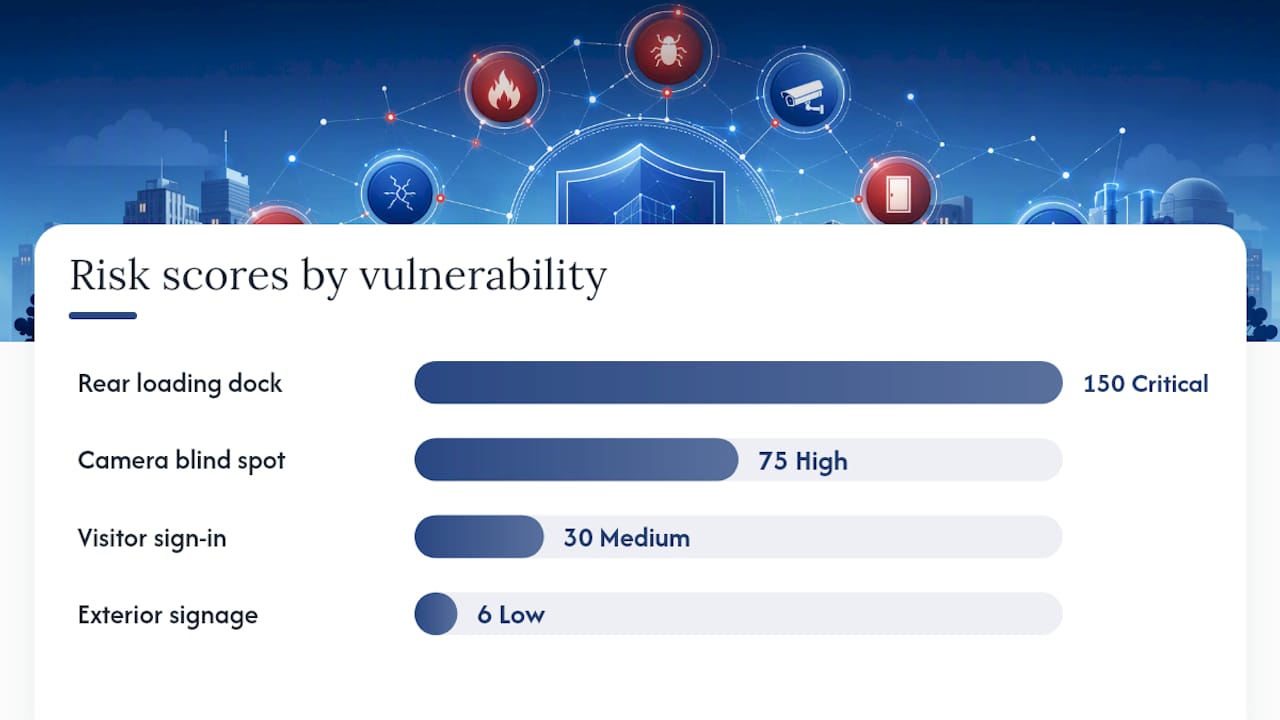
A score above roughly 150 typically lands in the Critical tier, calling for action inside 30 days. Medium and Low items can often wait for the next budget cycle.
Which Mitigations Reduce Risk Fastest?
Mitigations fall into four functional categories, and knowing which bucket a fix belongs to helps you sequence spending correctly:
- Deterrence: lighting upgrades, signage, visible roving patrols. Low cost, fast to deploy.
- Detection: repositioning existing cameras, adding sensor diversity. Low to medium cost.
- Delay: reinforced doors, upgraded locks, bollards and entry barriers. Medium to high cost, longer install timelines.
- Response: contracted guard services, alarm monitoring integration, remote video monitoring. Ongoing cost, immediate operational impact.
Lock replacement and camera re-aiming are typically low-cost, low-time fixes. Full CCTV system replacement or access-control upgrades run medium to high on both dollars and weeks. Bollards and permanent entry barriers sit at the high end for both.
The mitigations that punch above their price tag rarely involve new hardware. Updating an access policy, revoking stale credentials, tightening delivery and vendor sign-in rules, and running short staff training sessions often close Critical-tier gaps for a fraction of the cost of equipment. None of it matters without upkeep, though. The DOE’s Physical Security Systems Assessment Guide is blunt about this: most physical security system failures trace back to inadequate testing and maintenance, not bad design.
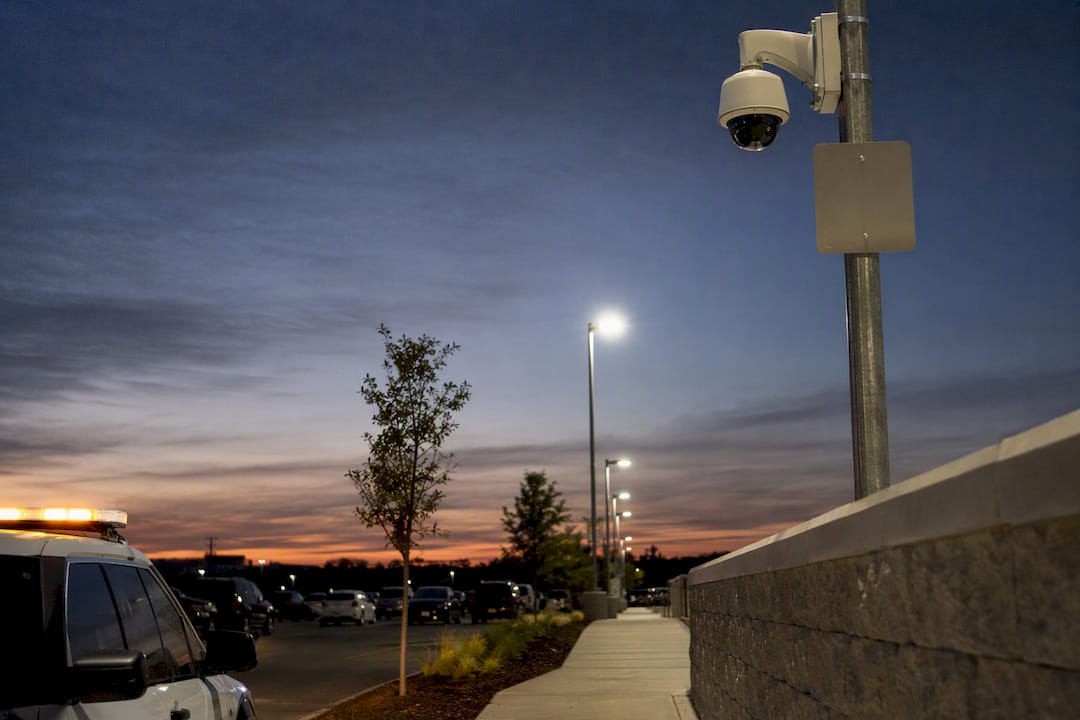
Pro Tip: Combine three cheap fixes at once for outsized impact: fix a lighting gap, reposition one camera to cover the resulting blind spot, and add a short-term roving patrol while permanent fixes get budgeted. That combination frequently drops a Critical-tier score into High or Medium within a week.
How Do You Hire the Right Assessment Contractor?
A short, specific scope of work protects you from vague deliverables and scope creep later. Request these items in writing before you sign anything:
- Defined scope, inspection methods, and site visit windows (including at least one after-hours visit).
- Deliverables: a risk register with scores, photo documentation, coverage diagrams, and a prioritized remediation roadmap.
- Pricing model (flat fee versus phased) and a firm timeline for the final report.
When vetting candidates, ask direct questions:
- What credentials does your lead assessor hold, and does that include law-enforcement, military or PSP-certified experience?
- Can you show a redacted sample report from a comparable site?
- Do you carry liability insurance, and can you provide references?
- What’s your testing and maintenance plan for any systems you install?
Watch for red flags: cookie-cutter checklists with no real on-site inspection, no sample reports available, missing insurance documentation, or a contractor who treats guards, cameras and procedures as three separate quotes instead of one integrated plan. A security survey that doesn’t connect physical measures to staffing and procedure changes is only half a plan.
Pro Tip: Ask for phased pricing: assessment, remediation design, then implementation. This lets you approve the assessment first without committing to a full buildout before you’ve even seen the findings. If your search includes both the evaluation and the follow-through, look for a provider whose guard services team can pick up implementation directly from the assessment report, rather than handing you off to a third party.
What’s in the Final Report, and When Should You Reassess?
The standard deliverable includes an executive summary highlighting your top financial exposures, a scope statement, a full risk register with scores and photos, a prioritized roadmap with cost and timeline estimates and assigned owners, plus system test results and coverage diagrams.
Use it in three ways: as an executive briefing to justify budget, as documentation for insurance conversations (implemented measures like monitored access control commonly support premium reductions), and as evidence of due diligence if you’re operating under a compliance framework.
- Run a full reassessment every two to three years for a typical commercial site.
- Reassess annually if you’re in a high-risk or regulated industry.
- Trigger an immediate review after any incident, renovation, or major system change.
- Schedule staff tabletop exercises and equipment testing on a recurring calendar, not an ad hoc basis.
Pro Tip: Put your reassessment date on the facilities calendar the same day the current report lands. Assessments that don’t get scheduled in advance tend to slip two or three years past their real expiration.
Why a Documented Process Beats a Gut-Feel Walkthrough
Facility managers who skip formal scoring almost always underfund the wrong fixes. A documented process with numeric scores gives you something a hallway opinion never will: a defensible reason for what gets funded first.
That structure also does something less obvious. It turns a security conversation into a budget conversation executives already know how to have, which is usually the fastest path to approval. Assessments built this way don’t just find gaps. They prevent the kind of surprise outage that blows up a quarter’s security budget in one incident.
Get a Site Visit Scheduled With a Team That Also Implements
Most assessors hand you a report and walk away, leaving you to find separate contractors for guards, cameras and monitoring. Gsgicorp closes that gap. Led by former law-enforcement and military personnel, the team runs the on-site evaluation and then implements the fix directly, whether that means professional guard services, roving patrols, or Virtual Guard remote monitoring that cuts staffing costs without cutting coverage.

For high-profile clients and events, that same team handles executive protection alongside standard guard deployment, so your assessment findings and your protective coverage come from one accountable source instead of three vendors pointing fingers at each other. If your next step is a real site visit rather than another PDF checklist, request a proposal for guard services and get a firm timeline for both the assessment and the fix.
Useful Resources for Building Your Own Assessment Process
Several vendor-neutral resources back the methodology covered above. The CISA Security Planning Workbook offers templates and self-assessment tools you can adapt directly. The DOE Physical Security Systems Assessment Guide covers the technical testing and maintenance standards that keep cameras and alarms reliable between assessments.
For the procurement side, Ciphrix’s guide to running a vulnerability assessment lays out process checklists useful for scoping conversations with contractors. If your report supports an insurance or budget request, a completed security survey with cost ranges attached gives executives the concrete numbers they need to approve remediation spending.
Frequently Asked Questions
How long does an on-site security vulnerability assessment take?
Most commercial sites take one to three days for fieldwork, including at least one after-hours visit, followed by one to two weeks for report drafting and a follow-up briefing.
What’s the difference between a security audit checklist and a full assessment?
A checklist confirms compliance with existing policy. A full assessment scores actual risk using threat, vulnerability and consequence data, then prioritizes fixes by severity rather than just flagging missing items.
Do I need a penetration testing service for a physical assessment?
No. Penetration testing evaluates network and application weaknesses. A physical security vulnerability assessment evaluates your building, perimeter, staffing and procedures, which is a separate discipline with separate credentials.
How much does a professional security survey typically cost?
Commercial surveys commonly range from a few thousand dollars to $15,000 or more, depending on site size, number of buildings, and whether after-hours visits are included.
Can an assessment help lower my insurance premiums?
Often, yes. Insurers frequently offer discounts, commonly in the range of 5% to 20%, for documented, implemented measures like monitored access control and surveillance systems.
Sources
- CISA Security Planning Workbook (AASB)
- Physical Security Systems (PSS) Assessment Guide — U.S. Department of Energy
- Physical security assessment best practices 2026 — Base Operations
- How to Conduct a Security Survey: Process and Report — LegalClarity