
A written, active workplace violence prevention program led by management is the single most effective step an employer can take to reduce workplace violence, following guidance from OSHA, NIOSH, and the DOL. The immediate next step is simple: appoint a program lead or commission a basic hazard assessment this quarter. Success looks like a documented program, a prioritized list of fixes, and training scheduled on the calendar, not just a policy sitting in a binder.
TL;DR:
- Implementing a written workplace violence prevention program with management accountability is essential to effectively address hazards and change behavior.
- Risk factors such as working alone, handling valuables, or recent layoffs should be prioritized in hazard assessments, especially in high-risk roles like healthcare and security.
- Engineering controls like access systems, physical barriers, and CCTV are the most durable methods to reduce violence, followed by administrative procedures and PPE.
- Regular hazard assessments should combine incident data, employee input, and physical walkthroughs, with a clear ownership and a prioritized mitigation plan.
- Post-incident support through employee counseling and feedback collection is vital for recovery and iterative program improvement.
Table of Contents
- What Counts as Workplace Violence Prevention?
- Who Faces the Highest Risk on the Job?
- Building the Program: Five Core Components
- Which Controls Actually Reduce Risk?
- How Do You Assess and Prioritize Risk?
- What Should Training and Incident Response Cover?
- Is the Program Actually Working?
- What Happens for Employees After an Incident?
- When Professional Security Services Make Sense
- How Gsgicorp Supports Your Prevention Program
- Sources
What Counts as Workplace Violence Prevention?
Workplace violence covers a wider range of conduct than most HR teams assume. OSHA’s guidance defines it as any act or threat of physical violence, harassment, intimidation, or disruptive behavior at a work site, spanning verbal abuse, threats, physical assault, and homicide. It happens between coworkers, from customers or patients, and from people with no legitimate business relationship to the organization at all.
The scale is larger than most leaders realize. Nonfatal workplace violence sends many workers to emergency departments each year, and homicide remains a significant cause of occupational death in certain sectors, according to NIOSH.
Underreporting compounds the problem. Employees frequently stay quiet about verbal threats or minor altercations because they doubt anything will happen, or because reporting channels feel unsafe or pointless. That silence hides the near-misses that would otherwise flag a hazard before it turns into an injury. A formal prevention program exists precisely to close that gap. Waiting for a serious incident before building one is the single most common and most costly mistake employers make.
Who Faces the Highest Risk on the Job?
Risk is not evenly distributed across your workforce. Certain roles, shifts, and physical layouts concentrate exposure far more than others, and NIOSH data shows workers in sales, protective services, and transportation face higher fatal risk, while healthcare workers face disproportionately higher rates of nonfatal injury. Knowing where your organization sits on that spectrum tells you where to spend your first prevention dollar.
Higher-risk factors worth flagging in any assessment include:
- Working alone or in isolated locations, especially during evening or overnight shifts
- Handling cash, valuables, or controlled substances
- Direct contact with the public, particularly in healthcare, retail, and social services
- Delivering services in clients’ homes or unfamiliar off-site locations
- Employees experiencing domestic violence that could spill into the workplace
- Recent layoffs, terminations, or disciplinary actions that heighten tension
Behavioral and performance shifts often surface before an incident does. A supervisor trained to notice a pattern, escalating irritability, a sudden drop in performance, veiled threats made in passing, catches far more than one relying on a single red flag. Massachusetts’s guidance on zero-tolerance policies makes the same point: pattern recognition beats gut instinct every time.
Building the Program: Five Core Components
OSHA and allied agencies converge on five building blocks for an effective workplace violence prevention program. Skip one and the whole structure weakens, no matter how strong the others are.
- Management commitment and employee participation. Leadership has to own the program, not just sign off on it. That means a named executive sponsor, a documented policy, and a real channel for employees to flag concerns and shape solutions.
- Worksite analysis. Regular walkthroughs, incident-history review, and employee interviews identify where hazards actually exist rather than where you assume they do.
- Hazard prevention and control. Every identified risk gets a corresponding fix, whether that’s a physical barrier, a policy change, or a training gap closed.
- Training. Every employee, not just supervisors, needs to know the policy, the warning signs, and what to do in a live incident.
- Recordkeeping and program evaluation. Incidents, near-misses, and corrective actions get logged and reviewed on a set cadence, feeding the next round of improvements.
Pro Tip: Assign a single accountable owner for the whole program, not a committee. Committees are great for input; they are terrible for follow-through on deadlines.
Governance matters more than most HR teams expect at the outset. A workplace violence policy that lives only in the employee handbook rarely changes behavior. It needs a visible sponsor, a communication plan, and a standing item on leadership’s agenda, treated with the same seriousness as a fire safety audit rather than a compliance checkbox filled out once a year.
Worksite analysis works best when it pulls from more than one source: incident logs, near-miss reports, exit interviews, and direct employee input all surface different blind spots. Prioritize what you find by frequency and severity, then work down the list. For KPIs, watch training completion rates, corrective action closure time, and how quickly reported concerns get a documented response. Annual audits keep the program from going stale, and any significant facility change, staffing shift, or incident should trigger an immediate reassessment rather than waiting for the next scheduled review.
Which Controls Actually Reduce Risk?
The hierarchy of controls, prioritizing engineering fixes first, then administrative changes, then personal protective equipment, is the framework NIOSH recommends for workplace violence hazards, and it exists because engineering controls remove the hazard rather than asking a person to manage around it.
Engineering controls typically deliver the most durable reduction in risk:
- Access control systems and locked entry points that limit who can reach sensitive areas
- Physical barriers, including reinforced glass or counters in high-cash or high-conflict settings
- Adequate lighting in parking lots, stairwells, and after-hours entrances
- Panic buttons and duress alarms tied directly to a monitored response
- CCTV coverage at entry points and other vulnerable zones, integrated with a monitoring service
Administrative controls fill the gaps engineering can’t reach. Visitor sign-in procedures, defined escort protocols for high-risk visitors, adjusted shift patterns to avoid solo overnight coverage, and lone-worker check-in systems all reduce exposure without a construction budget. PPE, duress alarms worn on the body, cut-resistant gear in specific roles, comes last in the hierarchy because it protects the individual after a threat has already materialized rather than preventing it.
One caveat matters here: engineering controls that work in a hospital emergency department, bulletproof glass, locked units, may be entirely wrong for a community care setting where preserving a therapeutic, open environment is part of the job. Match the control to the setting, not the other way around.
How Do You Assess and Prioritize Risk?
A worksite hazard assessment follows a repeatable sequence, and skipping steps is how organizations end up fixing the wrong problem first.
- Convene a cross-functional planning group that includes HR, facilities, security, and frontline employee representatives.
- Pull incident history, near-miss reports, and any prior complaints tied to the location or role.
- Walk the physical space with fresh eyes, looking specifically at entry points, lighting, sightlines, and isolated work areas.
- Collect direct employee input through anonymous surveys and interviews with staff in the highest-exposure roles.
- Score each identified hazard by frequency, severity, and trend to build a prioritized risk register.
A practitioner review of hazard analysis methods makes clear that physical walkthroughs alone routinely miss administrative gaps, particularly trust issues that keep employees from reporting in the first place. Combining incident analytics with anonymous surveys catches problems a hallway inspection never will.
The output should be concrete: a ranked mitigation plan, a rough cost estimate for each fix, a realistic timeline, and a named owner for every line item. A risk register with no owner attached is a wish list, not a plan.
What Should Training and Incident Response Cover?
Training has to reach every employee, not just managers, and it needs to cover more than a policy read-through.
- The written policy itself, including what behavior is prohibited and how to report it
- Recognizing early warning signs and behavioral patterns, not just obvious threats
- Basic de-escalation techniques for defusing tense interactions before they turn physical
- What to do in an active incident, including evacuation routes and safety system use
- Assurance that reporting carries no retaliation risk, and confirmation of who receives that report
Pro Tip: Run de-escalation training as a live scenario exercise, not a slideshow. Employees remember what they practiced far better than what they read.
Reporting pathways need a clear owner and a clock attached. A report that disappears into a shared inbox for two weeks teaches employees not to bother next time. Assign triage responsibility, set a response-time target, and confirm confidentiality is real, not just stated. Washington State’s employer guidance notes that programs which publicly track corrective actions see measurably higher reporting rates, because employees can see their reports actually go somewhere.
When an incident occurs, the immediate checklist is short but non-negotiable: get medical care to anyone injured, secure the scene, and notify law enforcement if the situation warrants it. Document everything: witness statements, timeline, physical evidence, before memory fades. A partner resource covering workplace violence prevention training delivery models offers additional detail on structuring these curricula for different industries.
Is the Program Actually Working?
A program you never measure is a program you’re guessing about. Track these on a regular cadence:
- Overall incident rate and severity trend over time
- Near-miss reporting rate, a rising number here is often a good sign, not a bad one
- Training completion rate across all employee tiers
- Time to close corrective actions after a hazard is identified
Run a full audit annually, and trigger an immediate reassessment after any significant incident, facility change, or staffing shift, an approach ISC/CISA guidance recommends for federal workplaces and one that translates cleanly to the private sector. After any incident, hold a structured after-action review, what happened, what worked, what didn’t, and convert every finding into a corrective action with a deadline and an owner. A prevention plan that never changes after new information arrives isn’t a program; it’s a document that happens to exist.
What Happens for Employees After an Incident?
The response to a workplace violence incident doesn’t end when the scene is secured. Employees who witnessed or were directly affected by a violent event need a path to recovery, and organizations that skip this step often see the same employees leave within months, or become the source of the next unreported near-miss.
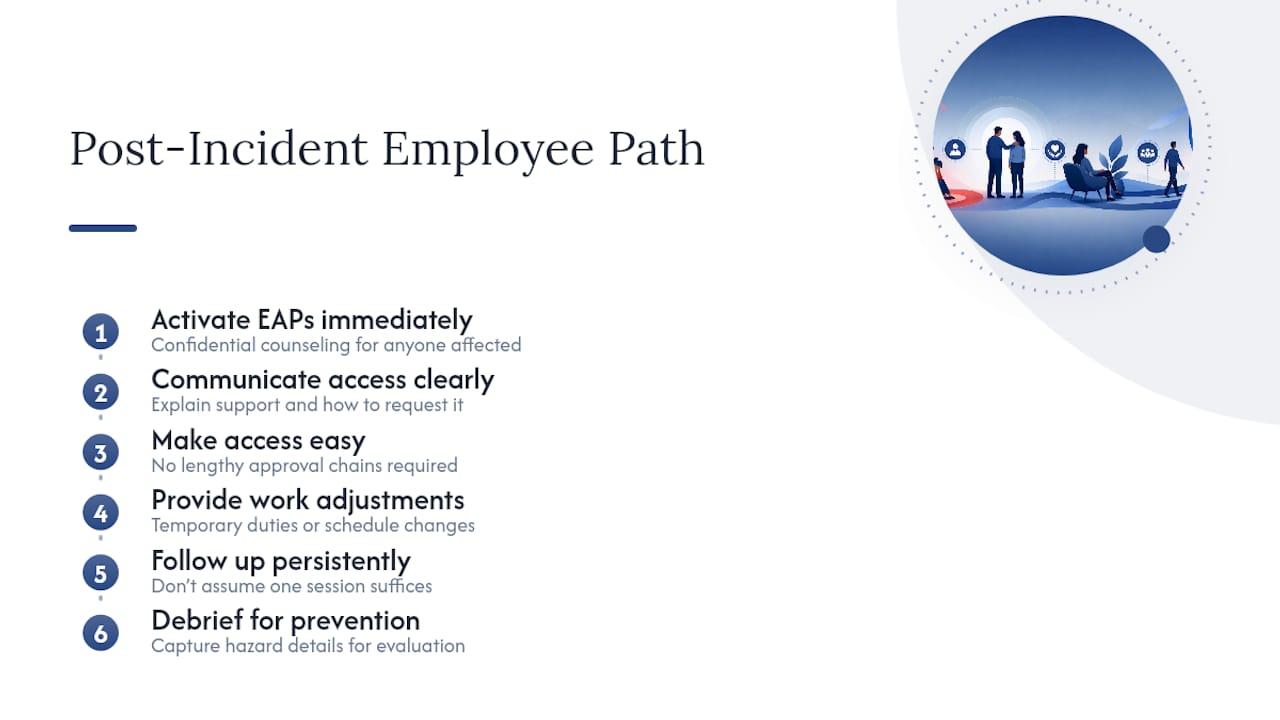
Employee assistance programs (EAPs) should be activated immediately after any significant incident, offering confidential counseling to anyone touched by the event, not just the direct victim. Bystanders and coworkers process trauma too, and treating support as available only to the person physically harmed leaves a gap that shows up later as absenteeism or turnover.
HR’s role here is logistical as much as emotional: communicate clearly that support exists, make it easy to access without a lengthy approval chain, and follow up rather than assuming a single counseling session closes the issue. Some employees will need modified duties or a temporary schedule change during recovery. Build that flexibility into your response plan ahead of time rather than negotiating it under pressure after the fact.
Post-incident care also feeds back into your prevention data. Debrief conversations with affected employees often surface hazard details a formal investigation misses entirely, small warning signs no one flagged, a policy gap that let the situation develop. Treat that feedback as part of your evaluation cycle, not a separate HR function running in parallel.
When Professional Security Services Make Sense
Most prevention work stays inside HR and safety teams. Bring in professional security services when the risk profile gets more complex than internal resources can handle: multi-site access control, technical monitoring, executive protection for high-profile leaders, or training capacity gaps your team can’t fill alone.
Services like remote video monitoring, trained roving patrols, and executive protection map directly onto the hazard-prevention and training building blocks OSHA outlines. They don’t replace management commitment. They execute the technical and operational pieces a lean HR team often can’t build in-house.
— Alston
How Gsgicorp Supports Your Prevention Program
Once you’ve identified gaps through a hazard assessment, the harder question is who executes the fix. Gsgicorp fills that gap for organizations that need trained personnel and technical systems in place fast, not a six-month internal buildout.

Our team, led by former law enforcement and military professionals, builds custom programs around the same five building blocks this guide walks through: armed and unarmed guard services for visible deterrence, Virtual Guard remote monitoring for continuous coverage without a full-time onsite headcount, CCTV integration for access-point surveillance, and executive protection for high-profile leadership. Our training programs also cover licensing and de-escalation skills for your internal team.
| Program Need | Gsgicorp Service |
|---|---|
| Engineering controls | CCTV integration, access systems |
| Visible deterrence | Roving vehicle patrols, guard services |
| Remote coverage | Virtual Guard monitoring |
| Executive risk | Executive protection |
| Training gaps | Security and de-escalation training |
Request a site security assessment through Gsgicorp’s services page to see where your current setup falls short.
Sources
- Guidelines for Preventing Workplace Violence for Healthcare and Social Service Workers — OSHA
- Violence in the Federal Workplace: A Guide for Prevention and Response — ISC/CISA
- Workplace Violence: Awareness and Prevention for Employers and Employees — Washington State L&I
- Violence and Work — NIOSH/CDC