
For perimeter security lighting, the right move is a layered security program: Virtual Guard-style remote monitoring paired with targeted on-site patrol coverage, full CCTV integration, and contract SLAs that name response times in writing. Remote video monitoring often costs 60 to 95 percent less than an equivalent standing guard post, and Gsgicorp builds its programs around certified monitoring backed by law-enforcement and military-trained leadership.
- Your first move: request a site risk scan before you touch a vendor contract.
- Ask any bidder for a sample of their post orders. If they can’t produce one, move on.
Pro Tip: Start your RFP with a walk of the property, not a spec sheet. What you see on foot rarely matches what a boilerplate proposal assumes.
Key Takeaways
A layered perimeter security program combining remote monitoring, on-site patrols, CCTV integration, and enforceable SLAs outperforms single-service approaches on both cost and response reliability.
| Point | Details |
|---|---|
| Define scope early | Perimeter security means guards, monitoring, patrols, and CCTV integration, not fixture-level lighting design. |
| Demand written post orders | Refuse any vendor who describes duties verbally instead of providing a documented playbook. |
| Verify monitoring capability | Require certified control rooms, operator training, and audio talk-down, not just camera access. |
| Negotiate SLA specifics | Contract language should name verification, audio, and dispatch times in minutes, with penalties attached. |
| Consider Gsgicorp for layered programs | Gsgicorp pairs Virtual Guard monitoring with on-site patrols and custom post orders built from a site risk assessment. |
Table of Contents
- What “Perimeter Security Lighting” Means in This Guide
- How Do Modern Perimeter Security Services Work?
- What Role Does Lighting Play in a Security Services Contract?
- How Does Remote Monitoring (Virtual Guard) Actually Work?
- How Do You Evaluate and Contract a Perimeter Security Vendor?
- What’s the Typical Timeline and Cost Structure?
- Building a Perimeter Program With Gsgicorp
- Why Vendor-Neutral Design Still Matters
- Frequently Asked Questions
- Sources
What “Perimeter Security Lighting” Means in This Guide
When facility managers search “perimeter security lighting,” most are not shopping for LED fixtures. They’re trying to secure a property’s outer boundary, and that means services: guards, roving vehicle patrols, remote monitoring, CCTV integration, sensors, and the operational procedures tying them together. This guide covers that scope exclusively. Fixture selection and lighting-fixture design sit outside it.
A typical perimeter security service contract includes:
- Written post orders defining officer duties, patrol routes, and reporting cadence
- Remote monitoring or Virtual Guard coverage with documented response protocols
- CCTV integration linking cameras to a certified control room
- Backup staffing plans and supervisor oversight ratios
- Service level agreements with defined verification and dispatch times
How Do Modern Perimeter Security Services Work?
A well-designed perimeter program runs on a three-step loop: detect, assess, respond. Sensors and cameras catch the initial event, a human or AI-assisted system assesses whether it’s a real threat, and a guard, patrol unit, or dispatched officer responds proportionately.
- Detect — Motion sensors, video analytics, and access-control triggers flag activity along the boundary.
- Assess — An operator or on-site guard reviews the flagged event to rule out false alarms.
- Respond — Based on severity, the response ranges from an audio warning to a mobile patrol dispatch or police call.
Illumination fits into step one and two conceptually. It gives cameras and human reviewers something to actually see, which is why modern perimeter security treats it as one input among structural barriers, radar, thermal sensors, and a certified control room, not a standalone deterrent.
Pro Tip: Ask vendors how their detection workflow accounts for low-visibility hours. If the answer is vague, your assessment step will be too.
What Role Does Lighting Play in a Security Services Contract?
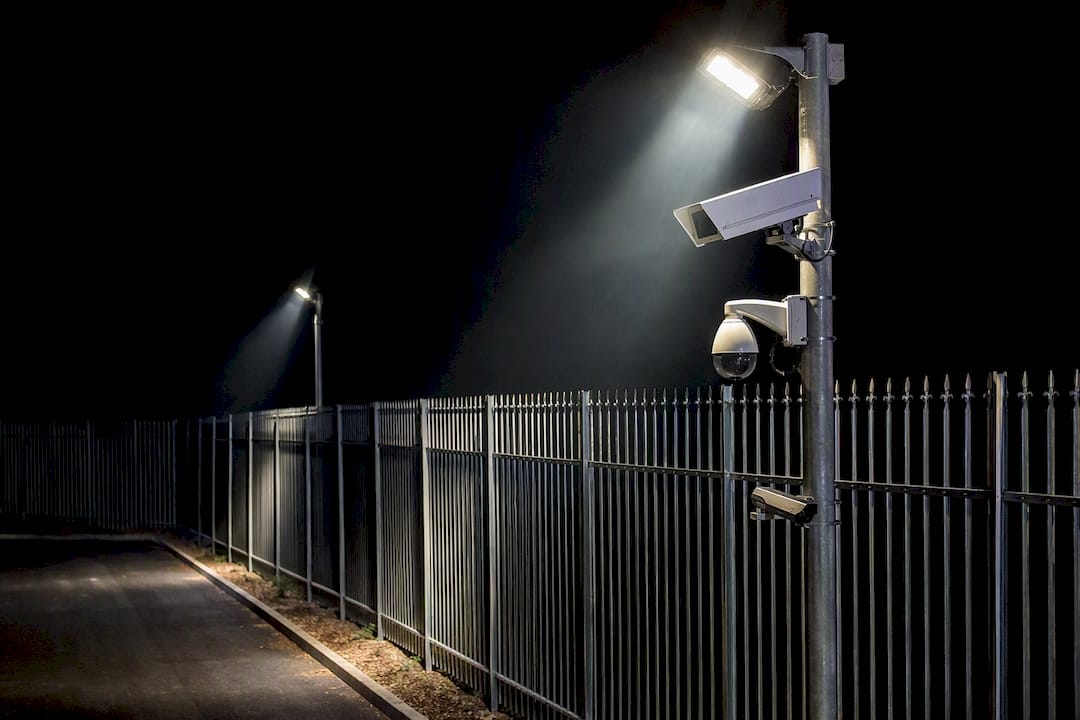
Within a monitored perimeter program, illumination supports three functions: detection accuracy, camera verification, and deterrence signaling. It matters only when it’s integrated into the monitoring workflow, not installed as an afterthought.
Your RFP should ask vendors to address:
- How camera sightlines and illumination zones are coordinated during system design
- Whether floodlighting is schedule-triggered or tied to monitoring-center rules
- What signage and deterrence protocols accompany illuminated zones
- How illumination interacts with audio talk-down activation during a verified event
Pro Tip: A strong proposal describes scheduled floodlighting synced to camera presets and monitoring-center triggers. A weak one just lists “lighting included” as a bullet point with no operational tie-in.
How Does Remote Monitoring (Virtual Guard) Actually Work?
Remote monitoring, often marketed as virtual guarding, is a human-in-the-loop service. AI flags anomalies, but a live operator verifies the event, issues an audio warning, and dispatches help when the threat is real. This isn’t a camera subscription. It’s a staffed operation with accountability built in.
Vendor capabilities to require:
- A certified or accredited monitoring center, not a home office setup
- Documented operator training and verified police dispatch workflows
- Live audio talk-down capability, not just recorded alerts
- System health monitoring and timestamped chain-of-custody reporting
A typical verified workflow looks like this:
- A sensor or camera flags motion at the fence line.
- An operator reviews the footage, often within 30 to 60 seconds.
- If the event is real, the operator issues an audio warning, frequently within a couple of minutes.
- If the intruder doesn’t leave, police or a mobile patrol gets dispatched, typically within three minutes.
Remote monitoring works well for large open perimeters, parking structures, and after-hours coverage. It works less well where you need face-to-face access control or physical intervention. Most mature programs blend the two: remote monitoring for wide-area detection, on-site staff for the human moments that require a person standing there.
How Do You Evaluate and Contract a Perimeter Security Vendor?
This is where most procurement teams either get it right or get burned. A vendor’s sales deck rarely tells you what you actually need to know, so build your evaluation around documentation, not promises.
RFP and shortlist checklist
- Valid state security license and current certificate of insurance naming your organization
- Monitoring center accreditation or certification, not just a claim of “24/7 monitoring”
- Sample post orders demonstrating how duties, patrol frequency, and incident reporting get documented
- Documented backup staffing plans and stated supervisor-to-officer ratios
- GPS-verified patrol tracking, not just a guard’s word that the round happened
- A standardized incident reporting format you can access in real time
- Clear escalation trees naming who gets called at each severity level
- SLA language with penalty clauses for missed verification or response windows
Good guard procurement starts with mapping your vulnerabilities and existing controls before you ever request a proposal. Skipping that step means you’re comparing vendor pricing without knowing what coverage gap you’re actually paying to close.
Questions to ask at the vendor interview
- How do you recruit and vet officers, and what’s your average tenure?
- What technology integrations do you support out of the box, and which require custom work?
- Can you provide three references from clients with a similar site profile?
- What does your data access and reporting portal actually show me, in real time?
- Who is my backup point of contact if my assigned supervisor is unavailable?
Red flags that should end a conversation
- A bid built entirely around the lowest hourly rate, with no explanation of what’s cut to hit that number
- Post orders described verbally instead of provided in writing
- No documented plan for officer callouts or coverage gaps
- Missing or expired state license, or a certificate of insurance that doesn’t name your entity
- No chain-of-custody process for incident video or audio records
- Escalation protocols that change depending on who you ask
Choosing on price alone is one of the most common procurement mistakes in this industry. A rock-bottom hourly rate almost always means cut corners somewhere, whether that’s training, supervision frequency, or insurance coverage. Before the first shift, walk the property with your assigned officers and confirm, in writing, who gets called in every likely scenario. If a vendor can’t produce that document before day one, that’s your answer.
Contract clauses worth negotiating
- Explicit SLA definitions: verification time, audio-response time, and dispatch time, each stated in minutes
- A post orders annex attached as a binding exhibit, not a loose reference
- Continuity and fill plans for officer absences, with penalties for repeated no-shows
- Indemnification language and stated insurance minimums
- Audit rights letting you review incident logs and system health reports on demand
- A site acceptance test clause for any integrated CCTV or sensor system, with a defined warranty period
Gsgicorp’s guard services team builds these deliverables into every proposal from the start, so you’re not negotiating for basics after the contract is signed.
What’s the Typical Timeline and Cost Structure?
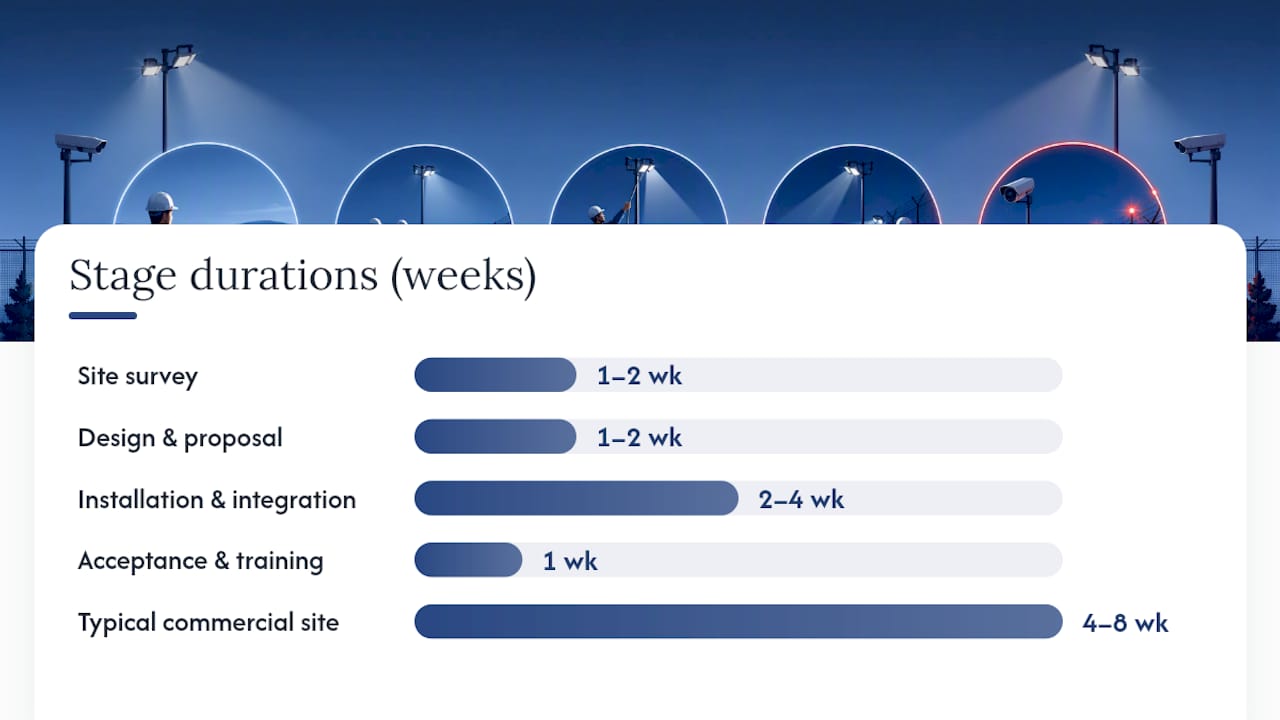
Expect a structured sequence: site survey, design, hardware installation, system integration, acceptance testing, and staff training. Most straightforward commercial sites move through this in four to eight weeks; larger or multi-building campuses take longer.
- Site survey: 1 to 2 weeks, mapping vulnerabilities and existing infrastructure
- Design and proposal: 1 to 2 weeks, including camera and sensor placement
- Installation and integration: 2 to 4 weeks, depending on existing CCTV compatibility
- Acceptance testing and training: 1 week, confirming the system performs as specified
Cost drivers include camera and analytics count, your chosen monitoring tier and hours of coverage, mobile patrol frequency, officer training requirements, and how much of your existing CCTV infrastructure survives integration versus needing replacement.
Remote monitoring typically costs a fraction of standing guard coverage while covering more ground per operator. That’s the math behind most hybrid recommendations: pay continuously for detection and verification, but pay for physical response only when an incident actually requires a person on-site.
Pro Tip: Don’t compare one-time installation costs against monthly guard labor in isolation. Model both over a three-year horizon, including turnover and training costs for standing guard posts, before you decide where the hybrid split should land.
Building a Perimeter Program With Gsgicorp
Gsgicorp designs layered perimeter programs that combine Virtual Guard remote monitoring with on-site patrol coverage, built around your site’s actual risk profile rather than a one-size-fits-all template.
- Site risk assessments that map vulnerabilities before any equipment gets specified
- Certified monitoring center coverage with trained operators and documented dispatch workflows
- Custom post orders written for your property, not copied from a generic template
- CCTV integration that connects existing cameras to live monitoring without forcing a full system replacement
- Firearms and security licensing training, including Florida Class D and G credentials, for teams that need in-house capability
- Roving vehicle patrols and rapid mobile dispatch for verified incidents
If you’re evaluating vendors right now, start by requesting a site survey or a sample post orders package from Gsgicorp’s guard services page. You’ll get a concrete look at how the coverage would actually run on your property, not a generic sales pitch.
Why Vendor-Neutral Design Still Matters
Every perimeter program I’ve reviewed that failed had the same root cause: a vendor sold a product first and designed the operation around it afterward. That’s backwards. The technology should follow the risk assessment, not the other way around, and that’s why physical security integration has to be evaluated on its own terms before you commit to a single provider’s ecosystem.
The industry’s dirty secret is that most RFPs get won on charisma, not documentation. A polished sales deck beats a vague, unverifiable promise every time, but polish doesn’t hold up during an actual incident at 2 a.m. What holds up is a written post order, a supervisor who actually answers the phone, and a monitoring center that can produce a timestamped audit trail when you ask for one. Buyers who insist on seeing those documents before signing consistently end up with better programs than buyers who negotiate purely on price.
Frequently Asked Questions
Does perimeter security lighting mean I need to buy new fixtures?
No. In a procurement context, perimeter security refers to guard services, remote monitoring, patrols, and CCTV integration. Illumination is one input those services rely on, not a standalone purchase.
What’s the fastest way to compare vendors?
Request a written site risk assessment, sample post orders, and documented SLA language from each bidder. Vendors who can’t produce these quickly usually can’t deliver them reliably later either.
Is remote monitoring enough on its own?
For wide-open perimeters and after-hours coverage, often yes. For sites needing physical access control or face-to-face interaction, pair it with on-site guards or mobile patrol dispatch.
How do I know if a monitoring center is legitimate?
Ask for their accreditation and request to see their incident reporting format and system health monitoring documentation before signing anything.
What contract clause protects me most?
Explicit SLA definitions with stated verification, audio-response, and dispatch times in minutes, backed by penalty language for missed windows.
Sources
- What is perimeter security? | e-shelter
- Remote video monitoring vs security guards (2026) | TechProSecurity
- Hiresecuritynow
- How to hire a security guard (2026) | Calvis