
Choose a maglock when the door needs fail-safe egress or surface mounting with no frame cutting, especially on glass storefronts. Choose an electric strike when the opening requires mechanical latching, fail-secure operation, or a fire rating. The deciding factor is not holding force. It is door function and the code that governs that specific opening.
TL;DR:
- Maglocks are inherently fail-safe devices that release instantly when power is cut, making them ideal for fire-rated doors and egress pathways.
- Electric strikes can be configured as fail-secure or fail-safe, with fail-secure options required by code for fire-rated openings to ensure positive latch retention.
- Proper installation depends heavily on door condition, backing material, and ensuring a supervised release path with backup power, push-to-exit, and fire alarm integration.
- Continuous power draw of maglocks necessitates careful UPS planning, while strikes only consume power during release, affecting backup and maintenance strategies.
- Mixing maglocks and electric strikes across building openings is common practice, but each must meet specific code, fire, and safety requirements based on door function.
Table of Contents
- Maglock vs Electric Strike: How Each One Actually Locks a Door
- Maglocks Explained: Why They Are Always Fail-Safe
- Fail-Safe vs Fail-Secure: What the Codes Actually Require
- Weighing the Trade-Offs: Maglock or Electric Strike?
- Matching the Lock to the Door: Real-World Applications
- Installation and Maintenance: What Keeps These Systems Working
- Your Pre-Installation Checklist Before Calling a Vendor
- What a Professional Site Survey Actually Delivers
- A Practitioner’s Take on the Maglock vs Electric Strike Debate
- Let Global Security Handle the Survey, Wiring, and Sign-Off
- Codes and Technical Bulletins Worth Consulting
- Sources
- FAQ
Maglock vs Electric Strike: How Each One Actually Locks a Door
The maglock vs electric strike question comes down to two completely different mechanical approaches, and understanding the hardware is the first step before you compare costs or codes.
An electric strike replaces the standard strike plate in the door frame, the metal piece the latch bolt slides into when the door closes. Inside that strike body sits a spring-loaded keeper. When the access control system sends power (or cuts it, depending on wiring), the keeper pivots out of the way and releases the latch bolt, letting the door swing open even though the latch never retracted. The mechanical lock on the door itself still does its job. The strike just decides when the keeper lets go.
That wiring decision creates two operating modes:
- Fail-secure strikes stay locked when power is lost. Someone still needs a key or a badge read to get in, which is why perimeter doors and retail entrances lean this direction.
- Fail-safe strikes unlock when power is lost, releasing the keeper automatically.
Fire-rated doors typically require fail-secure electric strikes, because NFPA 80 calls for positive mechanical latching that survives a power outage on those openings.
Strikes also integrate cleanly with hardware that is already on the door. A strike can work alongside a mortise lock, a cylindrical lock, or electrified panic hardware, and most listed strikes include a mechanical key override so a locksmith or fire responder can force entry manually. Fire alarm relay modules can be wired into the circuit to force a release on alarm, which is a requirement worth confirming with your integrator rather than assuming it is built in.
Maglocks Explained: Why They Are Always Fail-Safe
A maglock has no moving parts in the traditional lock sense. It pairs an electromagnet, mounted on the frame or header, with a steel armature plate mounted on the door. Energize the magnet and the two surfaces clamp together with enough force to resist a determined shove. Cut the power and the bond releases instantly.
That single fact defines the entire category: maglocks are inherently fail-safe. They need continuous current to hold the door closed, and they let go the moment power drops, whether that is intentional (a fire alarm trip) or accidental (a breaker fault).
Mounting flexibility is the maglock’s real selling point. Options include:
- Surface-mounted units, bolted directly to the face of the frame and door, common on glass storefront systems where you cannot cut into aluminum stiles.
- Shear locks, mounted so the holding force works in a shearing direction rather than a direct pull, often used on doors with limited header depth.
- Bracketed or Z-bracket configurations, used when the door and frame geometry does not allow a flush mount.
Maglocks commonly have a holding force rated to resist substantial physical force appropriate for commercial use, though the number that matters more in practice is whether the door and frame can physically support that pull without sagging over time.
Because a maglock offers no mechanical latch, codes require a way to release it that does not depend on the access control system working correctly. That typically means a request-to-exit (REX) sensor, a push-to-exit button wired directly into the lock circuit, and a fire alarm relay that drops power on alarm. All three need to be supervised, meaning the system reports back if one fails, not just present on paper.
Pro Tip: Ask your installer to show you the REX sensor triggering a release independent of the access control panel. If the only way to open the door is through the software, you have a single point of failure standing between your staff and an exit.
Continuous power draw also matters for planning. A maglock pulls current the entire time it holds the door, unlike a strike that only draws power during a brief release cycle, and that changes how you size a UPS and think about battery runtime during an outage.
Fail-Safe vs Fail-Secure: What the Codes Actually Require
The clearest way to remember the difference: fail-safe favors life safety, fail-secure favors asset protection. A fail-safe device unlocks when power fails, prioritizing the ability of people to get out. A fail-secure device stays locked when power fails, prioritizing keeping unauthorized people out.
Codes do not leave this as a matter of preference on every door. Fail-safe locks are generally required on stairwell doors that need re-entry and on doors that must release automatically when a fire alarm activates. Fail-secure hardware is more common on perimeter doors specifically because it preserves security when the power goes out, which is exactly the scenario a break-in attempt might exploit.
Replacing a mechanical latch with a maglock on a fire-rated door voids that door’s fire rating and creates a serious life-safety hazard, since NFPA 80 requires positive mechanical latching that a maglock cannot provide.
Fire alarm integration is not optional hardware trivia. It is where inspections get failed. A few things worth confirming before anything gets installed:
- Any auxiliary lock on a fire door must be coordinated with the authority having jurisdiction and must not defeat the door’s listed latching hardware.
- Sensor-release systems need UL 294 listing and generally require three independent release paths: loss of power, a manual push-to-exit button, and a fire alarm relay.
- Battery backup that keeps a maglock energized through a building power outage can conflict with egress requirements in many jurisdictions, since the whole point of fail-safe wiring is that the door releases when power drops.
Ask any vendor for a written wiring diagram before installation, not after. It should show exactly which circuits stay live, which drop on alarm, and where the supervised release points sit in the loop.
Weighing the Trade-Offs: Maglock or Electric Strike?
Neither device wins outright. Each one trades something away to gain something else, and the trade-off that matters depends entirely on the door you are securing.
- Holding force vs mechanical backup. A maglock’s clamping force can exceed what a strike-and-latch combination resists in a direct pull test, but a strike leaves a physical latch bolt engaged even if the electronics fail entirely. That mechanical redundancy is why fire doors lean toward strikes.
- Power draw and backup planning. Maglocks draw current continuously, which means your UPS sizing has to account for constant load. Strikes draw power only during the release cycle, so battery runtime calculations look very different between the two.
- Installation complexity. Strikes typically require frame prep, cutting a pocket for the strike body, and precise alignment with the existing latch. Maglocks often mount to the surface with no cutting, which is faster on aluminum storefront systems but demands solid backing material to carry the pull force.
- Maintenance and failure patterns. Door sag is the most common maglock failure trigger, since even a small gap between armature and magnet kills holding force. Strikes wear at the keeper pivot and suffer more from misaligned latches after a door settles.
Matching the Lock to the Door: Real-World Applications
Storefront and full-glass aluminum doors are the classic maglock scenario. There is often no metal to cut into for a strike pocket, and the surface-mounted magnet clamps directly to the header and door face without touching the glazing.
Hinged commercial doors, especially anything with a fire rating, generally call for an electric strike or electrified panic hardware instead. The mechanical latch stays intact, the door keeps its listing, and the strike simply controls when that latch releases.
Stairwell re-entry doors and assembly occupancy egress routes need fail-safe release almost by default, since locking a stairwell door against re-entry during an alarm event is exactly the failure mode fire codes are written to prevent. Whether that release comes from a maglock cutting power or a fail-safe strike depends on the door’s construction and rating.
Hybrid deployments show up more often than most facility managers expect:
- A maglock on an interior office suite door paired with a fail-secure strike on the exterior perimeter entrance.
- Maglocks on a glass lobby entry, strikes on the fire-rated stairwell doors one floor up.
- Axis’s summary of the industry confirms that mixing the two across a single building is common practice rather than a compromise, since different openings almost always carry different requirements.
Installation and Maintenance: What Keeps These Systems Working
Door and frame condition determines more about long-term reliability than the brand of hardware you buy. Installation reliability depends more on door alignment and closer strength than on holding-force specs, so a sagging door or a weak closer will undermine even premium equipment.
Power design deserves the same scrutiny as the lock itself:
- Back up the access control panel and monitoring circuits, not necessarily the lock circuit itself, since keeping a maglock energized through an outage can violate egress requirements depending on local code adoption.
- Confirm surge protection on the power supply, since maglocks and strikes both see repeated switching cycles that stress unprotected circuits over years of use.
- Verify the fire alarm interface uses a listed relay module, and ask for documentation showing it was tested, not just wired.
Pro Tip: Log every holding-force test and REX trigger test with a date and technician name. If an inspector or insurance adjuster ever asks for proof the release path works, a maintenance log beats a verbal assurance every time.
Routine maintenance should include a physical alignment check and a holding-force test on a set schedule, not just a reactive fix when someone complains a door feels loose.
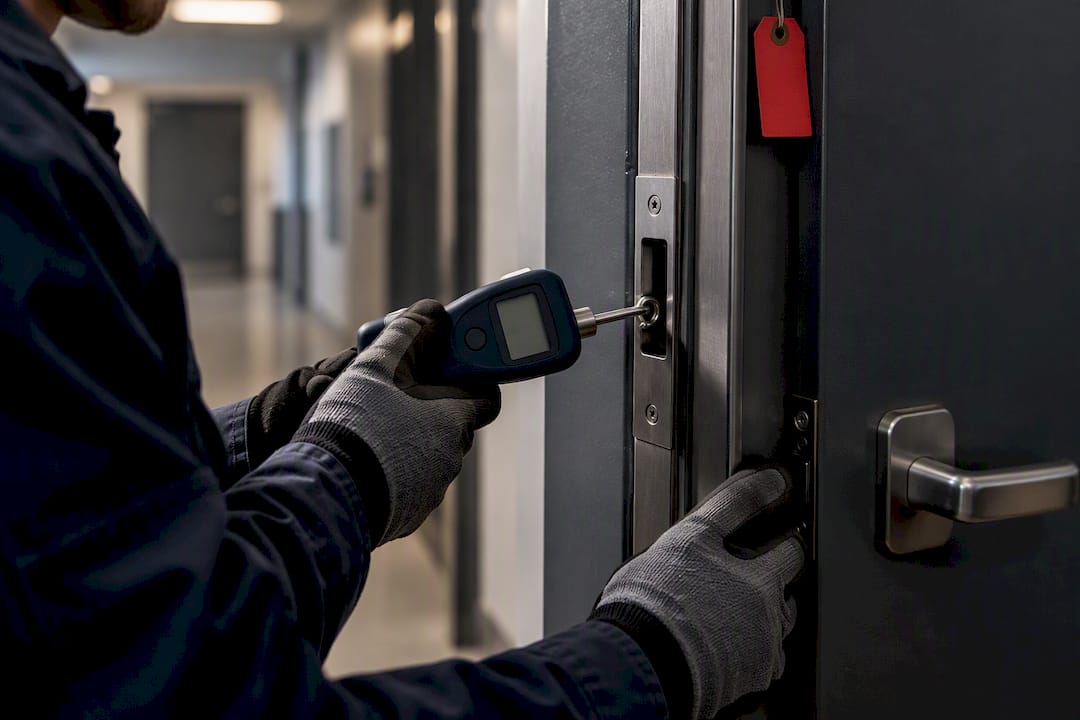
Your Pre-Installation Checklist Before Calling a Vendor
Confirm these before signing off on any hardware order:
- Door function first. Is this an egress path, a fire-rated opening, or a straightforward perimeter entrance?
- Fire rating and fail-state requirement. Does the door’s listing demand fail-secure operation, and does the release path meet the three-method requirement for sensor release?
- Power resilience plan. What gets backed up, and does that backup plan still allow the door to fail safely?
- Vendor documentation. Ask for UL listings, a wiring diagram, and battery backup policy in writing before installation begins.
Red flag: any installer suggesting a maglock as a drop-in substitute for a fire door’s mechanical latch — request a professional venue security risk assessment whenever a door’s use is ambiguous. Request a site survey with fire marshal coordination whenever a door’s use is ambiguous.
What a Professional Site Survey Actually Delivers
A qualified integrator does not start with hardware. They start with a door schedule that documents every opening’s function, rating, and current condition, then build a code check against that schedule before touching a single fastener.
The deliverable should include a wiring diagram, a fire alarm relay plan, and a maintenance schedule, not just a parts list. Coordinating with the local fire authority before installation, with documented test evidence afterward, is what separates a smarter, customized security strategy from a rushed retrofit that fails inspection. On borderline openings, a staged rollout that pilots the change on one door before a full build-out reduces that risk considerably.
A Practitioner’s Take on the Maglock vs Electric Strike Debate
The mistake facility managers make most often is shopping for holding force first and code compliance second. That order should be reversed on every single door. A 1,200-pound magnet means nothing on a door where the fire marshal will not sign off on the release path.
Pilot the change on one door, document every approval in writing, and bring in a qualified integrator before you buy hardware, not after installation reveals a wiring gap.
— Alston
Let Global Security Handle the Survey, Wiring, and Sign-Off
Getting the maglock vs electric strike decision right on paper is one thing. Getting it installed, wired to code, and signed off by the fire marshal is where most in-house teams lose weeks. Security teams built around law enforcement and military experience can provide a site survey with thorough attention to potential failure points, similar to a patrol officer’s building walk-through.

A site survey and threat assessment from Gsgicorp gives you a door schedule, a wiring diagram, a fire alarm interface plan, and a maintenance contract option, all before a single lock gets ordered. Pair that hardware decision with CCTV integration or Virtual Guard remote monitoring, and your entrances get watched around the clock, not just locked. If your building has doors where the right hardware choice is not obvious, consider requesting a consultation and letting a survey settle it before an inspection does.
Codes and Technical Bulletins Worth Consulting
Verify hardware choices against the NFPA 80 technical bulletin on fail-safe versus fail-secure locksets, the relevant IBC/ICC egress and sensor-release sections, and manufacturer bulletins like Allegion’s fail-safe/fail-secure guidance. ADA and OSHA requirements around door operating force also apply. Codes vary by local adoption, so confirm the current version enforced in your jurisdiction before finalizing a specification.
Sources
- Fail Safe vs. Fail Secure Electronic Locksets – Technical Bulletin
- Decoded Fail Safe vs Fail Secure – Allegion (Schlage) technical document
- Electric Strikes vs. Maglocks: Choosing the Right Electrified Lock for Your Building – PRO Locksmith
- Fail-safe vs fail-secure – Axis newsroom
- Electric strike vs maglock – Benson Inc. blog
FAQ
What Are the Downsides of a Magnetic Lock?
Maglocks draw continuous power, fail open during any outage, and cannot be used as a substitute for mechanical latching on fire-rated doors without voiding the door’s listing. They also require solid door and frame backing, since even minor sag reduces holding force significantly.
What Door Locks Do Security Professionals Recommend?
The right choice depends entirely on the door’s function and fire rating rather than a single preferred product. Fail-secure electric strikes are typically recommended for fire-rated and perimeter doors, while fail-safe maglocks suit storefront glass and stairwell re-entry openings where egress on power loss is required.
What Is the Difference Between an Electric Latch and an Electric Strike?
An electric strike controls release at the frame, letting the existing latch bolt swing free without retracting, while an electric latch or electrified lockset retracts the latch bolt itself electronically. Strikes are usually simpler retrofits since they replace only the strike plate, not the lock body.
What Is the Difference Between an Electric Strike and an Electric Mortise Lock?
An electric strike works with the door’s existing mechanical lock and only controls the frame-side keeper, while an electric mortise lock electrifies the lock body itself so the latch or bolt retracts on command. Mortise locks generally cost more and require more extensive door prep than a strike retrofit.