
LPR cameras, also called ALPR or ANPR systems, capture and read vehicle plates automatically using a two-stage detection and OCR pipeline. The single factor that separates a reliable deployment from a frustrating one is capture performance under your actual conditions: expected vehicle speed, lighting, and lane geometry. Budget equally for integration and data retention policy, because hardware alone won’t deliver results without both.
TL;DR:
- Achieving 95% or higher recognition accuracy requires global shutter sensors, proper lighting, and correct mounting angles under actual operating conditions.
- For highway-speed tolling and traffic management, shutter speeds must freeze vehicle motion at 45 mph or more, and capture range typically spans 50 to 100 feet.
- Edge processing reduces bandwidth and legal risks, but centralized cloud OCR enables broader analytics, requiring balanced infrastructure investment.
- Contractually, vendors should commit to recognition service level agreements, and procurement should cover full system costs, including software, storage, and integration.
- Privacy rules vary by state; policies should minimize retention, enforce access controls, and document lawful purposes to ensure regulatory compliance.
Table of Contents
- What Are LPR Cameras and How Are They Used?
- What Technical Features Determine Capture Reliability?
- How Should You Position and Install LPR Cameras?
- How Do You Integrate LPR Data and Manage Its Lifecycle?
- What Accuracy Benchmarks Should You Require?
- What Belongs in an LPR Procurement Checklist?
- What Privacy and Regulatory Issues Should You Plan For?
- How Global Security Deploys LPR Within Managed Programs
- How Global Security Supports Your LPR Deployment
- Sources
What Are LPR Cameras and How Are They Used?
An LPR camera works in two stages. First, it detects the plate region within a frame. Then optical character recognition (OCR) converts that image into readable text, according to technical breakdowns of the detection and recognition pipeline. Everything downstream, alerts, database matches, reporting, depends on how well those two stages perform together.
Security teams deploy LPR cameras across a range of operational contexts:
- Investigations and forensics — reviewing footage after an incident to identify vehicles of interest.
- Parking and access control — automating gate entry or flagging unauthorized vehicles in restricted lots.
- Tolling and traffic management — capturing plates at highway speeds for billing or enforcement.
- Perimeter security — monitoring vehicle traffic at facility entrances and exits.
- Logistics and fleet tracking — verifying trucks or delivery vehicles against expected schedules.
Hardware choices track the use case. Fixed cameras suit gates and choke points where traffic is predictable. Mobile units, mounted on patrol vehicles, cover larger areas but demand more forgiving optics for variable speed and angle. Trailer-based systems fill temporary gaps, construction sites, event perimeters, without permanent wiring. Handheld units work for spot checks in parking enforcement. Hybrid setups combine fixed cameras with mobile backup for facilities that need both constant coverage and flexible response.
What Technical Features Determine Capture Reliability?
Resolution matters less than most buyers assume. A 1080p sensor paired with the right lens and lighting will often outperform a poorly configured 4K camera at typical LPR working distances. What actually separates a workable system from an unreliable one is shutter behavior, illumination, and how the software handles motion.
Global shutter sensors capture the entire frame simultaneously. Rolling shutter sensors scan line by line, which distorts plates on fast-moving vehicles. For any lane with vehicles moving faster than walking speed, global shutter is close to mandatory, and shutter speed itself needs to be fast enough to freeze motion without underexposing the frame.
The 95% benchmark: the Department of Homeland Security’s LPR guidance identifies 95%+ recognition accuracy as the industry benchmark for reliable operations. Anything meaningfully below that threshold turns your system into a manual review burden rather than an automated tool.
Other specs that matter in the field:
- IR illumination and wavelength — near-infrared lighting synchronized with shutter timing avoids glare from reflective plates, day or night.
- Multi-lane optics — wide-angle lenses covering several lanes trade off capture distance and plate legibility per lane.
- Edge AI vs. server-side OCR — on-device processing cuts latency and bandwidth; centralized OCR offers more processing power but adds network dependency.
- Frame rate and region-of-interest (ROI) selection — tighter ROI settings reduce false triggers from irrelevant motion in the frame.
How Should You Position and Install LPR Cameras?
Installation geometry determines whether your specs on paper translate into usable footage. Even a top-tier sensor fails if mounted at the wrong angle or height.
- Keep camera tilt under 30 degrees relative to the plate plane where possible. Steeper angles distort character shapes and confuse OCR, a rule of thumb echoed in ANPR deployment guidance.
- Mount at choke points, not open areas. Gate lanes, stop lines, and single-file approach roads give you predictable vehicle position and speed, which is far more valuable than a wide, uncontrolled field of view.
- Match shutter speed to expected vehicle speed. Parking lots and access gates, typically under 10 mph, tolerate slower shutter settings. Highway or roadway approaches need shutter speeds fast enough to freeze motion at 45 mph or more.
- Verify capture distance against your lens. Practical LPR ranges tend to fall between 50 and 100 feet depending on lens and resolution combination, per the same ANPR technical overview.
- Protect hardware for the environment. Outdoor housings need an appropriate IP rating against rain and dust, along with mounting hardware rated for vibration if placed near heavy traffic or industrial equipment.
For teams weighing camera geometry and IR lighting configuration in more depth, BeyondSensor’s technical guide on plate recognition setup covers the trade-offs installers run into most often.
How Do You Integrate LPR Data and Manage Its Lifecycle?
Where processing happens changes what your system can do and what risk it carries. Edge processing, running recognition on the camera or a local appliance, cuts bandwidth needs and reduces how much personally identifiable data travels across your network, while still enabling real-time alerts, according to DataVLab’s analysis of edge versus cloud LPR architectures. Cloud processing centralizes search across sites and supports broader analytics, but it increases both bandwidth demand and your retention management responsibilities.
Integration typically runs through a few established patterns:
- VMS integration — feeding LPR alerts into your existing video management system for unified review.
- SIEM integration — routing plate events into security information and event management platforms for correlation with other alerts.
- CAD/CMS integration — connecting to computer-aided dispatch or case management systems for law enforcement workflows.
- Watchlist APIs — matching captured plates against internal or external watchlists in near real time.
Pro Tip: Set automated purge rules for non-match plate records rather than storing everything indefinitely. DHS guidance points to a 30-day baseline for routine non-hit data, which cuts storage costs and reduces legal exposure without weakening investigative value.
What Accuracy Benchmarks Should You Require?
Vendor accuracy claims deserve scrutiny before they land in a contract. The first distinction to nail down: capture rate (how many plates the camera actually sees and images clearly) is not the same as recognition rate (how many of those images the OCR engine reads correctly). A system can capture 99% of passing vehicles and still recognize only 80% of plates accurately if lighting or angle undermines the OCR stage.
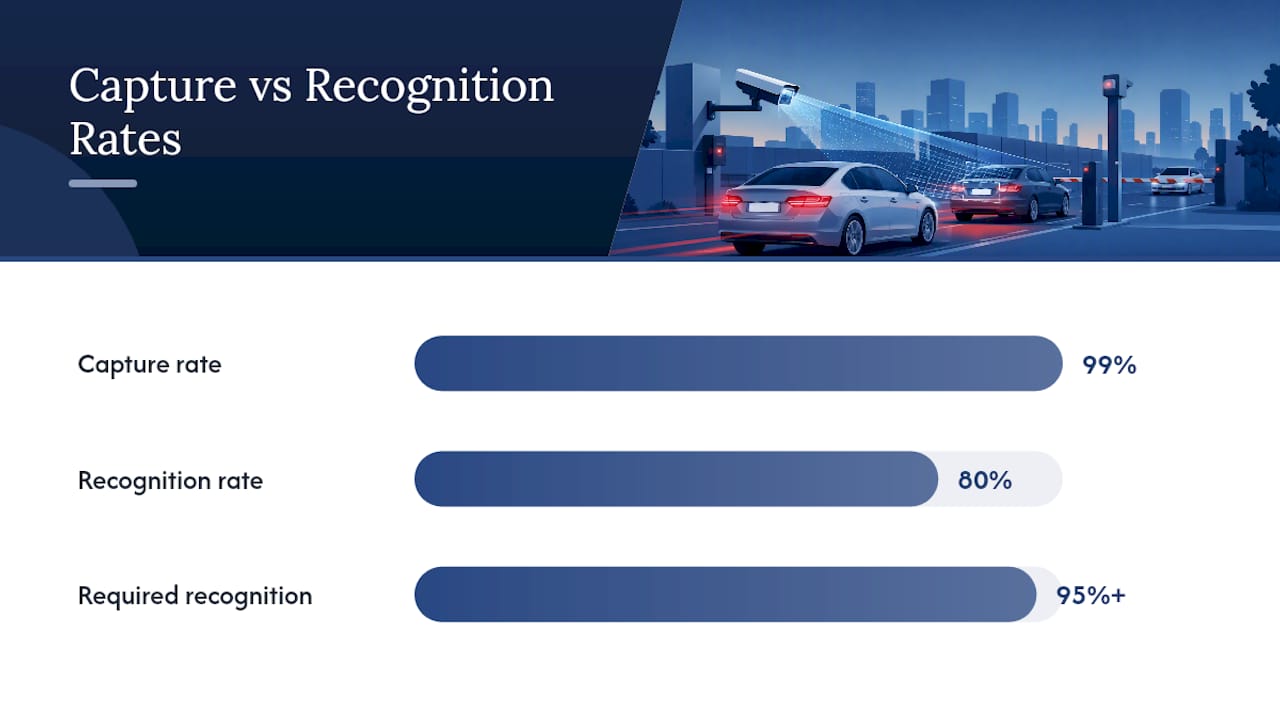
Benchmark to hold vendors to: 95%+ recognition accuracy under your actual operating conditions, not a vendor’s ideal test environment, matches the DHS-cited industry standard.
A practical validation protocol before signing anything:
- Request sample footage across day, night, and dusk lighting.
- Test across the full range of mounting angles you plan to use.
- Include your actual target vehicle speeds, not a slower demo speed.
- Ask for the vendor’s own testing methodology, not just a final percentage.
- Request independent client references who’ve run the system for at least six months.
What Belongs in an LPR Procurement Checklist?
Buying an LPR system means budgeting for far more than camera hardware. Cost drivers include the cameras themselves, software licensing, storage and retention infrastructure, cloud processing fees if applicable, and integration labor to connect the system to your existing security stack. This is a service area covered under Global Security’s CCTV integration work.
- Map operational needs first. Count the lanes you need covered, decide your retention window, and list every system LPR data needs to feed before evaluating hardware.
- Price the full stack, not just cameras. Get separate line items for hardware, software licensing, storage, and installation labor so you can compare vendors apples to apples.
- Demand an accuracy SLA in the contract. A vendor unwilling to commit to a measurable recognition rate under your conditions is signaling low confidence in their own product.
- Confirm firmware update and support terms. Ask how long the vendor commits to security patches and feature updates after purchase.
- Verify data access and export rights. You should be able to pull your own footage and metadata without vendor lock-in.
- Score demos on a rubric, covering accuracy, ease of integration, support responsiveness, and total cost, rather than a single impression from a sales pitch.
What Privacy and Regulatory Issues Should You Plan For?
Rules governing LPR data vary widely by state, and there is no single national standard to default to. The National Conference of State Legislatures compiles state statutes covering retention limits and usage restrictions, and that variability means legal counsel familiar with your specific jurisdiction needs to review your policy before deployment, not after.
Baseline practices worth building into any program:
- Minimize retention windows for non-hit records.
- Enforce role-based access control on who can query plate data.
- Maintain audit logs of every search and export.
- Document a lawful purpose for the deployment in writing.
- Communicate transparently with employees, tenants, or the public about camera locations and use.
How Global Security Deploys LPR Within Managed Programs
LPR cameras deliver the most value when paired with active monitoring and response, not left as an unmonitored data feed. Global Security integrates plate recognition alerts directly into Virtual Guard remote monitoring and roving patrol schedules, so a flagged vehicle triggers real action, not just a logged event. LPR fits best at gated facilities, logistics yards, and perimeter checkpoints; for interior coverage or high-profile individuals, guard presence or executive protection often matters more than plate data alone.
— Alston
How Global Security Supports Your LPR Deployment
Buying LPR hardware is the easy part. Getting cameras mounted correctly, wired into your video management system, and backed by someone who actually watches the alerts is where most programs stall. Global Security handles that full path, from CCTV integration and system configuration to Virtual Guard remote monitoring that turns plate alerts into an actual response instead of a log entry nobody reviews.

Some security teams include professionals with law enforcement and military backgrounds who understand both the technical side of camera placement and the operational reality of running a security program day to day. If you’re evaluating vendors or already have hardware that isn’t performing, request a discovery call and come prepared with your site layout, lane counts, and current pain points. Visit Global Security’s services page to schedule an assessment and get a straight answer on what your facility actually needs.
Sources
Before finalizing any LPR purchase, review these primary references directly:
- Department of Homeland Security — LPR technical guidance (2025)
- DataVLab — License plate detection and recognition
- NCSL — Automated license plate readers: state statutes