
HOA security patrols put a uniformed officer or marked vehicle on your streets at set or random times. The patrol deters trespassing, vandalism and rule violations, and it leaves a written record your board can rely on. The right setup depends on your layout, your incident history and your budget. Most communities choose between a roving vehicle patrol, a staffed gate or on-site guard, or a mix backed by cameras.
This guide explains each option, what private guards can legally do, how often to patrol, and what to write into the contract before you sign.
TL;DR
- A patrol works as a visible deterrent and a documented record. It does not replace the police.
- Randomized routes and times beat fixed schedules. Predictable patterns let would-be intruders plan around you.
- Private guards generally have no more arrest power than a private citizen, and traffic enforcement needs specific legal authority. Build your contract around “observe and report.”
- Associations can face negligence claims if they ignore foreseeable crime in common areas, so document your security decisions.
- Combine patrols with cameras, lighting and access control. Match the coverage to your real incident data, not to fear.
Table of Contents
- What HOA security patrols actually do
- Four patrol models compared
- What HOA security officers can and cannot do
- Does an HOA have to provide security?
- How often should a community be patrolled?
- Do patrols actually reduce crime?
- Our perspective: what boards get wrong
- How to choose a patrol provider
- Working with Global Security
- FAQ
- Sources
What HOA security patrols actually do
A community patrol has one core job: to be seen, and to notice. Officers drive or walk the property, check gates, common areas, pools, clubhouses and parking, and report what they find. The best programs also act as a force multiplier for local law enforcement. They call in what they see rather than trying to handle it themselves.
Scale shows what consistency looks like. The Villages in Florida runs a Community Watch that, according to the district’s own program page, serves more than 150,000 residents. Your HOA is far smaller, but the principle carries over: frequent, consistent and documented presence is what makes a patrol worth paying for.
A good patrol produces three things:
- Deterrence. A marked vehicle or uniformed officer changes how a trespasser or vandal judges your community.
- Information. Daily activity reports, incident write-ups and photos give the board facts instead of rumors.
- Enforcement support. Officers can document rule violations such as parking, gate misuse or after-hours amenity use, so the board can act under its own governing documents.
Four patrol models compared
| Model | How it works | Best fit | Main limit |
|---|---|---|---|
| Roving vehicle patrol | A marked vehicle makes randomized passes through the community | Mid-size and large communities, open streets, budget-conscious boards | Presence is intermittent between visits |
| Dedicated on-site guard | An officer stays on property for a set shift | Gated communities, high-incident areas, large amenity areas | Highest labor cost, and one person cannot see everything |
| Gate guard | Officer controls entry, checks vendors and guests | Gated communities with heavy traffic or package and contractor volume | Covers the entrance, not the interior |
| Remote video monitoring | Trained operators watch cameras and intervene by audio or dispatch | Communities that already have cameras or want coverage during off hours | Needs good camera placement and a response plan |
Most communities do best with a blend. A roving patrol covers the interior at irregular times, cameras cover fixed entry points, and a guard or gate officer is added only where the data shows a need.
Roving vehicle patrols
Roving patrols are the usual starting point because they scale. You pay for visits rather than for a stationary post. The marked vehicle is itself the deterrent, and the officer checks doors, gates, lighting and amenity areas during each pass. We run roving vehicle patrol services built on this model, with reporting back to the client.
Staffed posts and gate guards
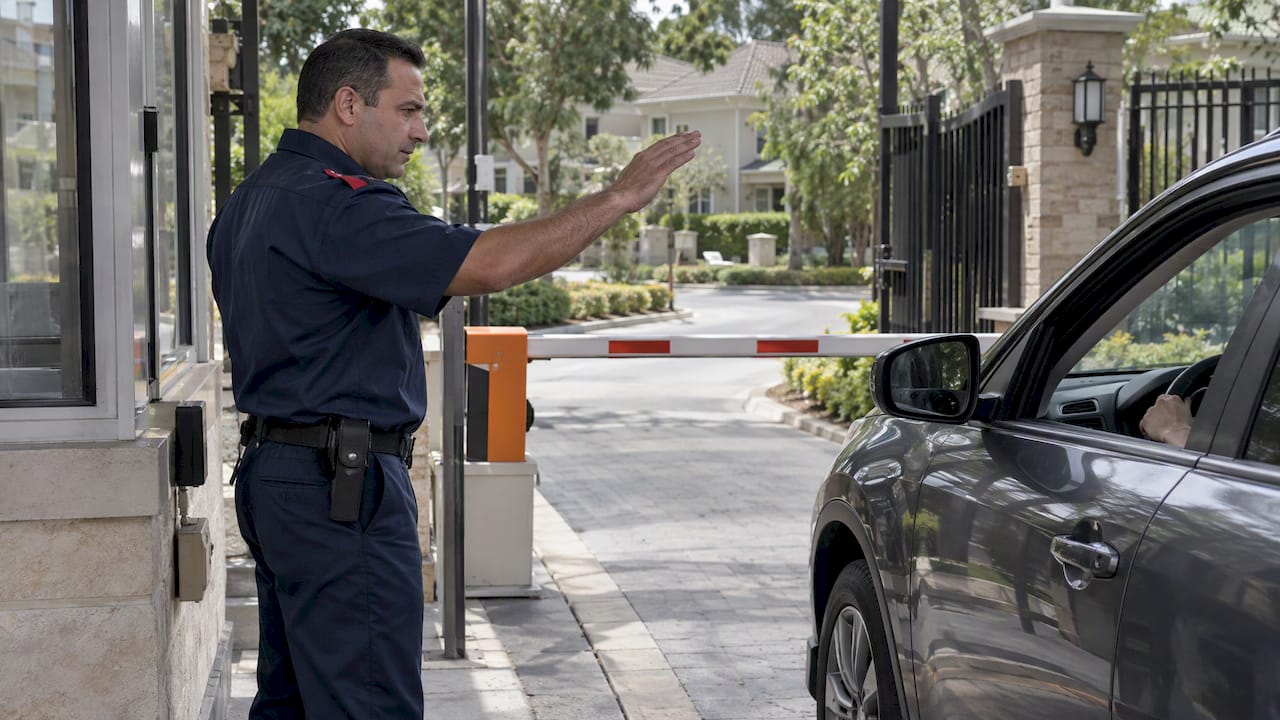
If your community has a single entrance and heavy traffic, a staffed gate gives you control over who comes in and a log of every vendor and visitor. It is also the most visible sign of security. If your board is weighing it, look at our gate guard services and decide whether the post needs to be armed or unarmed. We offer both unarmed and armed officers. Unarmed is the common choice for hospitality-style gate duty. Armed coverage is a decision for the board, your insurer and your attorney.
Remote monitoring as a force multiplier
Cameras do not get tired, but people watching them do. Research on physical security operators describes a vigilance decrement: human attention drops during long stretches of routine monitoring. Effective systems use technology to highlight anomalies instead of asking one person to stare at a quiet screen. That is the thinking behind Virtual Guard monitoring, which pairs cameras with trained remote operators who respond to events rather than simply record them.
What HOA security officers can and cannot do
This is where boards get into trouble. Residents often expect a guard to act like a police officer. Legally, a guard is not one.
An opinion from the South Carolina Attorney General on a guard in a gated residential enclave is a useful reference. It addresses whether a private officer can pursue and stop vehicles and issue traffic tickets. The opinion treats security guards as having no greater arrest power than a private citizen. That power is typically limited to detaining someone for a felony or a breach of the peace committed in the officer’s presence. Laws differ by state, so ask your own association attorney what applies to you.
Traffic stops
In most places, private guards cannot perform traffic stops or write state traffic citations on private roads. A community generally needs specific enabling legislation or a local ordinance that treats its roads like public ones. There are also exceptions based on association authority. In Poris v. Lake Holiday Property Owners Association, the Illinois Supreme Court found that a nonprofit association could adopt traffic rules for its grounds and have a security department enforce them against members through fines. That is an association rule system, not police power, and it depends on the governing documents and state law.
The practical answer for most boards: officers can observe, document and report speeding or violations. The association then follows its own violation procedure, or calls the police for anything criminal.
Detention and force
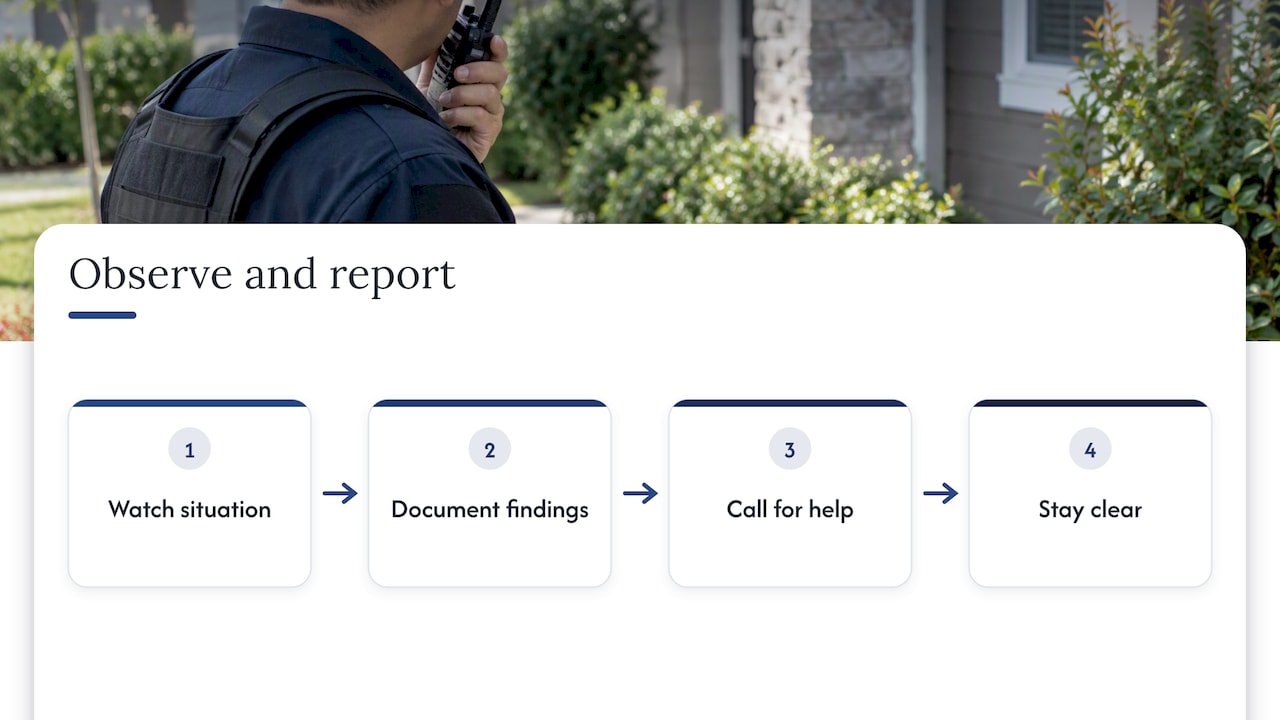
Excessive detention, physical confrontation and interfering with police create real liability. Careful operators stick to observe-and-report: watch, document, call, and stay clear of the arrest. Write this into the post orders so the officer and the board agree on it in advance.
Licensing
In Florida, private security work is regulated under Chapter 493 of the Florida Statutes. The version we reviewed is the 2021 text, so confirm current wording. Under it, a Class D licensee who carries a firearm must also hold a Class G license. Whatever your state, ask every vendor for proof of the licenses its officers hold, and match it to the post you are buying.
Does an HOA have to provide security?
No law says every association must hire guards. But boards do carry a duty of care for common areas, and that includes reasonable security measures against foreseeable crime.
In Janini v. London Townhouses Condominium Association, the Michigan Supreme Court wrote that a co-owner is an invitee in the common areas, and that the association owes a common-law duty to exercise reasonable care against dangerous conditions there. A New Jersey appellate decision, Lechler v. 303 Sunset Avenue Condominium Association, also addressed a condominium association’s statutory duty over its common areas. Courts decide these cases on their facts and by state, so this is not legal advice.
The takeaway for a board is practical:
- Keep gates, locks and lighting working, and fix reported failures quickly.
- When incidents occur, record them and record what the board did in response.
- Put security discussions and votes in the meeting minutes. If you are a California association, this guide to recording board decisions in electronic minutes covers that state’s side of the paperwork.
A dated trail of incidents, decisions and patrol reports is the strongest evidence that the board acted reasonably.
How often should a community be patrolled?
There is no universal number. As of 2026, typical programs run randomized routes with roughly two to six visits per evening, paired with real-time reporting to the board. Use that range as a starting point, then adjust to your property.
Factors that push the count up:
- Long perimeters, multiple entrances or open access roads
- A recent run of vehicle break-ins, theft or vandalism
- Amenities such as pools, courts or a clubhouse that attract after-hours use
- Construction or vacant lots that offer cover
- Seasonal vacancy, which is common in Florida communities
Randomize, always
UK guidance from ProtectUK explains why. Predictable patrols let intruders carry out hostile reconnaissance and slip around the routine, while randomized routes make it hard to judge when a property is safe. If a vendor sends the same car past the clubhouse at 10:15 every night, residents and criminals both learn the schedule. The guidance is from the UK, but the logic holds anywhere.
Plan for tired officers
Night work degrades performance. A report from the Center for Problem-Oriented Policing on fatigue and night work covers the effects and countermeasures for security personnel and police. Ask any vendor how it manages shift length, rest and supervision. An alert officer at 3 a.m. is worth more than an extra drive-by.
Do patrols actually reduce crime?
Be honest with residents about this one. Some people argue that visible patrols do little to prevent crime, and a patrol is not a guarantee. What a patrol reliably gives you is deterrence at the margin, faster reporting, documentation, and enforcement of your own rules. It works best when it is one layer among several.
Those layers:
- Lighting and landscaping. Trim hedges that hide entries and fix dark stretches.
- Access control. Working gates, key fobs and visitor logs.
- Cameras. Cover every entry and exit point. Our guide on CCTV camera placement walks through mounting heights, tilt and overlap.
- Patrol or guard. Human presence and response.
- Resident habits. Locked cars, closed garages and prompt reporting.
If your board is still shaping a plan, our piece on a smarter, customized security strategy explains how to tie these layers together.
Our perspective: what boards get wrong
Our team comes from law enforcement and military backgrounds, and the same mistakes show up in community after community.
First, boards buy hours instead of outcomes. A contract that says “patrol 10 p.m. to 6 a.m.” tells you nothing about what the officer checks, reports or does when something is wrong. We start with a threat assessment of the property and write post orders from it: what to inspect, how to log it and when to call 911.
Second, boards expect the guard to be a police officer. The most useful officers know their limits. They observe, document and report, and they work with local law enforcement instead of around it. That keeps the community out of liability and gets better results.
Third, boards underuse technology. A person alone cannot watch everything, and attention fades. Cameras, remote monitoring and a roving officer together cost less than a full-time post for many communities and cover more ground.
Finally, every patrol should leave a paper trail. Reports are what turn a feeling of unease into a decision the board can defend.
— Alston
How to choose a patrol provider
Use this checklist when you collect proposals. It applies to any vendor, ours included.
- Licensing and insurance. Ask for the company license, officer licenses and a current certificate of insurance naming the association.
- Officer background. Ask who trains and supervises the officers and how they are vetted.
- Post orders. Request a written scope: routes, checkpoints, what officers do and do not do.
- Reporting. Ask what the board receives, how fast, and in what format.
- Randomization. Ask how routes and times are varied and how the vendor proves it.
- Supervision. Ask how often a supervisor checks officers in the field.
- Response plan. Confirm who is called, in what order, and how quickly the vendor responds to the board.
- Contract terms. Check the length, the cancellation terms and any change in rates. Have your association attorney review it.
Pricing varies widely by state, community size and coverage hours, so get at least three quotes written to the same scope. That lets you compare like with like. We do not publish rates because we price from the property itself.
Working with Global Security
We design security plans for residential communities, businesses and events. For HOAs, that usually means a roving vehicle patrol, gate or on-site officers where needed, and camera coverage through CCTV integration or Virtual Guard. Our guard services are staffed by officers supervised by law enforcement and military professionals. To talk through your property, start at gsgicorp.com and request a site assessment.
FAQ
Can HOA security do traffic stops?
Generally, no. Private guards are not peace officers, and traffic enforcement on private roads usually requires specific enabling legislation or a local ordinance. Some associations can enforce their own traffic rules against members through fines if their documents and state law allow it. Ask your association attorney before you put anything about stops in a contract.
What is the purpose of a security patrol?
The purpose is deterrence, observation and documentation. A visible officer discourages trespassing and vandalism, notices problems such as open gates or broken lights, and reports to the board and to police when needed. The written record also helps the association show it acted reasonably.
Does an HOA have an obligation to provide a safe community?
There is no blanket duty to hire guards, but courts have held associations to a duty of reasonable care over common areas. That can include keeping gates, locks and lighting in working order, especially where crime is foreseeable. The rules differ by state, so check with your attorney.
What is the biggest enemy of a security guard on patrol?
Fatigue and complacency. Attention drops during long, uneventful stretches, which is known as the vigilance decrement. Rest management, varied routes, supervision and technology that flags anomalies all help.
Sources
- Community Watch, The Villages Community Development Districts
- Physical Security Operators and Cognitive Science, OSTI
- South Carolina Attorney General opinion on private security officers in gated communities
- Poris v. Lake Holiday Property Owners Association, Illinois Supreme Court
- Chapter 493, Florida Statutes, The Florida Senate
- Janini v. London Townhouses Condominium Association, Michigan Supreme Court
- Lechler v. 303 Sunset Avenue Condominium Association, New Jersey courts
- Tactic VB2: Review patrol and positioning of security staff, ProtectUK
- Fatigue effects, Center for Problem-Oriented Policing