
A festival security plan must deliver safe, scalable operations built on a site-specific risk assessment, with clear procedures for crowd management, access control and incident command. The strongest plans name a single command structure, set alert levels before gates open, and tie every staffing and screening decision back to that risk assessment rather than guesswork.
TL;DR:
- Set final capacity after subtracting the largest exit’s share, then define density thresholds that trigger extra lanes or paused entry.
- Place Event Control at a secure site and give one named authority clear evacuation powers tied to preset alert levels and agency contacts.
- Start planning six to nine months ahead, share risk and site plans with emergency agencies early, and secure permits before ticket sales.
- Scale medical staffing to audience, event duration, and activities, while keeping triage areas and ambulance routes clear of pedestrian flows.
- Size entry lanes for peak arrivals, train search staff in consistent procedures, and issue credentials that expire and can be deactivated immediately.
Table of Contents
- How to run a site-specific all-hazards risk assessment that drives the plan
- Capacity modelling and practical crowd-management steps for ingress, circulation and egress
- Practical access control: searches, queues, credentialing and throughput
- Event Control, ELT, alert levels and incident-response protocols
- Medical provision: triage, EMS staging and casualty management
- Design decisions that improve safety: exits, lighting, signage and circulation
- Perimeter security and proportionate hostile-threat mitigations
- Staffing model: supervisors, roving teams, stewards and competence checks
- Public messaging, staff comms, PACE and technical redundancy
- Timeline and deliverables for multi-agency coordination and permits
- Prioritized timeline checklist: what to finish at each milestone
- How experienced providers operationalize festival plans
- Field-tested priorities from the author
- How Global Security helps: tailored festival security services and next steps
- FAQ
- Sources
How to run a site-specific all-hazards risk assessment that drives the plan
Every credible festival security plan starts with an event profile: footprint, expected audience size, duration, and any special activities like pyrotechnics or late-night stages. That profile sets the scope for everything that follows.
From there, hazards get sorted into categories rather than treated as one undifferentiated list. We find it useful to walk through weather, fire, medical surges, criminal activity, improvised explosive device (IED) threats, and infrastructure dependencies like power and water, because each category demands different mitigations. The WHO All-Hazards Mass Gatherings Risk Assessment Tool gives organizers an evidence-based framework for identifying these hazards and scoring them systematically rather than by instinct.
Once hazards are identified, build a risk register that scores each one by likelihood and consequence, then assigns a named action owner to each mitigation. A register with no owner is just a list of worries.
- Score each hazard by likelihood and consequence, not by gut feeling alone.
- Assign a named owner to every mitigation so accountability survives shift changes.
- Set trigger points that automatically escalate screening or staffing when conditions change.
Capacity modelling and practical crowd-management steps for ingress, circulation and egress
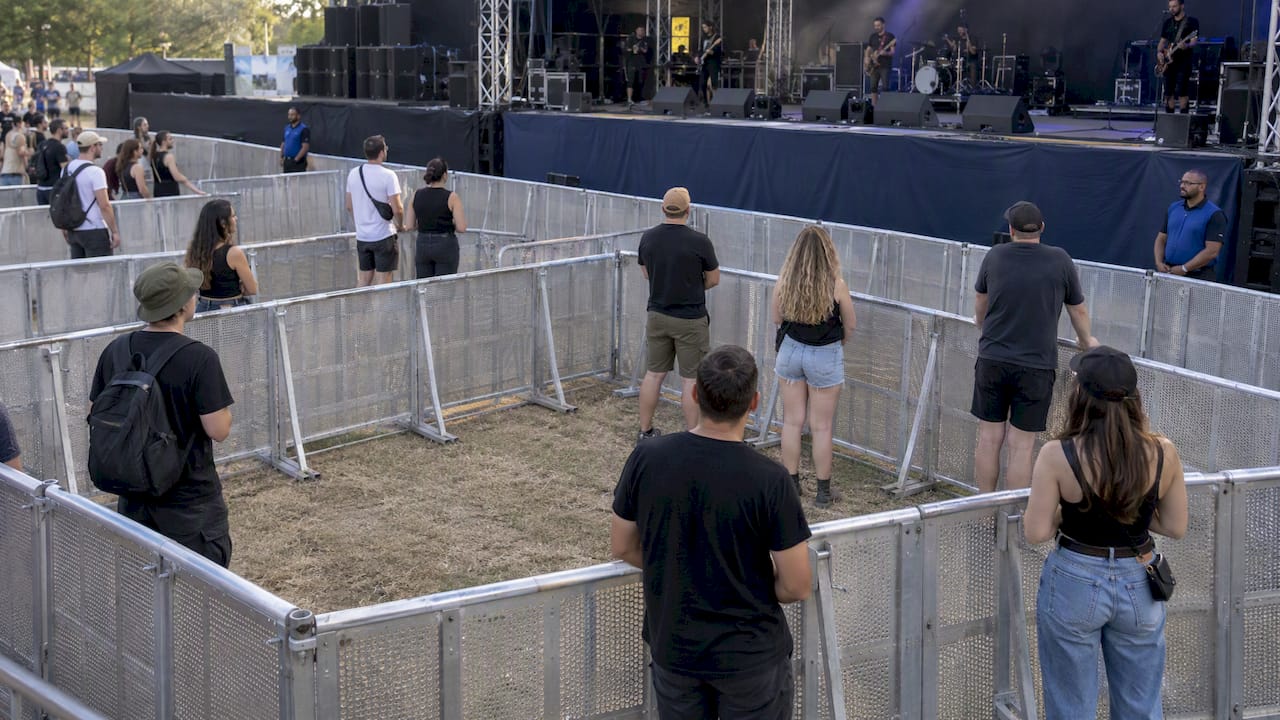
Crowd safety starts with a defensible capacity number, not a guess based on how many tickets sold last year. A common conservative practice is to discount the capacity of the largest single exit when modelling total egress, so the plan still works if that exit becomes blocked during an incident. This single adjustment changes how many entry lanes, barriers and stewards a site actually needs.
- Calculate maximum safe capacity for each zone, then subtract the largest exit’s share before setting the final figure.
- Design ingress lanes and barrier systems that spread arrivals across multiple points rather than funneling everyone toward one gate.
- Build circulation spaces wide enough to absorb peak movement between stages without creating pinch-points.
- Set density thresholds that trigger a defined response, such as opening additional lanes or pausing entry.
Pro Tip: Use video screens at the rear of crowded viewing areas to redistribute attention and reduce forward pressure toward the barrier.
Front-of-stage subdivision and improved sightlines solve the same problem from a different angle: when people can see the stage from where they are standing, they stop pushing forward to get a better view.
Practical access control: searches, queues, credentialing and throughput
Access control works best when the secondary perimeter and entry lanes are sized for the throughput you actually expect, not the throughput you hope for. CISA’s Public Venue Bag Search Procedures recommends trained search staff, a defined secondary perimeter, and standardized procedures for handling evidence and notifying law enforcement when something suspicious turns up. Bag searches should scale to the threat level and the physical space available rather than applying one rigid standard everywhere.
Credentialing deserves the same rigor. A well-built program sorts credentials into categories (staff, vendor, artist, press), sets clear expiry periods, and uses scannable or RFID options that can be deactivated instantly if a credential is lost or compromised.
- Size entry lanes for peak arrival, not average arrival.
- Train search staff on consistent procedures and clear public messaging.
- Build credential categories with expiry dates and instant deactivation capability.
- Monitor queue length in real time and open lanes before backups form.
Event Control, ELT, alert levels and incident-response protocols
Every incident response depends on a single command point. Event Control, staffed by the Event Liaison Team (ELT), should operate from a secure, identifiable location with direct lines to police, fire, EMS and site management. One crowd management plan appendix from a UK festival shows how this works in practice: Event Control functions as the operational nerve center, receiving tiered crowd-density reports and making resourcing decisions from that single feed.
- Define alert or status levels in advance, each tied to specific actions like increased screening or added staffing.
- Set first-on-scene protocols so whoever arrives first knows exactly what to do before backup arrives.
- Identify muster points and rendezvous points (RVPs) and integrate them with the wider unified command structure used by responding agencies.
- Write decision rules for show-stop, partial evacuation and full evacuation, including who has the authority to call each one.
Rehearsed decision rules matter because confusion costs time, and time is the one resource an incident never gives back.
Medical provision: triage, EMS staging and casualty management
Medical resourcing should be sized against the audience profile and the nature of the activities on site, not a flat per-head formula that ignores what the festival actually involves. First-aid posts, triage areas and EMS staging zones need ambulance access routes that stay clear throughout the event, not just at setup.
- Size medical staffing against audience, duration and activity type, not attendance alone.
- Position triage and EMS staging where ambulances can reach them without crossing crowd flow.
- Build clear escalation procedures from first-aid posts to Event Control and to receiving hospitals.
- Capture post-incident welfare checks and documentation as a standard closing step.
Design decisions that improve safety: exits, lighting, signage and circulation
Site design either supports a fast evacuation or quietly works against one. Conservative density assumptions and multiple egress routes give crowds somewhere to go even when one path is blocked, and emergency lighting on those routes matters as much as the lighting on the stage.
- Install emergency lighting and high-visibility signage along every designated egress route.
- Design viewing areas and temporary structures with clear sightlines to the nearest exit.
- Coordinate wayfinding signage with a provider like A3M so exit routes stay legible in low light and bad weather.
- Keep emergency-vehicle access lanes physically separated from pedestrian traffic flow.
- Confirm traffic management plans with local authorities before the gates open.
Perimeter security and proportionate hostile-threat mitigations
Perimeter measures should match the threat level identified in the risk assessment, not a generic template borrowed from another event. CISA’s Security and Resiliency Guide outdoor events annex outlines ten C-IED goals and recommends perimeter lighting, fencing, and vehicle standoff distance where the risk register justifies them.
- Conduct a full security sweep before gates open and maintain continuous roving patrols afterward.
- Scale screening and detection measures to the alert level set for that day.
- Bring in specialist teams such as bomb squads when the threat assessment calls for it.
- Coordinate perimeter decisions directly with law enforcement rather than setting them independently.
Pro Tip: Pair fixed perimeter cameras with roving vehicle patrols so static coverage and mobile deterrence reinforce each other rather than leaving gaps between shifts.
Staffing model: supervisors, roving teams, stewards and competence checks
Staffing numbers should track arrival peaks, departure surges and stage-change timings, not a flat ratio applied across the whole day. A gate that needs eight stewards at 6 PM may need two at 11 AM.
- Build staffing schedules around known peaks: gates opening, headline changeovers and the final egress surge.
- Give supervisors and gate managers clearly defined responsibilities that link directly back to Event Control.
- Run routine briefings and competence checks so every steward and security officer knows their role before doors open.
- Retain trained staff through build, overnight security and derig, since those windows carry their own risks.
Public messaging, staff comms, PACE and technical redundancy
Communications fail quietly until the moment they matter most, which is why redundancy belongs in the plan from the start. Pre-scripted public messages, delivered across PA, signage and social channels, keep information consistent when an incident unfolds.
- Pre-write public announcements for common scenarios so no one drafts them under pressure.
- Build a radio channel plan with spare batteries and a PACE (primary, alternate, contingency, emergency) structure for fallbacks.
- Keep event logs and standardized reporting templates so incidents are documented consistently.
- Test PA systems and backup power before gates open, not after something goes wrong.
Timeline and deliverables for multi-agency coordination and permits
Statutory partners need lead time, not a plan dropped on their desk the week before the event. Engaging police, fire and EMS months in advance, with the risk register and site plans already drafted, gives those agencies room to raise concerns while there’s still time to act on them.
- Share capacity modelling, traffic plans, medical plans and the full risk register with statutory agencies well ahead of the event.
- Run multi-agency tabletop exercises, followed by live exercises where the scale of the event justifies them.
- Distribute contact lists and staging locations to every agency involved, not just the ones expected to respond first.
- Finalize permits and licensing before ticket sales open and before contracts with vendors are locked in.
Prioritized timeline checklist: what to finish at each milestone
A festival security plan comes together in stages, and each milestone has an owner.
- Six to nine months out: complete the risk assessment, assign vendor contracts and draft the security staffing schedule.
- Three months out: finalize the medical plan, traffic plan and credential system design.
- Four weeks out: confirm agency sign-off, lock staffing numbers and finish signage orders.
- Event week: run the site security sweep, test communications systems and activate credentials.
- Event day: staff checkpoints per schedule, monitor density reports continuously and hold a post-event debrief within days.
How experienced providers operationalize festival plans
Festival security plans should start with the site survey and risk assessment, then produce a staffing schedule tied to it. A delivered plan typically includes a written Event Security Planning document, a staffing schedule, and direct support for Event Control during the event itself.
- Site survey and written risk assessment before any staffing decisions are made.
- Staffing schedule built around arrival peaks, stage changes and overnight coverage.
- Virtual Guard remote monitoring to extend perimeter coverage between patrol passes.
- CCTV integration for camera placement that supports both deterrence and evidence capture.
Field-tested priorities from the author
Three things matter more than any checklist: risk-led decisions, rehearsed staff, and an Event Control structure simple enough that everyone understands it under pressure. Festivals that debrief after every event, not just after a bad one, build a safety culture that shows up when it counts.
— Alston
How Global Security helps: tailored festival security services and next steps
Festival organizers get more out of a security partner who builds the plan around the event’s actual risk profile instead of a generic package. We offer guard services staffed by teams with law enforcement and military backgrounds, Virtual Guard remote monitoring to extend coverage without adding static headcount, CCTV integration, roving vehicle patrols, and firearms and security training for staff who need it.

- Site survey and written Event Security Management Plan tailored to your footprint.
- Staffing schedule and on-site Event Control support during the event.
- Roving patrols and Virtual Guard monitoring working together across the perimeter.
A typical engagement starts with a site visit and a conversation about your risk profile. Reach out for a quote on guard services and we will build a plan around your event.
FAQ
What should a festival security plan include?
A festival security plan should include a site-specific risk assessment, a crowd management plan with capacity figures, access control and credentialing procedures, a medical plan, and a clear incident-command structure. It should also set alert levels, communication protocols and coordination arrangements with police, fire and EMS.
How far in advance should festival security planning start?
Large festivals typically start security planning six to nine months before the event, beginning with the risk assessment and vendor contracts. Statutory agencies should receive the risk register and site plans well before the final weeks so they have time to review and respond.
Who is responsible for calling an evacuation at a festival?
Evacuation decisions, including partial or full evacuations, should be made by a named authority within Event Control, following rules set out in the plan before the event opens. The WHO All-Hazards Risk Assessment Tool supports building these decision rules as part of the broader risk framework.
How does bag searching work at festival entrances?
Bag searches at festival entrances use trained staff, a defined secondary perimeter, and standardized procedures for handling suspicious items, scaled to the threat level and available space. CISA’s bag search guidance recommends clear protocols for evidence handling and law enforcement notification.
What is the Event Liaison Team at a festival?
The Event Liaison Team, often shortened to ELT, staffs Event Control and serves as the command point connecting security, medical, police, fire and site management during an event. It receives incident reports and crowd-density data and makes resourcing and escalation decisions from that single point.
Sources
- Public Venue Bag Search Procedures (CISA)
- Generic All-Hazards Risk Assessment Tool for Mass Gathering Events (WHO)