
Start by assigning a single named security lead, completing a threat, vulnerability and risk assessment (TVRA), and adopting an operational plan template that links roles, communications and resources. That is the foundation every credible event security plan rests on, and skipping it is the most common reason plans fail under real pressure.
Three authoritative resources anchor everything that follows: the Mass Gathering Security Planning Tool from CISA, guidance from the Sports Grounds Safety Authority, and the planning primer behind FEMA IS-15. Each treats event security as an all-hazards discipline, not a single-threat checklist.
In the first 72 hours, your planning team needs to:
- Name one security lead who owns the plan and reports directly to event leadership.
- Assemble the core planning team, including a safety officer and a law enforcement liaison.
- Open an initial risk register, even a rough one, to start tracking hazards.
- Notify key stakeholders (venue, police, EMS, fire) that planning is underway.
Statistic to know: major events typically need 12 to 18 months of lead time for serious pre-event planning. Smaller events compress that timeline, but the sequence of decisions stays the same.
Key Takeaways
Effective event security planning requires a single named security lead, a completed TVRA, and an operational plan template that ties roles, communications, and resources together before the event opens.
| Point | Details |
|---|---|
| Name one accountable lead | A single security lead, reporting to event management, prevents diffuse accountability during incidents. |
| Rank hazards before buying gear | Use a frequency times severity score to decide which controls actually deserve budget. |
| Match staffing to attendee flow | Dynamic shift rotations tied to arrival curves outperform static, fixed-hour schedules. |
| Test the plan before relying on it | Tabletop and full-scale exercises catch bottlenecks and comms gaps no document review will find. |
| Global Security fills the staffing gap | Guard services, executive protection, CCTV integration, and training turn a written plan into an executed one. |
Table of Contents
- What Belongs on a One-Page Event Security Checklist?
- How Far in Advance Should You Start Planning Event Security?
- What Is a Threat, Vulnerability, and Risk Assessment for Events?
- How Do You Build an Event Operational Plan?
- How Do You Choose Security Measures by Threat and Cost?
- How Do You Manage Crowds and Vehicle Risk at Events?
- How Should Event Communications and Emergency Plans Work?
- What Staffing and Training Does an Event Security Plan Need?
- What Should an Event Security Budget Look Like?
- Common Pitfalls Field Teams See in Event Security Plans
- Sources
What Belongs on a One-Page Event Security Checklist?
A checklist earns its place on your desk only if every line has a clear owner and a clear definition of “done.” Print this one, or drop it into whatever project tool your core planning team already uses.
- Named security lead assigned — done when one person, not a committee, is accountable and documented in the plan.
- TVRA initiated — done when hazards are listed with frequency and severity ratings, even preliminary ones.
- Command and communications point established — done when an Incident Command System (ICS) or equivalent structure names who make decisions on-site.
- Credentialing vs. ticketing rules set — done when you know which roles need vetted credentials versus a general admission ticket.
- Perimeter and screening baseline defined — done when fencing, bag checks, and screening technology are matched to expected attendance.
- Emergency Action Plan (EAP) drafted — done when fire, medical, severe weather, and security incidents each have a documented response.
- Liaison with police, fire, and EMS confirmed — done when a named contact at each agency has reviewed the plan.
Store the checklist and its backup documents in a shared cloud folder accessible to the entire core planning team, not just the security lead. Version control matters here: a plan reviewed six months ago and never updated is a liability, not an asset.
| Point | Details |
|---|---|
| Ownership drives completion | Every checklist item needs one accountable name, not a shared responsibility. |
| TVRA comes before technology | Risk findings should determine which measures you buy, not the reverse. |
| Plans need a living home | Store checklists where the whole planning team can update and review them. |
How Far in Advance Should You Start Planning Event Security?
Lead time scales with event size, and rushing it is where most plans break down. A community festival with 500 attendees might reasonably start serious planning three to four months out. A mid-size conference or concert with several thousand attendees needs closer to six to nine months. Major events and mass gatherings, the kind involving multiple jurisdictions and thousands of daily attendees, typically require 12 to 18 months of dedicated planning before doors open.
That timeline isn’t arbitrary. It reflects how long it actually takes to coordinate law enforcement agencies, secure vendor contracts, run credible exercises, and revise a plan based on what those exercises reveal. Institutional planning models, including the IPO Security Planning Model used by national security planners, organize this work around 19 operational areas, ranging from transportation and medical services to intelligence and public information. Your core planning team doesn’t need 19 separate people, but every one of those areas needs a single point of contact who can answer for it.
Recommended planning timeline:
| Phase | Timeframe before event | Primary owner | Key deliverables |
|---|---|---|---|
| Strategic planning | 12–18 months (major events); 3–6 months (smaller) | Security lead + core planning team | TVRA draft, stakeholder list, budget outline |
| Detailed operational planning | 6–9 months | Operations lead | Operational plan template, credentialing rules, comms plan |
| Build and setup | 2–4 weeks | Site operations lead | Perimeter installation, signage, staging areas |
| Final readiness review | 1–2 weeks | Security lead | Tabletop exercise, agency sign-off, staffing confirmation |
| Operational day | Event day(s) | Command post | Live monitoring, incident logging, real-time adjustments |
| Post-event decommission | 1–2 weeks after | Operations lead | Equipment recovery, financial reconciliation, debrief scheduling |
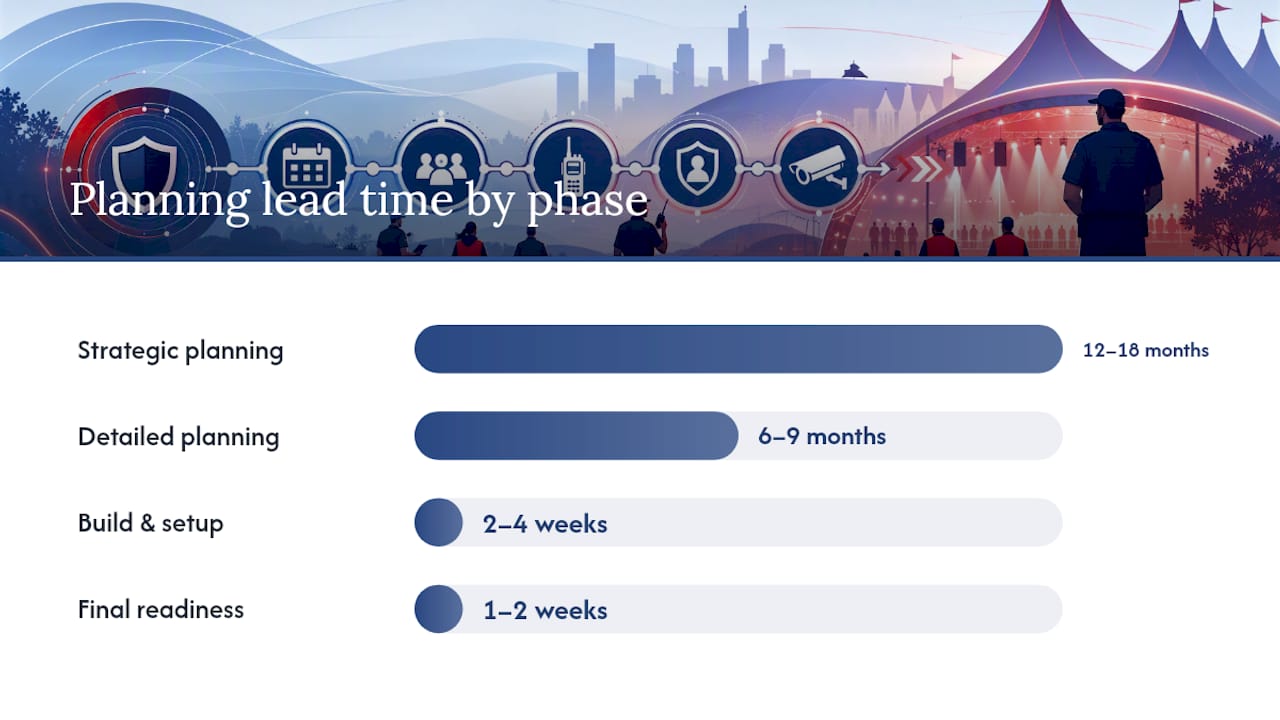
Each phase has its own failure mode. Skipping the final readiness review is the most common one: teams assume the plan works because it looks complete on paper, then discover during the event that the radio channel nobody tested doesn’t reach the far perimeter. Research into event security decision-making identifies this tension directly, noting that practitioners must balance security, business, and safety objectives while documenting exactly what can be controlled and how. A plan that looks thorough but was never pressure-tested controls nothing.
What Is a Threat, Vulnerability, and Risk Assessment for Events?
A TVRA is the method that turns a vague sense of “we should be careful” into a ranked list of controls you can actually budget for and staff against. It has four steps: identify plausible threats, list the vulnerabilities that would let each threat succeed, estimate how frequently each hazard might occur and how severe the consequences would be, then multiply frequency by severity to produce a risk score you can rank against every other hazard on the list.
Here’s a simplified example a planning team might build for a mid-size outdoor concert:
| Hazard | Frequency rating (1–5) | Severity rating (1–5) | Risk priority score |
|---|---|---|---|
| Unauthorized perimeter breach | 4 | 3 | 12 |
| Medical emergency in crowd | 5 | 4 | 20 |
| Severe weather disruption | 3 | 4 | 12 |
| Vehicle intrusion at loading zone | 2 | 5 | 10 |
| Counterfeit credential use | 3 | 2 | 6 |
Once hazards are ranked, convert the top scores into a tiered control list: deterrence measures that discourage an incident (visible patrols, signage), detect and delay measures that slow an incident down (screening, fencing), and response measures that limit damage once something happens (EAPs, trained medical staff). The CISA Venue Guide for Security Enhancements frames this as choosing from a menu of options rather than adopting every available measure, since higher complexity does not automatically buy higher effectiveness.
Pro Tip: For short-duration events at temporary venues, lean toward personnel-heavy controls over permanent technology investment. A team of trained guards can adapt to a hazard that wasn’t on your original list; a fixed camera system cannot.
How Do You Build an Event Operational Plan?
An operational plan (often called an EOP) is the document that turns your TVRA findings into assignments, and it needs eight sections to function under pressure: situation, mission, execution, administration and logistics, command and coordination, communications, staging, and demobilization. The command and coordination section is where the SGSA’s core guidance applies directly: responsibility for security should sit with one named individual who reports to venue management or the event organizer, because safety and security are interdependent and diffuse accountability is where both fail together.
Credentialing deserves its own subsection inside the plan, and it’s frequently underbuilt. A ticket proves someone paid to attend; a credential proves someone has been vetted for a role that grants elevated access, backstage, staging areas, or command posts. Anti-counterfeit measures (holograms, sequential numbering, same-day photo verification) matter most for high-vetting roles like vendor staff and press. Institutions like Brown University’s public safety office document exactly this kind of coordination between campus and event stakeholders when approving access levels for different roles.
Roles and responsibilities table:
| Function | Primary responsibility | Reports to |
|---|---|---|
| Security lead | Owns the overall plan, final decision authority | Event organizer / venue management |
| Safety officer | Monitors crowd conditions, structural and fire safety | Security lead |
| Operations lead | Manages staging, logistics, vendor coordination | Security lead |
| Police liaison | Coordinates with law enforcement command | Security lead |
| EMS liaison | Coordinates medical response and evacuation routing | Safety officer |
Escalation flows one direction under normal conditions: staff report anomalies to their function lead, function leads report to the security lead, and the security lead holds final on-scene decision authority unless law enforcement assumes command during an active incident. That handoff point, who decides when police take over, needs to be written into the plan explicitly, not assumed.
How Do You Choose Security Measures by Threat and Cost?
Match every measure to a specific hazard on your TVRA list before you spend a dollar on it. Generic categories of measures fall into predictable cost and complexity tiers, and the pairing matters more than the price tag.
| Measure category | Threats mitigated | Complexity tier | Cost tier |
|---|---|---|---|
| Perimeter hardening (fencing, barriers) | Unauthorized access, crowd overflow | Low to moderate | Low |
| Access control and credentialing | Impersonation, unvetted access | Moderate | Low to moderate |
| Screening (bag checks, magnetometers) | Prohibited items, weapons | Moderate | Moderate |
| CCTV and video monitoring | Post-incident review, real-time detection | Moderate to high | Moderate |
| Hostile vehicle mitigation (HVM) | Vehicle-borne attacks | High | High |
| Canine or explosive detection | Explosive threats | High | High |
| Cyber protections for event infrastructure | Data breach, IoT compromise | Moderate | Moderate |
Combine low-cost, high-effectiveness measures first. Perimeter hardening and clear credentialing rules cost far less than HVM hardware and cover a large share of common vulnerabilities. Reserve high-investment tiers, canine detection, advanced screening technology, layered HVM, for events where the TVRA specifically flags those hazards as high-frequency or high-severity, not as a default because a comparable event used them.
Technology has a hard ceiling on what it can replace. The SGSA’s guidance is blunt on this point: a venue’s technological sophistication is not a substitute for strong safety management, and competent personnel operating solid processes routinely outperform advanced infrastructure run by an undertrained team. Integrating CCTV and IoT sensors into a broader plan works only when trained staff are watching and empowered to act on what they see.
How Do You Manage Crowds and Vehicle Risk at Events?
Crowd flow and vehicle risk sit right next to each other on most TVRA lists, because both hinge on the same thing: how well you control movement across the site’s boundaries.
Design queues and ingress points around expected arrival curves, not average attendance. A festival with a hard 7 p.m. start draws a spike, not a trickle, and static staffing plans buckle under it. Shift resources dynamically to match attendee flow at queues, vendor zones and transition points rather than locking guards into fixed posts for the entire event window.
Layer your perimeter in three bands: a soft perimeter (signage, low barriers, greeters) that shapes movement without confrontation, a middle perimeter (screening and credential checks) where access decisions actually happen, and a hard perimeter (fencing, vehicle barriers) that physically stops unauthorized entry.
- Place barriers to funnel crowds toward screening points, never away from them.
- Reserve separate access routes for deliveries and emergency vehicles, and keep them staffed at all times.
- Stage HVM equipment (planters, bollards, vehicle checkpoints) at every point a vehicle could reach a crowd, not just the main entrance.
- Mark ingress, egress, and HVM zones clearly on the venue site map handed to every staff lead and outside agency.
Traffic management plans fail most often at the seams, the point where public roads meet the controlled event perimeter. That handoff needs a named owner too.
How Should Event Communications and Emergency Plans Work?
Build your communications plan around the PACE model: Primary, Alternate, Contingency, Emergency. Radio is usually primary, cellular is alternate, a backup internet connection or mesh network is contingency, and satellite communication is the emergency fallback for events where cellular infrastructure might fail entirely.
Your venue’s Emergency Action Plan needs distinct response protocols for:
- Fire and structural emergencies
- Medical emergencies and mass casualty scenarios
- Active threat situations
- Hostile vehicle incidents
- Severe weather and evacuation triggers
Public messaging deserves the same rigor as internal comms. Pre-event visitor messaging (what’s prohibited, what to expect at screening, where to go if separated from a group) reduces friction and deters people from testing your perimeter with items they already know are banned. For incidents that do occur, rapid and accurate public communication limits reputational damage as much as it limits confusion; guidance built for crisis communications teams applies directly to event organizers managing a live incident.
Before opening day, confirm your comms equipment inventory, finalize frequency assignments with any outside agencies sharing your radio spectrum, and run at least one full comms test across every zone of the venue, including dead spots you didn’t expect.
What Staffing and Training Does an Event Security Plan Need?
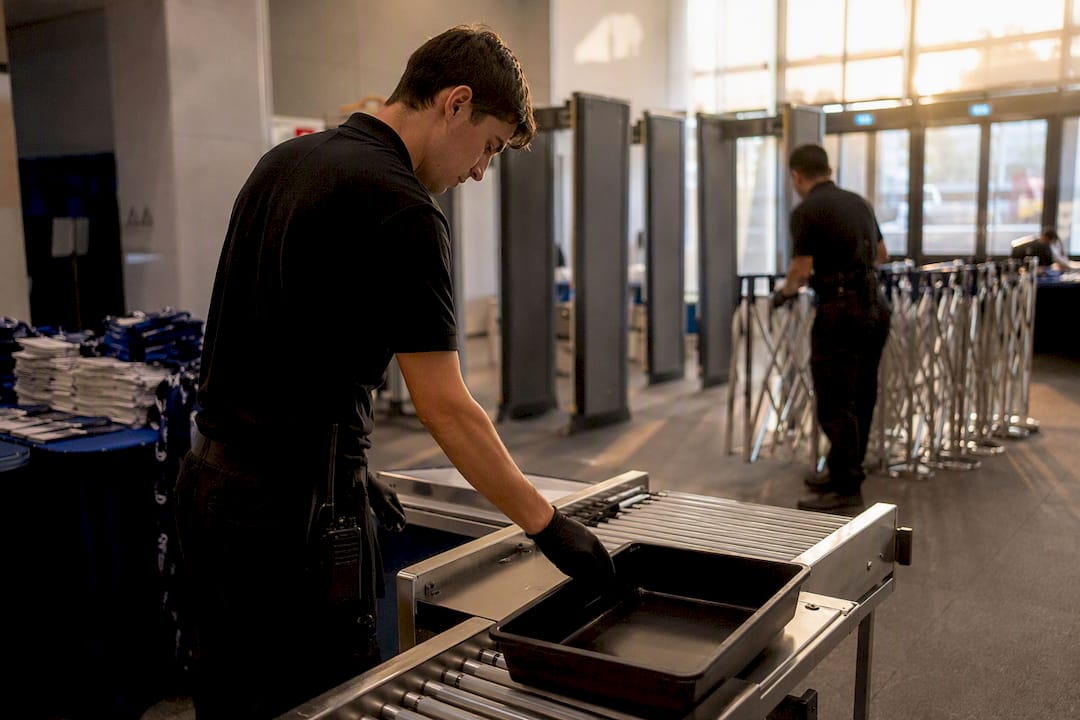
Staffing plans fail less often from having too few guards and more often from having the wrong ratio at the wrong time. Build a matrix that ties staffing levels to attendee flow, not a flat headcount for the whole day.
| Role | Typical shift length | Minimum ratio guidance | Relief rotation |
|---|---|---|---|
| Perimeter security | 8 hours | 1 per 50–75 meters of fence line | Rotate every 4 hours |
| Screening staff | 6 hours | 1 per lane, minimum 2 lanes per 1,000 attendees | Rotate every 2–3 hours |
| Command post staff | 12 hours | 1 lead, 2 support minimum | Split shift, no solo coverage |
| Medical staff | 8 hours | Per local EMS guidance | Rotate every 4 hours |
Every role above needs training that’s realistic, not theoretical. Run tabletop exercises for command staff months out, functional exercises (partial live drills) closer to the event, and at least one full-scale exercise involving vendors, stewards, and outside agencies before a major event opens its gates. A planning primer for law enforcement agencies managing large events emphasizes exactly this progression, recommending scalable plans paired with realistic, multi-agency training rather than a single dress rehearsal. Document every finding from each exercise and feed it back into plan revisions immediately, not after the event.
What Should an Event Security Budget Look Like?
Cost tiers roughly follow the complexity tiers already mapped to your TVRA: perimeter hardening and credentialing sit low, screening and CCTV sit moderate, and HVM or canine detection sit high. Justify higher spend to stakeholders by pointing directly at the risk score that drove it, not a general sense of caution.
Budget note: major events typically commit to procurement and vendor contracts well before the 12 to 18 month planning window closes, since equipment lead times and staffing contracts both take months to finalize.
- Lock vendor contracts early; equipment and specialized staff (canine teams, HVM providers) book out fastest.
- Blend temporary staffing surges with fixed technology investments to avoid overcommitting capital before final attendance numbers are confirmed.
- Check public safety grant cycles early. Many jurisdictions require applications 6 to 9 months ahead of the funding period.
- Weigh security spend against total event budget the same way you’d weigh any other line item competing for marketing and operational dollars.
Common Pitfalls Field Teams See in Event Security Plans
Two failures show up more than any others in post-event debriefs. The second is over-reliance on technology in place of trained personnel, buying a CCTV upgrade instead of fixing a credentialing gap that CCTV can’t close.
Pro Tip: Run your credential production check a week before the event, not the morning of. Printer misalignment, wrong color coding, and expired vetting data are the most common last-minute discoveries, and they’re the hardest to fix under time pressure.
Pro Tip: Build surge staffing agreements into your contract before you need them. Waiting until attendance projections spike to find extra guards costs more and limits your options.
A mid-size venue shifted its screening staff schedule from fixed shifts to attendee-flow-based rotations after a tabletop exercise revealed a 40-minute bottleneck at peak arrival. The change, paired with adding a second screening lane, cut wait times enough that the queue never backed up past the soft perimeter again.
Why rigorous event security planning matters
Global Security has watched plans succeed and fail on the same variable every time: whether anyone actually tested them before the gates opened. A checklist that looks complete on paper means nothing until it survives a tabletop exercise and a real crowd. That’s the standard this guide was built to meet.
How Global Security Supports Your Event Security Plan
Building a plan is one thing. Staffing it, training for it, and running command on the day are another, and that gap is where Global Security’s guard services come in: licensed, trained officers who can scale from a single roving patrol to a full command post team without you having to build an internal security department from scratch.

Global Security’s services cover the full arc of what this guide walks through: on-site guard services and roving patrols for perimeter and crowd coverage, executive protection for VIP attendees and speakers, CCTV integration for monitoring and post-incident review, and scenario-based training for staff who need to handle real incidents, not just theoretical ones. A typical engagement starts with a site survey, moves into a tailored staffing and technology plan matched to your TVRA findings, and ends with trained personnel who know the venue before event day starts. If your next event needs a security partner who can act on this plan rather than just help you write it, request a site survey through Global Security’s services page and get a plan built around your actual risk profile.
Sources
- Mass Gathering Security Planning Tool
- Event Security: Vision-Setting, Planning, and Implementation Considerations
- Planning Toolkit (appendices) / Special events planning references