
Choose duty gear by role first: carry only mission-critical items, distribute weight to protect your lower back, prioritize certified body armor, and validate every setup with field testing before you carry it on shift. Start with a quick inventory check against your assignment’s actual demands, then schedule a fit and function test before trusting new gear in the field.
TL;DR:
- Patrol officers need higher firearm retention and full medical kits, while plainclothes officers need concealment and tactical teams benefit from load bearing vests.
- A review of ten studies linked duty belts with impaired movement and higher injury risk; separate research found suspenders reduce oblique and back muscle activation.
- Thigh holsters can improve seated vehicle comfort, but hip mounted holsters tend to interfere less with sprinting, so choose according to daily movement demands.
- NIJ Standard 0101.07 recommends continued use of currently certified armor during transition; check certification tags and manufacture dates before replacing panels.
- A duty IFAK should include a tourniquet, hemostatic dressing, chest seal, compression bandage, and trauma shears, positioned for access with either hand.
Table of Contents
- Duty gear checklist: audit or assemble your standard kit
- Choosing gear by role and mission
- Duty belt vs load-bearing alternatives: what the evidence says and how to mitigate injury risk
- Holster selection and placement: draw ergonomics, vehicle comfort, and gait effects
- Body armor basics and NIJ standards: reading labels and what to prioritize
- Fit, sizing, and field testing protocol for your loadout
- Practitioner guidance from Global Security (author and team proof points)
- Balancing readiness with long-term health
- How Global Security can help with gear training and fit sessions
- FAQ
- Sources
Duty gear checklist: audit or assemble your standard kit
A duty loadout earns its place on your belt only if it serves a clear purpose. Before adding or swapping any item, ask whether it supports a task you perform regularly, and whether it can be reached quickly under stress.
Your core kit typically includes:
- Firearm and holster: matched to retention needs and duty assignment, with a holster that allows a consistent draw angle.
- Magazines: carried in a fixed position for muscle-memory reloads, usually on the support side.
- Radio: mounted for one-handed access without blocking your firearm draw.
- Flashlight: a dedicated duty light, separate from a personal device, rated for one-handed operation.
- Handcuffs: positioned for a smooth draw with either hand depending on suspect control tactics.
- Tourniquet and IFAK: carried where you can reach it with either hand, since injuries do not wait for your dominant side to be free.
- Gloves and trauma shears: accessible without digging through pouches.
- Baton or impact tool: sized and mounted so it does not interfere with seated posture in a vehicle.
- Multi-tool or knife: a backup utility option, not a replacement for issued tools.
- Spare batteries, phone, notepad and pen: lower priority but still worth a fixed spot so you are not searching for them mid-call.
Your individual first aid kit deserves particular attention because the consequences of a poorly chosen component are immediate. At minimum, carry a tourniquet, a hemostatic or quick-clot style dressing, a chest seal, a compression bandage, and trauma shears. Placement matters as much as contents: a kit buried under other gear defeats its purpose in an emergency.
Retention and speed pull against each other, and the right balance depends on your assignment. A patrol officer working alone needs higher retention on the firearm; an officer in a controlled facility may prioritize faster access. Wherever possible, set up critical items, especially medical gear, for ambidextrous access so an injury to your dominant hand does not leave you unable to help yourself or a partner.
Pro Tip: Lay out your full kit on a table once a quarter and ask which items you have actually used in the last 90 days. Anything you cannot justify is extra weight on your spine.
Choosing gear by role and mission
Gear priorities shift with assignment; for roles requiring high-visibility gear, consider options like custom hi-vis vests that meet AS/NZS compliance to ensure safety and clear identification. A setup built for a patrol shift rarely transfers cleanly to plainclothes work or a protective detail, so matching equipment to mission is one of the most practical steps you can take.
- Patrol: prioritize visible deterrence, full retention holsters, and a complete medical and restraint kit, since patrol officers face the widest range of unpredictable encounters.
- Detective or plainclothes: prioritize concealment and a slimmer profile, often shifting to an inside-the-waistband holster or a reduced belt load while keeping a compact IFAK within reach.
- Executive protection: prioritize discretion, rapid access, and redundancy, since a protective detail often carries backup magazines and medical gear without a visible duty belt at all; our Executive Protection Training program covers this kind of role-specific setup in detail.
- Corrections: prioritize restraint tools, radio access, and impact weapons over firearms in many facilities, with gear selected around close-quarters control rather than long engagement distances.
- Tactical units: prioritize load-bearing vests over belts, since armor plate carriers and vests distribute heavier ammunition and breaching tools more evenly across the torso.
Officers who rotate between roles benefit from modular setups: a core belt or vest platform with swappable pouches lets you reconfigure for a plainclothes assignment one day and a uniformed patrol shift the next, without rebuilding the entire kit from scratch.
Duty belt vs load-bearing alternatives: what the evidence says and how to mitigate injury risk
The standard duty belt has real costs. A systematic review of ten studies on duty belts and load placement found that duty belts and their equipment loads consistently impair task performance and movement, and increase the potential for musculoskeletal injury, regardless of how the gear is arranged on the belt.
That review carried a mean appraisal score of 79.8% across the included studies, which reflects a reasonably consistent body of evidence pointing in the same direction: belt load is a real occupational hazard, not just an officer complaint.
Alternatives exist, and each comes with trade-offs:
- Load-bearing vests distribute weight across the shoulders and torso instead of concentrating it at the waist, which suits tactical and high-load assignments.
- Undershirt suspenders transfer a portion of belt weight to the shoulders, and research on duty belt ergonomics found this reduces muscle activation in the obliques and back, a practical mitigation for belt-related low-back pain.
- Padded belts cushion pressure points without changing the fundamental weight distribution, offering modest relief for officers who cannot change their carry system.
Departments considering suspenders typically pair them with standardized belt layouts, since inconsistent placement across officers undermines muscle-memory training. Practical mitigation starts today: move your heaviest items off the lumbar area, add suspenders if your department authorizes them, maintain core and back conditioning, and schedule periodic equipment checks to catch gear that has drifted into an uncomfortable or unsafe position.
Holster selection and placement: draw ergonomics, vehicle comfort, and gait effects
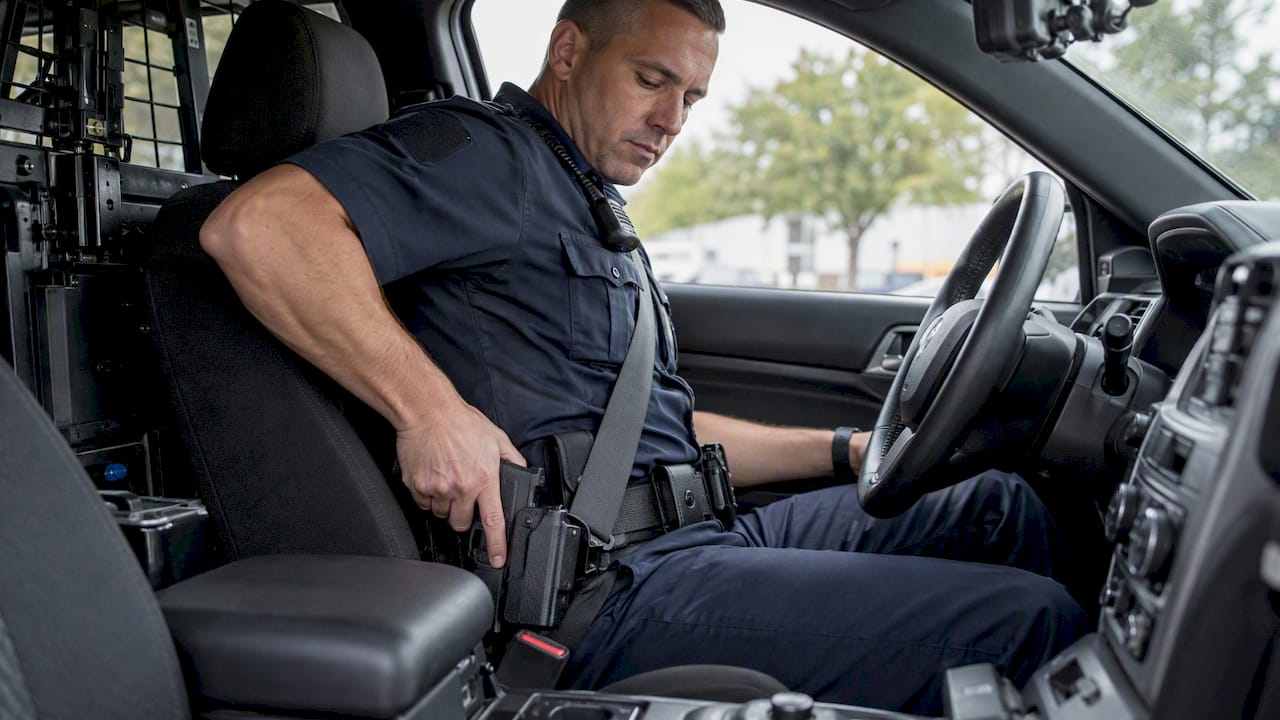
Where you mount your holster changes more than comfort. A peer-reviewed study on police ergonomics found that holster position, hip versus thigh, affects gait mechanics and perceived discomfort across different walking and sprinting intensities. Thigh holsters can improve seated comfort in a patrol vehicle, but they also shift your center of mass, which can affect sprint mechanics and rapid transitions between positions.
The right choice depends on your actual duty day:
- Vehicle-heavy roles often favor thigh holsters for seated comfort over long shifts.
- Foot patrol and high-mobility assignments often favor hip-mounted holsters, since they interfere less with sprint mechanics.
- Retention and concealment needs should override comfort preferences whenever the two conflict.
Before trusting a new holster, run through a mounting checklist: confirm the height sits at a consistent draw point regardless of seated or standing posture, set the cant to match your natural wrist angle, and verify the retention level matches your assignment’s threat profile. Small adjustments to cant and height can meaningfully affect draw time under stress, and iterative adjustment paired with live and dry-fire practice produces the most reliable improvement.
Pro Tip: Practice your draw seated in your patrol vehicle, not just standing on a range. A holster that performs well standing can snag or bind when you are belted into a seat.
Body armor basics and NIJ standards: reading labels and what to prioritize
Certified body armor is not optional equipment, and the standard behind that certification just changed. NIJ Standard 0101.07 updates body armor testing methods and recommends that agencies continue using currently certified armor while they transition to the new standard, with older certified models remaining valid through the transition period.
The update matters for procurement decisions for a specific reason: it includes improved female-fit testing and new shot-placement testing protocols, both of which affect how well a given panel actually protects the person wearing it rather than a generic test form. A certified panel is only as good as the carrier it sits in, and a certified panel worn in a poor-fitting carrier can reduce protective coverage while increasing discomfort enough that officers avoid wearing it consistently.
Before accepting any armor into service, run these checks:
- Certification tag: confirm the NIJ certification level and verify it has not expired.
- Sizing: fit should follow body measurements, not a generic small/medium/large guess, particularly under the newer female-fit testing guidance.
- Carrier fit: the carrier must hold the panel in correct position during movement, not just when standing still.
- Replacement cycle: track manufacture date and plan replacement before the panel’s rated service life ends.
Soft armor protects against handgun threats and is worn daily under a uniform; plates add rifle-rated protection and are typically reserved for tactical response rather than routine patrol. Matching the right category to the actual threat level of an assignment avoids both under-protection and unnecessary bulk.
Fit, sizing, and field testing protocol for your loadout
A new setup should never debut on an actual call. Before carrying new gear operationally, run it through a structured field test:
- Vehicle egress and ingress: confirm nothing snags or digs in while entering, exiting, or sitting in your patrol vehicle.
- Seated comfort over a full shift length: wear the setup for an extended seated period to catch pressure points early.
- Draw and reload repetitions: practice until the motion feels automatic, not deliberate.
- Sprint and agility drills: confirm the setup does not shift, bind, or slow you down during sudden movement.
- Casualty response with your IFAK: simulate applying your own tourniquet or dressing one-handed, since that is the scenario it exists for.
Repetition builds the muscle memory that matters under stress, and consistent practice, ideally in the range of hundreds to a couple thousand repetitions over time, improves access speed and reduces the cognitive load of finding equipment during a crisis. If any item causes persistent pain, numbness, or a change in your gait during testing, treat that as a signal to adjust the setup or consult a medical professional before relying on it operationally.
Practitioner guidance from Global Security (author and team proof points)
We include seasoned law enforcement and military experts whose experience shapes how we approach training rather than sales. We offer Global Solutions Training and Executive Protection Training programs built around scenario-based drills, fit sessions, and role-specific equipment guidance, alongside Virtual Guard monitoring for agencies that need to extend coverage without adding headcount. A fit session with trained instructors catches problems a mirror check misses: a holster cant that looks fine standing but binds when seated, or a belt layout that works on the range but shifts during active movement.
Balancing readiness with long-term health
Officers often treat gear selection as a one-time decision made during academy or initial issue. It deserves the opposite: a recurring review, because the evidence on belt load and musculoskeletal injury is not going away, and neither is the responsibility to carry certified armor and a complete medical kit every shift. I would rather see departments standardize suspenders and vest options now than wait for a documented injury trend to force the conversation. Readiness and long-term health are the same goal, not competing ones, and treating them that way starts with how an agency reviews and trains on its standard loadout.
— Alston
How Global Security can help with gear training and fit sessions
Choosing the right setup is only half the job: validating it under real conditions is where most officers run out of time or structured guidance. We offer hands-on support to help validate gear setups under real conditions.

- Executive Protection Training: role-specific instruction for officers moving into protective detail work, covering gear configuration alongside tactics.
- Global Solutions Training: scenario-based drills and fit-testing support for agencies standardizing equipment across a team.
- Firearm and rifle training: live-fire practice that reinforces draw, reload, and transition mechanics under realistic pressure.
- On-site consulting: a review of current duty gear policy against ergonomic and NIJ guidance for your specific roles.
If your department is overdue for a gear policy review, visit our guard services page to start a conversation about training and consulting options built around your actual assignments.
FAQ
What is the best way to start selecting duty gear?
Start by listing your actual job tasks, then choose equipment that serves those tasks directly, prioritizing certified armor, a complete medical kit, and ergonomic load distribution. Field test the full setup before relying on it operationally.
Should I use a duty belt or a load-bearing vest?
A systematic review of duty belts found that belt loads consistently impair performance and raise injury risk regardless of placement, so vests or suspenders are worth considering for heavier loadouts. The right choice depends on your role: tactical assignments often favor vests, while standard patrol often stays belt-based with added suspender support.
Is hip or thigh holster placement better?
Neither position is universally better: a peer-reviewed ergonomics study found that thigh holsters can improve seated vehicle comfort while hip holsters tend to interfere less with sprinting. Choose based on how much time your role spends seated versus moving at speed.
Do I need to replace my body armor under the new NIJ standard?
NIJ Standard 0101.07 recommends continuing to wear currently certified armor while agencies transition to the new standard, so immediate replacement generally is not required. Check your panel’s certification tag and manufacture date to confirm it remains valid during the transition period.
What should be in a duty IFAK at minimum?
A duty IFAK should include at least one tourniquet, a hemostatic or quick-clot style dressing, a chest seal, a compression bandage, and trauma shears. Position it for access with either hand so an injury to your dominant side does not block your ability to treat yourself or a partner.
Sources
- Impacts of duty belts and load placement on police officers: a systematic review
- Exploring police ergonomics: Effects of personal protective equipment, holster position and perceived discomfort on different gait intensities
- Ballistic Resistance of Body Armor, NIJ Standard 0101.07
- Duty belt ergonomics and alternative load-bearing strategies (NCSU research repository)