
A layered program built from AI-capable video, disciplined key control, access management, perimeter hardening, and a blended staffing model prevents most dealership theft and vandalism. No single camera or guard covers the gaps the others leave open.
The non-negotiables of any real car dealership security plan:
- AI-capable video surveillance with real-time verification
- Electronic key control with logged checkouts
- Access control on service bays, parts rooms, and gates
- Perimeter lighting and physical barriers
- 24/7 monitoring with a documented response chain
Start this week with a night-time perimeter walk and a key-log audit. Most loss events trace back to a gap one of those two checks would have caught.
Key Takeaways
A layered program combining AI-capable video, logged key control, access management, perimeter hardening, and blended staffing prevents most dealership theft and vandalism losses.
| Point | Details |
|---|---|
| Layer your defenses | Combine video, key control, access management, and staffing rather than relying on any single measure. |
| Audit at night | Run a lighting and camera-angle check after dark, since daytime walkthroughs miss glare and dead zones. |
| Log every key | Electronic key cabinets with checkout logs close the most common gap behind vehicle theft. |
| Verify before dispatching | Human verification of AI alerts cuts false dispatches and speeds real response. |
| Get a tailored survey | Global Security maps CCTV, Virtual Guard, and guard staffing to your lot’s specific gaps during a site survey. |
Table of Contents
- What Car Dealership Security Actually Covers
- Core Components Of A Dealership Security System
- Staffing Options: Guards, Patrols, Or Remote Monitoring?
- How Should Monitoring And Incident Response Work?
- Choosing A Dealership Security Provider
- Rolling Out And Maintaining Your Security Program
- How Global Security Supports Dealership Security Needs
- Incident Response Planning And Crisis Management
- Integrating Security With Dealership Operations And IT
- Legal And Regulatory Compliance For Dealership Security
- Risk Assessment Methods For Car Dealerships
- Insurance Implications Of Dealership Security Measures
- Get A Site Survey From Global Security
- Sources
What Car Dealership Security Actually Covers
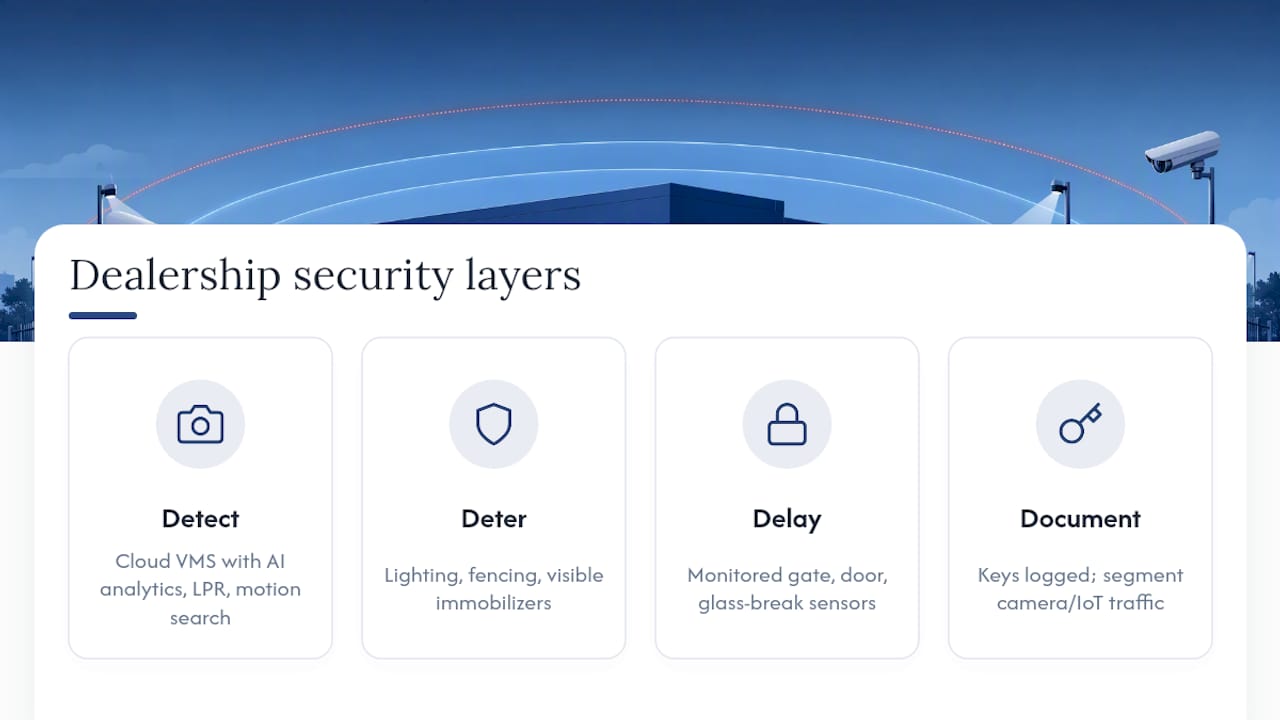
Car dealership security protects four categories of assets: vehicles on the lot, keys and fobs, parts and customer property, and the data your cameras and systems generate. A working program rests on four pillars: detect, deter, delay, and document.
The stakes are real. FBI crime data tracks motor vehicle theft trends that dealerships can use to benchmark local risk. A lot holding dozens of unattended, keyed vehicles overnight is a denser target than almost any other retail environment.
Legacy alarms and DVR cameras record what happened. Modern systems verify what’s happening in real time, which cuts false dispatches and gives investigators usable evidence instead of grainy footage from a hard drive nobody checked in months.
- Vehicles: theft, joyriding, and vandalism of unattended inventory
- Keys: unlogged checkouts that let a single missing fob become a stolen car
- Parts and tools: overnight service-bay losses
- Data: camera feeds and customer records exposed by weak network hygiene
Core Components Of A Dealership Security System
Technology does the heavy lifting, but only when the pieces are chosen deliberately rather than bolted on one at a time.
Video surveillance. A cloud-capable video management system (VMS) with AI analytics, line-crossing alerts, loitering detection, and license-plate capture turns cameras from passive recorders into active tripwires. Cloud-based VMS platforms with motion search cut the time managers spend hunting for the right clip after an incident. Prioritize cameras with strong low-light and wide dynamic range performance. A daytime walkthrough won’t reveal it, but glare and overexposure at night routinely make plates unreadable on cheaper cameras.
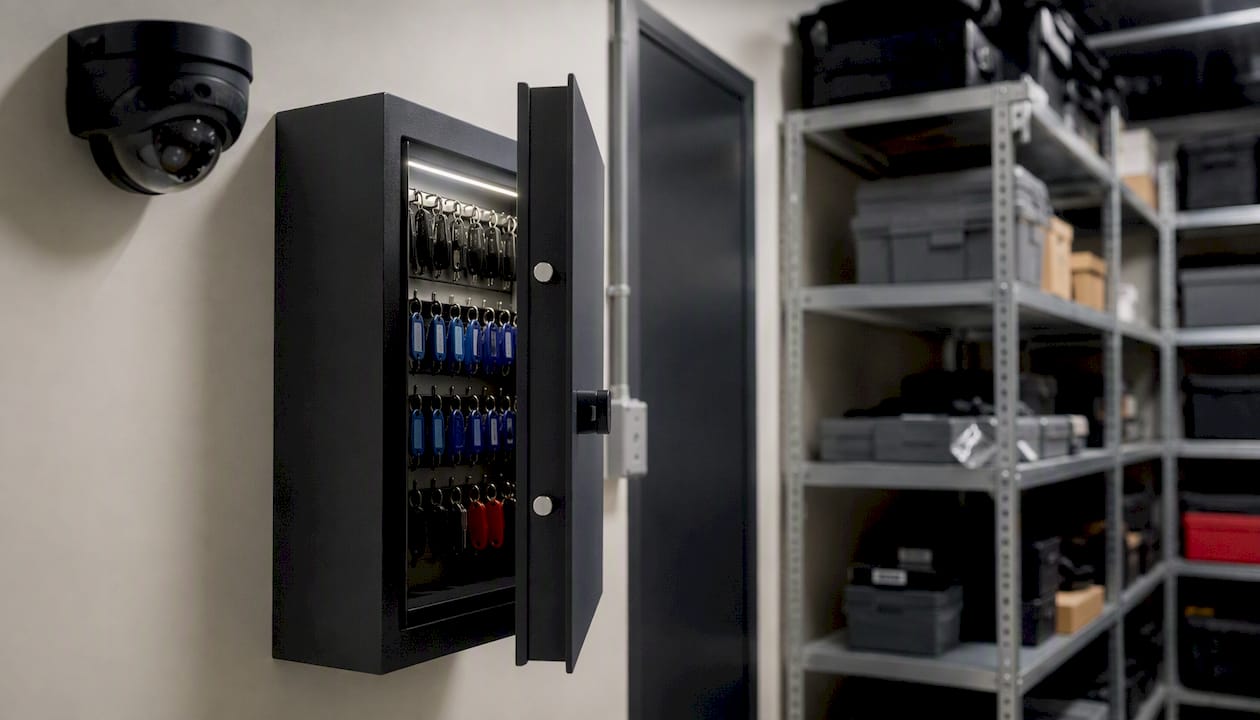
Key control. Electronic key cabinets that log every checkout, tied to staff credentials, close the single biggest gap in most lots. Integrated key management systems that snapshot the person taking a key at checkout give investigators and insurers a real chain of custody instead of a paper log nobody trusts.
Alarms and intrusion detection. Monitored gate sensors, door and window contacts, and glass-break or rollup-door sensors close the gap between a breach and a response.
Perimeter and physical measures. Lighting design, fencing, immobilizers on high-value stock, and secure parts storage matter as much as any camera. NHTSA’s guidance on vehicle-theft prevention points to immobilizers and secure key practices as measurable levers against theft.
Network basics. Segment camera and IoT traffic from your business network, patch firmware on a schedule, and treat customer data the way the FTC’s Safeguards Rule expects businesses handling financial information to treat it.
Pro Tip: Retain video for at least 30 days, longer if your insurer requires it for claims review. Storage is cheap compared to a disputed claim with no footage to back it.
Staffing Options: Guards, Patrols, Or Remote Monitoring?
The right mix depends on lot size, hours of operation, and how much visible deterrence you need versus how fast you need a response.
Onsite guards provide the strongest visible deterrence and immediate physical response, but they’re also the highest fixed cost and carry liability exposure if not properly trained and licensed.
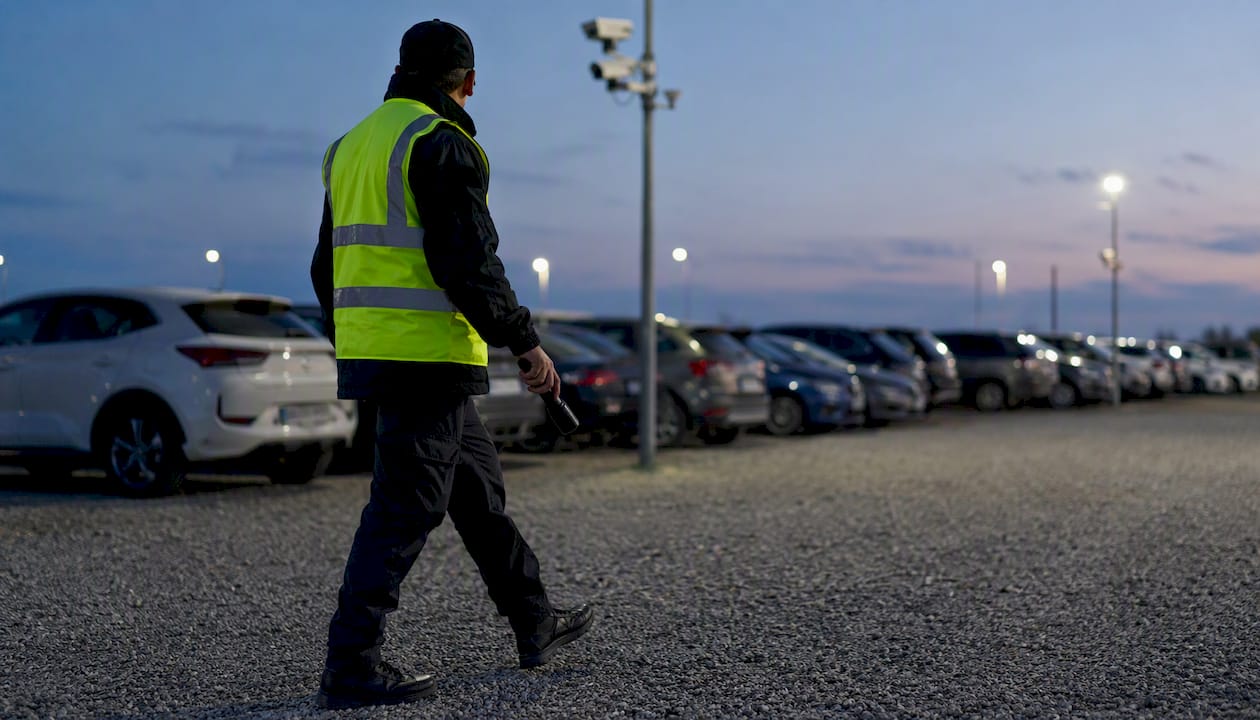
Roving patrols cover multiple properties or a large lot at lower cost than static guards, trading constant presence for periodic, visible passes that still deter opportunistic theft.
Remote or virtual guarding pairs monitored cameras with live agents who verify alerts and can issue voice warnings before dispatching anyone. It costs a fraction of overnight onsite staffing while still delivering a human response.
Wage levels are a major cost driver for onsite guards, and Bureau of Labor Statistics data shows meaningful regional variation, plus a premium for armed versus unarmed roles and certification requirements.
Most dealerships land on a hybrid: remote monitoring overnight when the lot is empty, roving patrols in the early morning and late evening, and visible guards during peak business hours. That combination tends to deliver the best cost-to-deterrence ratio without paying for 24-hour static coverage nobody needs.
How Should Monitoring And Incident Response Work?
A dealership’s monitoring rules should specify what gets watched around the clock: entry gates, service bay doors, the key cabinet area, and any line-crossing zones around the lot perimeter.
- AI analytics flag motion, a line crossing, or an after-hours access attempt.
- A human monitor verifies the event on live video before anyone acts.
- If it’s real, a voice-down warning or remote deterrent (strobe, spotlight) is issued through the camera speaker.
- If the intrusion continues, the system escalates to onsite staff, a roving patrol, or local police.
That verification step is what separates modern monitoring from a noisy alarm that police learn to deprioritize. Outcome-based monitored video shifts security from after-the-fact evidence collection to stopping the event mid-act.
- Preserve original footage files, never just a screen recording of playback
- Log every person who accesses or exports evidence
- Share footage with insurers and police through a documented handoff, not an email attachment
Choosing A Dealership Security Provider
A vendor’s proposal tells you almost as much as the equipment it lists. Ask for a written monitoring service-level agreement, proof of device health reporting (so you know when a camera goes offline before an incident, not after), and references from other dealerships they currently serve.
Confirm the provider can integrate video, key control, and access control into one system rather than three disconnected logins. Ask directly how they handle evidence chain of custody, what their average verified-alarm response time is, and how they’ve reduced false dispatches for other clients. Guard staff should carry documented training and background checks; ask to see the training curriculum, not just a certificate.
Red flags: vague or usage-based pricing for video retention with no cap, unmonitored alarms sold as “monitored,” no device health dashboard, and no clear answer on how footage gets handed to police or insurers. If a vendor can’t explain their chain-of-custody process in one sentence, they don’t have one.
Rolling Out And Maintaining Your Security Program
A realistic rollout runs in phases, and skipping steps to save time is where most systems underperform for years afterward.
- Site survey, including a night-time lighting and camera-angle check
- Phased installation of cameras, key cabinets, and access control
- Integration testing across the VMS, key control, and alarm systems
- Staff training on key-checkout procedure and evidence preservation
- Go-live with a 30-day monitoring review
Ongoing maintenance keeps the system from decaying quietly:
- Monthly device health checks across cameras and sensors
- Quarterly coverage audit to catch new blind spots as lot layout changes
- Firmware updates on a fixed schedule, not ad hoc
- Re-check camera aim and lighting after any construction or landscaping change
Loop in your insurer and local police contact during rollout and again after any significant incident. Both relationships work better when they’re established before you need them urgently.
How Global Security Supports Dealership Security Needs
Global Security maps directly onto the components above: CCTV integration for AI-capable video and system health monitoring, Virtual Guard for remote verification and voice-down response, and guard services covering onsite staff, roving patrols, and executive protection for high-value inventory or high-profile events.
- CCTV design, installation, and ongoing maintenance
- Remote video monitoring (Virtual Guard) for overnight and off-hours coverage
- Licensed, trained guards and roving patrols
- Security training programs for staff and guard personnel
A site survey identifies your specific gaps before any proposal gets written.
Incident Response Planning And Crisis Management
A written incident response plan turns a chaotic first ten minutes into a controlled sequence. Without one, staff freeze, evidence gets mishandled, and the wrong people get called first.
Start with a clear chain of command: who makes the call to contact police, who notifies ownership, and who’s authorized to speak to media or customers if a break-in becomes public. Post this chart where night staff and managers can find it without hunting.
Build separate protocols for the incident types you’re actually likely to face: after-hours break-ins, daytime armed robbery, vandalism discovered at opening, and a lost or stolen key that could mean a vehicle is missing. Each protocol should specify the first three actions, in order, not a general “call security” instruction.
Crisis management extends beyond the immediate event. Decide in advance how you’ll communicate with customers if their vehicle in for service was damaged or stolen, how you’ll document the timeline for insurers, and who preserves footage before it’s overwritten by your retention cycle. A rushed export of the wrong 20 minutes of video, done after the fact instead of immediately, is a common and preventable failure.
Run a tabletop drill twice a year. Walk staff through a fake break-in scenario and time how long it takes them to find the right footage, lock down the key cabinet, and reach the right person. Gaps show up fast in a drill and cost far less to fix there than during a real incident.
Integrating Security With Dealership Operations And IT
Security systems that live in isolation from daily operations create blind spots and duplicate work. A key cabinet that doesn’t talk to your dealer management system means a sales manager still tracks test-drive keys on paper while the electronic log sits unused.
Integration works best when access control ties into existing employee schedules and roles, so a terminated employee’s badge and key-cabinet credentials get revoked the same day, not weeks later during a routine audit. Camera feeds should route to the same network segment your service department and sales floor rely on for daily operations, but on a separate, secured subnet, not the flat network everyone shares.
That segmentation matters more than most owners assume. Connected automotive systems and IoT security devices expand the attack surface any dealership network carries, and a camera or key cabinet running outdated firmware on the same network as customer financial data is a real liability, not a theoretical one. Component-level security architecture used in modern connected vehicles reflects the same principle dealerships should apply to their own networks: isolate what’s sensitive, and update it on a schedule.
Practical integration checklist:
- Sync access-control permissions with HR onboarding and termination
- Put cameras, key cabinets, and alarms on a segmented network, not the main office LAN
- Set a firmware update schedule for every connected device
- Give managers a single dashboard for video, key logs, and alarm status instead of three separate logins
Legal And Regulatory Compliance For Dealership Security
Dealership security decisions carry legal weight that goes beyond catching a thief. Guard licensing requirements vary by state, and hiring an unlicensed guard or contracting an unlicensed patrol company can expose a dealership to liability if that guard is involved in a use-of-force incident.
Customer data captured by license-plate recognition cameras, financing applications, and service records falls under data-protection expectations similar to those the FTC’s Safeguards Rule sets for businesses holding consumer financial information. That means access controls on who can view stored footage and customer records, encryption where it’s feasible, and a documented retention and deletion policy rather than footage sitting indefinitely on an unsecured drive.
Employment law also touches security staffing. Armed guard contracts typically require proof of firearms certification and liability insurance specific to armed roles, and dealerships should confirm a security vendor carries that coverage rather than assuming it.
Local ordinances on lighting, fencing height, and signage for monitored premises vary by municipality, and some jurisdictions require posted notice when video surveillance is active on a commercial property. Check local requirements before installing exterior lighting or perimeter cameras, since a compliant system in one state can run afoul of a different city’s rules a few counties over.
Work with legal counsel to review guard contracts, video retention policies, and data-sharing agreements with monitoring vendors at least once a year, since regulations in this space shift more often than most owners expect.
Risk Assessment Methods For Car Dealerships
A useful risk assessment starts with mapping assets by value and exposure, not by treating every part of the lot as equally at risk. High-value inventory near unlit perimeter fencing carries a different risk profile than economy vehicles parked under a lit canopy near the showroom.
Walk the property at night, not just during business hours. A lighting audit conducted after dark frequently reveals glare, dead zones, and unreadable license plates that a daytime inspection would never catch, because the problems only exist once the sun goes down.
Score each vulnerability by two factors: how likely it is to be exploited, and how costly the loss would be if it were. A gap in service-bay access control might be less likely to be targeted than the main lot, but a single missing key from that gap can result in one stolen vehicle. Rank fixes by that combined score, not by whichever fix is cheapest to implement first.
Review theft and vandalism trends specific to your region using data like FBI motor vehicle theft statistics, and compare that against your own incident history over the past two to three years. A dealership with no recent incidents in a low-crime area still needs baseline controls, but the urgency and budget allocation should reflect actual local risk, not a generic industry checklist applied uniformly everywhere.
Reassess annually, and immediately after any incident, expansion, or change in lot layout. Risk profiles shift when new inventory arrives, a service bay gets relocated, or a neighboring property changes hands.
Insurance Implications Of Dealership Security Measures
Insurers price dealership policies partly on the strength of the security measures in place, and a documented program can materially affect premiums and claims outcomes. A lot with monitored alarms, logged key control, and retained video evidence presents a lower risk profile than one relying on a single unmonitored camera and a trust-based key drawer.
Claims move faster and pay out with fewer disputes when there’s clear evidence. Key management systems that capture a snapshot at checkout give insurers a chain of custody that removes ambiguity about who had access to a vehicle before it went missing, which shortens the back-and-forth that stretches out contested claims.
Ask your insurer directly what security measures qualify for premium discounts. Many carriers reduce rates for monitored alarm systems, documented key control, and retained video with a defined retention period, but the specific requirements vary by carrier and aren’t always advertised upfront.
Share your incident response plan and monitoring provider’s credentials with your insurer during renewal, not just after a claim. Insurers that understand your program in advance tend to process claims faster because they’re not evaluating your security posture for the first time during a dispute. Keep documentation of every system upgrade, since insurers may ask for proof that specific measures were active at the time of a loss.
What The Field Actually Teaches About Dealership Security
Most installs fail quietly during acceptance testing, not during the sales pitch. Managers should insist on a live night-time walkthrough before signing off, checking every camera angle and light for glare or dead zones the daytime demo never revealed.
The one fix owners skip most often: locking down key-cabinet access logs from day one. It’s the cheapest control and the one insurers and investigators lean on hardest.
Get A Site Survey From Global Security
Global Security is the alternative to piecing together a security plan from three or four separate vendors. Instead of a standalone camera installer, a separate alarm monitoring company, and a staffing agency for guards, Global Security integrates CCTV, key control coordination, Virtual Guard remote monitoring, and licensed guard staffing under one team of former law enforcement and military professionals.

That single-vendor approach means one point of contact for device health, one chain of custody for evidence, and one team accountable for response times instead of finger-pointing between providers when something goes wrong. Whether your priority is overnight remote monitoring, roving patrol coverage, or a full CCTV integration project, the starting point is the same conversation.
Request a site survey and Global Security will walk your lot, day and night, and return a proposal built around your actual gaps rather than a generic package. Get started with Global Security to schedule that first assessment.
Sources
- Bureau of Labor Statistics — Occupational Employment and Wages, Security Guards and Gaming Surveillance Officers
- NHTSA — Vehicle theft prevention
- Federal Trade Commission — Safeguards Rule
- FBI — Crime in the U.S. 2018: Motor vehicle theft