
A business emergency plan must protect people first and restore critical operations second, and the immediate action is to secure leadership sponsorship and assemble a cross-functional planning team. That team, guided by OSHA minimum requirements and Ready planning templates, turns a stack of good intentions into a document people can follow under pressure.
TL;DR:
- Conduct a thorough hazard assessment and develop a risk register that prioritizes risks based on likelihood, impact, and dependencies on external systems.
- Ensure your emergency plan includes clear reporting, evacuation, accountability, and incident command procedures, with designated backups for each role.
- Perform brief, focused business impact analyses to set realistic recovery time and data loss objectives, accounting for supply chain and partnership vulnerabilities.
- Regularly train staff and conduct drills across all levels, updating plans based on debriefs and organizational changes to maintain operational readiness.
- Maintain and review financial, contact, and resource documentation, along with external support resources, to ensure swift response and recovery during actual emergencies.
Table of Contents
- Identify Your Hazards Before You Write a Single Procedure
- What Every Emergency Action Plan Must Include
- Running a Business Impact Analysis That Sets Realistic Targets
- Emergency Response Actions Your Team Can Follow Under Stress
- Building Communication Channels That Survive a Real Emergency
- Keeping Training and Exercises on a Real Schedule
- Keeping the Plan Current So It Stays Useful
- A One-Page Skeleton You Can Fill in Today
- Supporting Employees Through the Aftermath of an Emergency
- Planning for the Financial Side of an Emergency
- Why a Plan Only Works if You Practice It
- How Global Security Supports Your Emergency Planning Effort
- Sources
- FAQ
Identify Your Hazards Before You Write a Single Procedure
Every credible plan starts with a hazard map, not a template. List natural hazards (fire, flood, severe weather), technological hazards (power loss, IT failure, hazardous material release), and human-caused hazards (theft, workplace violence, cyber intrusion), then rank each by likelihood and operational impact.
- Score each hazard on likelihood and impact so leadership can see which risks deserve budget first.
- Map dependencies on suppliers, utilities, and IT systems that could turn a small disruption into a full stoppage.
- Build a risk register listing an owner, a mitigation step, a probability rating, and the residual risk that remains after mitigation.
- Pull data from local sources, including your regional emergency management office and any documented history of incidents at your site.
This register becomes the backbone of everything that follows, from evacuation procedures to your business impact analysis.
What Every Emergency Action Plan Must Include
OSHA’s 1910.38 sets the floor for what a written emergency action plan must contain, and Ready.gov’s guidance builds on it with practical detail. A compliant plan needs these pieces at minimum:
- Reporting procedures that tell employees exactly how to report a fire or other emergency.
- Evacuation policies and exit assignments covering every work area, including procedures for employees who must stay behind to shut down critical operations before leaving.
- Accountability procedures to confirm all employees have evacuated safely, along with rescue and medical duties assigned to specific, trained individuals.
- Names or job titles of people employees can contact for more information or clarification of duties.
- Incident command structure with a named leader, a clear line of succession, floor wardens, and assembly-point monitors.
- Protective action definitions so staff understand the difference between evacuation, shelter-in-place, and lockdown before an incident forces the choice.
- Appendices with site maps, contact lists, supplier agreements, and IT recovery contacts kept current and attached to the master document.
Pro Tip: Assign a named backup for every role in your incident command structure, because the person you count on most is often the one traveling when the alarm sounds.
Running a Business Impact Analysis That Sets Realistic Targets
A business impact analysis does not need to take weeks. A focused two-hour workshop with department leads can identify your critical processes, name an owner for each, and expose single points of failure that would otherwise surface only during a real outage. From there, Ready.gov’s guidance recommends setting recovery time objectives and recovery point objectives, meaning how long a process can be down and how much data loss is tolerable, for example a four-hour RTO for order processing versus a 24-hour RTO for archived records.
- List continuity options such as manual workarounds, alternate worksites, telework arrangements, data backups, and supplier redundancy.
- Rank each critical process by how quickly it must resume before the business suffers material harm.
- Confirm supplier and landlord agreements cover emergency access, alternate delivery routes, and communication during a disruption.
The ILO’s SME continuity guidance frames these decisions around People, Processes, Profits, and Partnerships, a reminder that your building can be untouched and you can still be unable to operate if a single supplier goes dark.
Emergency Response Actions Your Team Can Follow Under Stress
Scripted, short steps beat long policy prose when adrenaline is running high. Each hazard in your risk register deserves its own numbered sequence:
- Fire: Activate the alarm, evacuate by the nearest safe exit, and account for everyone at the assembly point.
- Medical emergency: Call for help, send someone to guide responders to the location, and begin first aid only if trained.
- Severe weather: Move to the designated shelter area and stay clear of windows and exterior walls.
- Chemical release: Evacuate upwind and uphill, and notify responders of the substance involved if known.
- Active threat: Follow the run, hide, fight sequence taught in your training and call 9-1-1 when safe to do so.
When reporting to 9-1-1 or local responders, give the exact address, the nature of the emergency, and the number of people involved before answering further questions. Ready.gov’s emergency response guidance notes that the first minutes matter most, which is why decisions about activating your emergency operations center and drafting a simple incident action plan should already be pre-scripted rather than improvised.
Roll call matters as much as the evacuation itself. Someone must own the roster, including visitors and contractors signed in that day, because an incomplete headcount is the single most common failure point in real evacuations.
Building Communication Channels That Survive a Real Emergency
A plan is only as strong as the alerts that trigger it. Redundant channels matter because any single system, an alarm, an app, or a phone tree, can fail exactly when you need it most.
- Layer your channels: physical alarms, SMS mass notification, a phone tree, and PA announcements should all point to the same instructions.
- Draft message templates in advance, one for the initial alert and one for a 24-hour follow-up update, so no one is writing under pressure.
- Share site plans and access details with local fire and police departments before an incident, not during one.
- Test contact lists quarterly so a stakeholder list built two years ago does not fail you when a supplier or employee has moved on.
Clear, compliant signage around assembly points and evacuation routes, the kind detailed in facility signage guidance, reduces confusion when people are moving fast and reading little.
Keeping Training and Exercises on a Real Schedule
A plan that lives in a binder and never gets rehearsed is a liability disguised as a document. Build a training matrix and stick to it:
- All staff receive annual orientation on reporting procedures and evacuation basics.
- Emergency team members receive first aid and CPR certification along with warden-specific training.
- Exercises rotate through orientation, tabletop, functional, and full-scale formats, with tabletop exercises run at least annually and full-scale drills less frequently but on a fixed calendar.
- Corrective actions from every exercise or real incident get logged, assigned an owner, and tracked to closure.
Involving suppliers and local responders in at least one exercise a year exposes gaps that internal drills alone will miss.
Pro Tip: Treat every drill debrief as a working session, not a formality, because the gaps people notice five minutes after an exercise are the ones that matter most in a real event. Programs like executive protection training can sharpen these skills for staff who carry emergency-team responsibilities.
Keeping the Plan Current So It Stays Useful
A plan that reflects last year’s staff and last year’s suppliers will fail you exactly when you need it. Store a controlled electronic master copy, keep printed binders in your emergency operations center, and maintain a backup on a secure USB drive.
- Review triggers include personnel changes, new technology, supplier changes, completed exercises, real incidents, and facility renovations.
- Assign an owner for each section of the plan and for tracking corrective actions to completion.
- Track simple readiness metrics, including the date of your last exercise and the share of staff who have completed training.
ISO 22301 frames continuity as an ongoing management system rather than a static document, which means the plan only earns its value when leadership commits to reviewing and improving it on a fixed schedule.
A One-Page Skeleton You Can Fill in Today
You do not need fifty pages to start. A one-page emergency action plan skeleton with labeled fields, hazard, reporting contact, evacuation route, assembly point, and accountability owner, gives your team something usable while the fuller document takes shape.
- Evacuation accountability checklist: who brings the roster, who monitors the assembly point, and how the all-clear gets communicated.
- BIA scorecard fields: process name, impact if down, target RTO, and key dependencies.
- Official templates from Ready.gov’s business continuity plan cover program administration, BIA inputs, and maintenance guidance you can adapt directly.
| Field | Example entry |
|---|---|
| Hazard | Severe weather |
| Reporting contact | Facility manager, extension — |
| Evacuation route | Stairwell B to north lot |
| Assembly point | North parking lot, lane 3 |
| Accountability owner | Shift supervisors |
Supporting Employees Through the Aftermath of an Emergency
The plan does not end when the all-clear sounds. Employees who lived through a fire, a violent incident, or a serious accident often need support that goes beyond a debrief memo. Build a simple protocol into your plan: identify who checks in with affected staff in the days following an incident, and know in advance where to refer someone who needs more than a conversation, whether that is an employee assistance program, a local counseling service, or a company-sponsored benefit.
Managers should be briefed on basic signs of acute stress so they know when a quiet, capable employee needs a nudge toward help rather than a return-to-work date. Reassigning duties temporarily, offering flexible scheduling, and simply acknowledging what happened in a team meeting can matter more than any formal program.
Keep a short list of external resources, crisis hotlines, counseling providers, and employee assistance contacts, in the same appendix as your emergency contact list, because searching for that information after the fact wastes time people do not have. Revisit this section after any incident that involved injury, violence, or a serious scare, since the response you planned on paper rarely matches what people actually need once the adrenaline fades.

Planning for the Financial Side of an Emergency
An emergency plan that never mentions money leaves a gap that surfaces fast once the immediate danger passes. Review your business insurance coverage before you need it: property damage, business interruption, cyber liability, and general liability policies each respond differently, and knowing your deductibles and coverage limits in advance saves confusion during a claim.
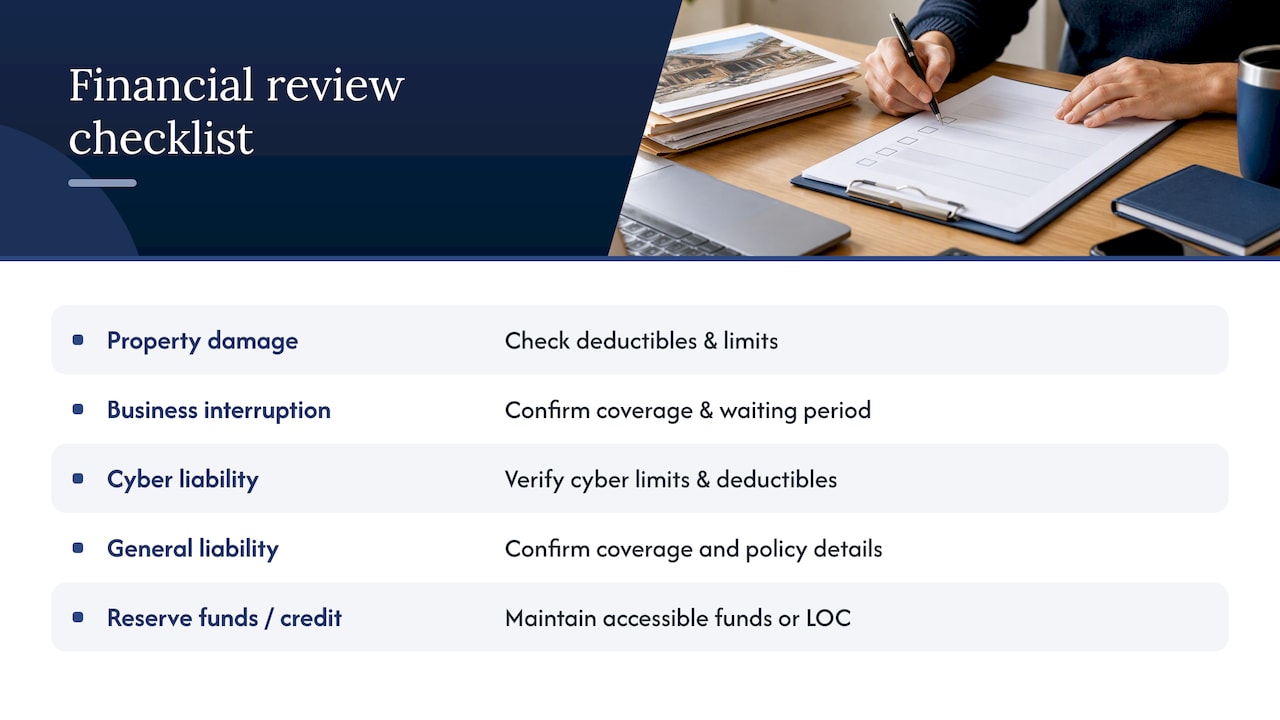
Keep policy numbers, agent contacts, and a summary of coverage in your plan’s appendix alongside your other emergency contacts. Maintain a reserve of accessible funds or a pre-arranged line of credit to cover payroll and urgent repairs while a claim is processed, since insurance payouts rarely arrive within days.
Document your critical financial records, banking relationships, and vendor payment obligations so that whoever manages recovery is not starting from a blank page. A supplier agreement that lapses because an invoice went unpaid during a crisis creates a second emergency on top of the first. Coordinate with your accountant or financial advisor before an incident occurs so decisions about emergency spending authority are already agreed upon rather than debated in the moment.
Why a Plan Only Works if You Practice It
The plans that fail are rarely missing sections. They fail because no one ran a drill, updated the contact list, or challenged the assumptions behind an RTO that was never tested against reality. Treat the document as an operating capability, not paperwork, and revisit it every time your business changes. Firms that train security and response personnel see the same pattern: readiness comes from repetition, not from the binder itself. Start with leadership sponsorship and a two-hour BIA session this month.
— Alston
How Global Security Supports Your Emergency Planning Effort
Some businesses build their entire plan in-house, and that is the right call when leadership has the time and the internal expertise to run risk assessments and drills consistently. Others reach a point where hiring outside support makes more sense, particularly for threat assessments, on-site monitoring, or training that requires law enforcement and military-trained instructors.
- Threat assessments identify vulnerabilities a planning team may not catch on its own.
- Virtual Guard remote monitoring extends coverage without adding full-time headcount.
- On-site guard services and roving patrols provide a visible layer of protection during heightened risk periods.

If your plan needs a professional set of eyes, Global Security’s guard services team can walk through your site and your risk register together to identify where hired security fits your plan.
Sources
- 1910.38 – Emergency action plans. | Occupational Safety and Health Administration
- Ready
- ISO 22301 business continuity management — BSI
- Small and medium enterprise tool for business continuity — ILO
FAQ
Can you provide an example of a business emergency plan?
A basic example pairs an evacuation procedure with a business continuity section: reporting steps, an assembly point, an accountability process, and a business impact analysis setting recovery targets for critical processes. Ready.gov’s business continuity template provides a full structure you can adapt to your own operations.
What are the 7 requirements of an emergency plan?
Under OSHA 1910.38, a written plan must cover reporting procedures, evacuation policies and exit assignments, procedures for employees who remain to operate critical equipment, post-evacuation accounting, rescue and medical duties, and the names or job titles of plan contacts. These elements form the regulatory floor on which most business plans build beyond.
What are the 5 components of an emergency plan?
Common components include hazard identification, protective action procedures such as evacuation and shelter-in-place, communication and notification plans, roles and incident command, and training with regular exercises. Definitions vary slightly by organization, but these five threads run through most official guidance, including Ready.gov’s planning framework.
What are the 4 C’s of emergency management?
There is no single, universally recognized “4 C’s” framework in official emergency management guidance, so definitions vary by source. Businesses are better served focusing on the documented elements in OSHA’s standard and Ready.gov’s planning steps rather than an informal acronym.