
A bodyguard provides close personal protection: a trained individual who stays near the principal and responds to immediate threats. Executive protection is a programmatic risk-management system that may include bodyguards but adds advance work, protective intelligence, and logistics planning. A one-off event or short trip usually calls for a bodyguard. Sustained, elevated, or reputational risk calls for a full executive protection program.
TL;DR:
- Executive protection programs include advance work, route surveillance, and contingency planning, reducing the likelihood of threats materializing in the first place.
- Qualifications for providers should include documented SOPs, threat assessments, and staff certifications in medical, firearms, and surveillance detection.
- Full programs encompass residential security, travel logistics, continuous monitoring, and communication planning, unlike narrow bodyguard services that focus on immediate threat response.
- Setting up a comprehensive program takes several weeks and involves detailed threat assessments, SOP documentation, and performance measurement protocols, with costs scaling alongside scope.
- Buyers should request sample threat assessments, SOPs, and performance metrics before contracting, emphasizing documented procedures over individual resumes for effective protection outcomes.
Table of Contents
- 1. How duties and outcomes differ between the two models
- 2. What training and credentials should you verify?
- 3. What services come with each coverage model?
- 4. What drives cost and how long setup takes
- 5. A decision checklist for choosing and contracting protection
- 6. How a mature provider builds these program elements
- 7. Where protection programs usually go wrong
- 8. How to start an engagement with Global Security
- FAQ
- Sources
1. How duties and outcomes differ between the two models
A bodyguard’s job centers on physical presence. The core responsibilities are close protection, visible deterrence, and immediate response to a threat as it happens. This is reactive by design: the guard reacts to what occurs in the moment, whether that means stepping between a principal and a crowd or escorting someone quickly out of a building.
Executive protection works further upstream. It combines protective intelligence, advance work, travel security, residential coverage, and medical contingency planning into a single coordinated system. Law enforcement policy documents that govern protective units describe this clearly: a municipal executive protection policy lists route surveys, venue advance work, surveillance detection, tactical medical readiness, and cover-and-evacuate planning as standard tasks for assigned personnel, not optional extras.
The outcome difference follows from that structure. A bodyguard reduces harm after a threat materializes. An executive protection program is built to reduce the odds that the principal ever reaches a confrontation in the first place, largely through intelligence gathering and route planning done before the principal arrives.
The ASIS Executive Protection Standard frames this as a shift from individual protective roles to an enterprise risk-management discipline, with documented risk assessment, governance, and resource planning as defining features of a mature program.
Several practical distinctions follow from that framing:
- A bodyguard typically works alone or in a small pair focused on the principal’s immediate space.
- An executive protection program coordinates multiple functions: intelligence, logistics, medical support, and communications.
- A bodyguard’s effectiveness is measured by response time and presence.
- A program’s effectiveness is measured by incidents avoided, not just incidents managed.
EP programs are increasingly treated as formal risk-management functions rather than ad-hoc protective assignments, according to ASIS benchmarking research. That shift matters for buyers deciding whether a single hire or a structured program fits their actual exposure.
2. What training and credentials should you verify?
Individual competence and organizational maturity are two separate questions, and buyers often check only the first.
For individual operators, confirm these baseline qualifications:
- Current certification in first aid and tactical medicine, since medical response is often the first few minutes that matter most.
- Firearms qualification appropriate to the jurisdiction and assignment, with documented renewal dates.
- Evasive and defensive driving training for any role involving transport.
- Surveillance detection training, which distinguishes someone trained to notice a developing threat from someone trained only to react to one.
Organizational maturity is a different check entirely. Ask whether the provider has written standard operating procedures, a governance structure for decision-making during an incident, defined performance measures, and a reporting cadence for ongoing engagements. A long individual resume does not substitute for program documentation. The ASIS standard treats this distinction as central: evaluate the organization’s capability, not just the operator’s history.
Red flags include a provider who cannot produce a sample threat and risk assessment, cannot describe their SOPs in specific terms, or gives vague answers about training frequency and equipment standards.
Pro Tip: Ask every candidate provider for one redacted sample document, whether a training log, an SOP excerpt, or a past advance-work report, before signing anything.
3. What services come with each coverage model?
Buyers often assume “security” means one fixed package. In practice, the two models deliver very different scopes.
A full executive protection program typically includes:
- Advance work at venues and along travel routes before the principal arrives.
- Residential and family security planning, not just coverage during public appearances.
- Travel planning and secure transport coordination, including contingency routing.
- Ongoing protective intelligence monitoring between engagements.
- Communications planning so the detail, the principal, and support staff stay coordinated.
A bodyguard-only engagement is narrower by design: a close personal detail, venue-specific security during a single event, and in-the-moment response if something goes wrong. There is no advance work beyond a basic walkthrough, and coverage typically ends when the event or trip does.
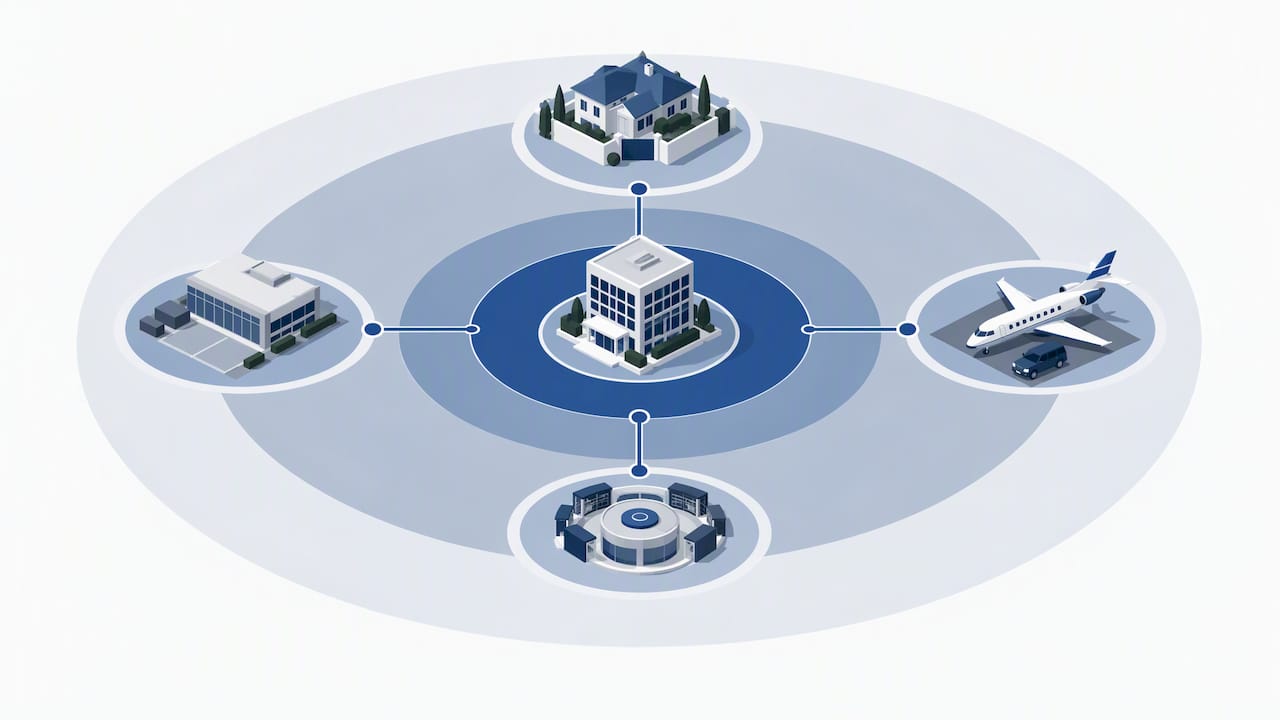
Team structure scales with the model. A two-person close-protection team can cover a single event or a short trip. A full protective detail, the kind an executive protection program runs, adds residential teams, advance teams, and rotating shift coverage for round-the-clock protection. Global Security’s executive protection services are built around this tiered structure, scaling from single-detail coverage to full residential and travel programs depending on the client’s exposure.
4. What drives cost and how long setup takes
Cost follows scope, not headcount alone. The main drivers are staffing hours, whether coverage runs 24/7, the geographic scope of travel, the depth of advance work and intelligence gathering, and any vehicles or medical support attached to the detail.
Timelines vary just as widely. A single-event bodyguard detail can be arranged in days. A full executive protection program, including a documented risk assessment and written SOPs, typically takes several weeks to stand up properly.
Buyers should expect two common pricing structures:
- Hourly or day rates for bodyguard-only or short-term event coverage.
- Program retainers for ongoing executive protection that bundles staffing, intelligence, and logistics into one fee.
A recurring gap in the industry, per ASIS benchmarking research, is that many EP programs lack consistent KPIs or incident-response protocols. That gap is exactly what a buyer’s contract should close before money changes hands.
5. A decision checklist for choosing and contracting protection
Start with a written threat and risk assessment before discussing staffing or price. A usable assessment names coverage boundaries, escalation criteria, a communications plan, and triggers for review, not just a general statement that risk exists.
Use this sequence to decide and contract:
- Assess threat, exposure, and consequence together. A single public appearance with low exposure often needs only a bodyguard. Sustained public visibility, prior threats, or high-value assets usually justify a full program.
- Request the provider’s standard operating procedures in writing, not described verbally.
- Confirm advance-work deliverables: route surveys, venue diagrams, and medical contingency plans with named accountable roles.
- Verify insurance and liability coverage specific to protective services, not general business liability.
- Ask how the provider measures performance: incident logs, reporting cadence, and defined KPIs.
The ASIS standard treats this kind of documentation as the baseline for evaluating a program, not an optional add-on. Buyers evaluating a provider for the first time can also review practitioner resources like the ISCG executive protection knowledge base for the standard tiers of coverage providers typically offer.
Pro Tip: Treat the first briefing as a document request, not a sales call: if a provider cannot produce a sample TRA or SOP on request, that alone answers the vetting question.
6. How a mature provider builds these program elements
A provider meeting ASIS-level program expectations needs more than trained staff. Global Security’s protection services are led by personnel with law enforcement and military backgrounds, and the company pairs on-site detail work with Virtual Guard remote monitoring to extend intelligence and surveillance coverage between physical assignments.
Those capabilities map onto the program elements buyers should expect:
- Governance and documented procedures, supported by leadership with operational law enforcement and military experience.
- Advance-work and intelligence capacity, extended through remote monitoring rather than relying solely on on-site staff.
- Training depth, delivered through executive protection training programs covering firearms, tactical response, and protective procedures.
Buyers evaluating any provider, including Global Security, should request sample training records, a redacted threat and risk assessment, and an SOP excerpt before contracting.
7. Where protection programs usually go wrong
The most common procurement mistake is treating a long individual resume as proof of program capability. A skilled bodyguard does not automatically mean a documented, governed protection program exists behind them.
Three corrections fix most of this. Insist on a written threat and risk assessment before any staffing discussion. Request sample SOPs in writing, not a verbal summary. Ask how the provider reports performance and handles incident review.
The difference shows up in outcomes: a reactive guard responds well after something happens, while a coordinated program’s advance work often means the confrontation never develops.
— Alston
8. How to start an engagement with Global Security
Readers comparing a single bodyguard against a full program do not have to choose blind. Providers can build both: standalone guard services for event or short-term coverage, and full executive protection programs for sustained or elevated risk, each customized to the client’s actual exposure rather than a fixed package.

An initial briefing with any provider, including Global Security, should produce a written threat and risk assessment, sample SOPs, a proposed staffing model, and a clear pricing structure before any contract is signed. Teams drawn from law enforcement and military backgrounds typically build these documents as part of onboarding rather than treating them as optional paperwork.
Relevant services to request information on include:
- Executive Protection for sustained coverage, estate security, and travel programs.
- Guard Services for event-specific or short-term bodyguard coverage.
- Virtual Guard remote monitoring to extend surveillance between physical shifts.
- Threat assessment and executive protection training for organizations building internal capability.
Contact Global Security to request a briefing and a written threat and risk assessment for your specific situation.
FAQ
How much do you get paid to be a bodyguard for the president?
Pay for protective roles tied to a head of state is not publicly listed in a way that applies consistently across countries or agencies. Compensation depends on the employing agency, rank, and jurisdiction, and is not standardized across the industry.
Is it hard to get into executive protection?
Breaking into executive protection typically requires stacking credentials: first-aid and tactical medical certification, firearms qualification, defensive driving training, and often a law enforcement or military background. Providers increasingly look for candidates who understand protective intelligence and advance work, not just physical presence, which raises the bar compared to entry-level guard roles.
How much does executive protection cost?
Executive protection pricing is not publicly standardized because it depends heavily on scope: staffing hours, 24/7 coverage, travel distance, and the depth of advance work and intelligence gathering. Programs are typically priced through a retainer structure rather than a flat rate, while single-event bodyguard coverage is usually billed hourly or by the day.
How much do Taylor Swift’s bodyguards get paid?
Specific compensation figures for individual celebrity protective details are not publicly listed. Public figures with sustained, high-profile exposure typically contract full executive protection programs rather than single bodyguards, given the scale of advance work and travel coordination required.
What is the main difference between a bodyguard and executive protection?
A bodyguard provides close personal protection focused on immediate physical response, while executive protection is a coordinated program that adds advance work, protective intelligence, and logistics planning around that close protection. The ASIS Executive Protection Standard frames the program version as an enterprise risk-management discipline rather than a standalone protective role.
Sources
- Introducing the ASIS Executive Protection Standard: A New Era in Organizational Risk Management
- NOPD Chapter: Executive protection of city officials (policy excerpt)
- Executive Protection knowledge resource (ISCG)