
The priority for any hospital right now is a documented workplace violence prevention program paired with layered engineering, administrative, technical, and human controls. This approach protects staff, patients, and visitors while keeping electronic protected health information secure and care operations running during an incident.
TL;DR:
- Hospitals should implement layered communication systems, including mass notifications and silent alarms, with regular testing and backup channels to ensure reliable incident response.
- A workplace violence prevention program built on management commitment, site analysis, hazard control, training, and ongoing evaluation is essential to address high-risk areas effectively.
- Physical design features such as secure reception counters, safe rooms, and lighting upgrades help reduce risks without hindering patient care or access.
- Access control policies should balance security and welcoming environments by using layered zones, visitor screening, and staff-escort procedures, with regular badge audits.
- Surveillance and monitoring systems must be strategically placed, integrated with access logs, and supported by trained staff to facilitate quick investigations and incident resolution.
Table of Contents
- 1. Emergency response and notification systems
- 2. Workplace violence prevention program built on OSHA’s five building blocks
- 3. Engineering and physical controls that reduce risk without blocking care
- 4. Access control and visitor management that still feels welcoming
- 5. Surveillance, monitoring, and technical safeguards that support investigations
- 6. Staffing, patrols, and clearly defined security roles
- 7. Training, de-escalation, and a reporting culture without blame
- 8. Incident response, drills, and coordination with local law enforcement
- 9. Protecting ePHI when physical security incidents occur
- 10. A 90-day implementation checklist and the evidence to collect
- Security as a people-first program
- How we support hospitals putting these practices in place
- FAQ
- Sources
1. Emergency response and notification systems
A hospital cannot respond to a threat it cannot announce. Mass notification systems, overhead paging, duress alarms, and silent panic buttons each serve a different moment in an incident, and most hospitals need several working together rather than one system doing everything.
- Mass notification platforms push alerts to phones, desktops, and digital signage at once, useful for facility-wide lockdowns.
- Overhead paging (PA codes) reaches patients and visitors who have no device, though it depends on everyone recognizing the code.
- Duress and silent alarms let staff signal for help without alerting an aggressor, critical in exam rooms and behavioral health units.
- First-responder kits, including floor plans, master keys, and camera access, speed up law enforcement response once they arrive.
Every system should map to current floor plans and tie into the hospital’s operations center so staff can confirm a threat’s location in seconds. CISA’s physical security guidance recommends facility-wide alert systems and coordination with local law enforcement as core preparedness steps, alongside designated safe locations staff can reach quickly.
Redundancy matters as much as the primary system. If the main notification platform depends on Wi-Fi, a cellular or radio backup keeps communication alive during an outage. Test every channel on a fixed schedule, log the results, and keep those records on file for surveyors and insurers.
Pro Tip: Run regular silent drills where staff confirm receipt of a test alert without disrupting patient care, then log response times to spot gaps before a real event does.
2. Workplace violence prevention program built on OSHA’s five building blocks
Hospitals report higher rates of serious workplace violence than private industry overall, which is why OSHA’s roadmap for healthcare facilities structures prevention around five building blocks rather than a single policy document.
- Management commitment and employee participation. Leadership funds the program and frontline staff help shape it, since nurses and techs see hazards administrators do not.
- Worksite analysis. Walk every unit, review incident logs, and flag high-risk areas like the emergency department, psychiatric units, and overnight pharmacy windows.
- Hazard prevention and control. Apply the fixes the analysis surfaces, from better sightlines to revised staffing during peak violence hours.
- Safety and health training. Teach de-escalation and warning-sign recognition to every role that interacts with patients and visitors, not only security staff.
- Recordkeeping and program evaluation. Track incidents, near misses, and corrective actions, then revisit the program on a set schedule.
A multidisciplinary committee, pulling in clinical leads, facilities, HR, and security, tends to catch hazards a security-only review misses, since nurses notice workflow friction that creates flashpoints long before an incident occurs. Meet monthly in high-risk units and quarterly elsewhere, and bring incident data to each session.
Recordkeeping is not paperwork for its own sake. An incident review board that examines every reportable event, documents root cause, and assigns a corrective action turns scattered reports into a feedback loop. Store meeting minutes, corrective action logs, and training completion records together so the program’s progress is easy to demonstrate during a regulatory review or accreditation survey.
3. Engineering and physical controls that reduce risk without blocking care
Physical design does quiet work that no policy can replace. A reception desk with a clear sightline down the main corridor lets staff see a problem developing before it reaches the waiting room, and a nurse station built with a barrier height that still allows eye contact keeps the space functional for patients while adding a layer of separation.
- Secure reception counters with reinforced glass in high-traffic entry points, paired with a clear view of the parking area.
- Safe rooms or duress zones near behavioral health and the ED where staff can retreat during an escalating encounter.
- Furniture selection that avoids heavy, throwable objects in exam rooms and waiting areas prone to agitation.
- Lighting upgrades across parking structures, loading docks, and exterior walkways, since poor lighting is a recurring factor in after-hours incidents.
- Mirrors and signage at blind corners and stairwells to reduce ambush points without adding staff.
Exterior environment matters as much as interior layout. WHO and ILO guidance on workplace violence in health settings points to environmental interventions and workflow changes, such as shorter waiting times, as cost-effective ways to reduce tension before it escalates into violence.
Deciding where to add physical barriers comes down to a tradeoff between security and accessibility. Clinical areas with controlled populations, such as psychiatric wards or medication rooms, justify hardened barriers. Public-facing areas like lobbies and cafeterias need softer controls, since an overly fortified entrance can make patients and families feel unwelcome at the moment they are most vulnerable.
4. Access control and visitor management that still feels welcoming
Layered access zones give hospitals a way to open some areas widely while locking down others. A typical structure runs from public zones (lobbies, cafeterias) through semi-restricted zones (patient floors) to restricted zones (pharmacy, NICU, server rooms), each with its own credentialing requirement.
- Badge policies should require visible ID for all staff and time-limited visitor badges tied to a specific patient or appointment.
- Visitor screening at a single main entrance after hours reduces the number of unmonitored access points.
- Escort requirements for contractors and vendors entering restricted zones, logged by name and time.
- Exception handling for compassionate circumstances, such as end-of-life visits outside normal hours, should have a documented fast-track process rather than an ad hoc decision at the door.
Policy language can hold both goals at once: “All visitors must check in and receive a visible badge; staff may grant reasonable exceptions for compassionate circumstances with charge nurse approval.” That single sentence protects the perimeter without turning every grieving family member into a security problem.
Pro Tip: Audit badge-reader logs regularly for repeated after-hours entries by the same credential, a common early indicator of tailgating or shared badges.
5. Surveillance, monitoring, and technical safeguards that support investigations
Camera placement should follow traffic patterns and risk, not just available wall space. Entrances, parking structures, pharmacy corridors, and the ED waiting room deserve coverage with minimal blind spots, while patient rooms and restrooms remain off-limits under most privacy rules, with clear signage wherever recording occurs.
- Entrances and parking areas first, since these generate the highest volume of unauthorized-access attempts.
- Blind-spot testing after any renovation or furniture change, since a single relocated cart can create a new gap.
- Retention schedules that balance storage cost against the realistic window for a complaint or investigation to surface.
- Chain-of-custody logs for any footage pulled for an incident review, so the recording holds up if it is needed later.
Onsite monitoring staff can act immediately on what they see, which matters in a busy ED. Remote monitoring services, sometimes called Virtual Guard models, extend coverage to overnight hours or secondary buildings at a lower marginal cost than adding headcount, and work best as a complement to onsite staff rather than a full replacement. We maintain CCTV integration and monitoring services built around this kind of layered coverage. A partner resource on security camera design for medical centers covers placement and hardware choices in more technical detail for teams planning a system refresh.
Integrating video with access-control logs and alarm triggers turns three separate systems into one timeline, which shortens investigation time considerably when an incident review board needs to reconstruct what happened.
6. Staffing, patrols, and clearly defined security roles
Patrol frequency should match risk levels, with higher risk areas like emergency departments and behavioral health units receiving more frequent rounds and checklists, while a quiet administrative wing can run on a longer interval.
- Tiered patrol schedules that assign the highest frequency to the ED, behavioral health, and maternity units.
- Per-shift checklists covering door alarms, camera function, and lighting, signed and timestamped at handoff.
- Defined roles, including a security supervisor, a clinical liaison for behavioral escalations, and a threat-assessment team lead.
- Mobile logging so patrol records, timestamps, and photos sit in one searchable system instead of a paper binder.
A clear line of authority matters during an escalating event. Staff need to know, without hesitation, who calls the lockdown and who coordinates with arriving police. Our guard services are staffed by personnel with law enforcement and military backgrounds, which shapes how we structure these reporting lines for hospital clients.
Documented patrol evidence, timestamped and stored centrally, becomes the backbone of an accreditation review or an after-incident investigation, since it shows what was checked, when, and by whom.
7. Training, de-escalation, and a reporting culture without blame
Training only works when it reaches every role that touches a patient or visitor, not just the security team.
- De-escalation training for clinical and front-desk staff, refreshed at least annually.
- Warning-sign recognition covering verbal and behavioral cues that precede an escalation.
- Role-based response training, so a nurse knows what to do differently than a security officer during the same event.
- Multidisciplinary drills that include registration staff, housekeeping, and food service, since an evacuation or lockdown touches everyone in the building.
Drills should test communication systems, not just evacuation routes. A tabletop exercise that stalls because half the staff never got the mass notification alert reveals a real gap worth fixing before the next real event.
Reporting culture determines whether warning signs ever reach decision-makers. A confidential reporting pathway, separate from a disciplinary process, encourages staff to flag a tense interaction before it becomes an incident. Triage reports within a set window and share the resolution back with the reporting staff member, since silence after a report discourages the next one.
Pro Tip: Close the loop within 48 hours on every reported concern, even a minor one, since a documented response is what sustains staff trust in the system.
8. Incident response, drills, and coordination with local law enforcement
A written incident response plan needs clear, rehearsed procedures for lockdown, shelter-in-place, and reunification, each with a named decision-maker and a communication script.
- Lockdown procedures specifying who can issue the order and how it reaches every unit simultaneously.
- Shelter-in-place protocols for events outside the building that still require staff and patients to stay put.
- Reunification plans for family members separated from patients during an evacuation.
- After-action reviews following every drill and every real incident, with findings tracked to a specific corrective action.
Annual operational walk-throughs with local police and fire departments build the relationships that matter most in the first minutes of a real event, when responders need to know the building layout before they arrive. CISA’s healthcare security guidance recommends this kind of ongoing coordination alongside designated safe locations and access controls at entrances.
After-action reviews should preserve evidence, including camera footage and access logs, before routine retention schedules overwrite them, and should include support resources for staff who were directly involved.
9. Protecting ePHI when physical security incidents occur
A lockdown or evacuation cannot be allowed to cut off access to the patient records a care team needs mid-shift. HHS Security Rule guidance on technical safeguards requires measures that keep ePHI both protected and available.
- Unique user IDs for every system user, so access can be traced to a specific person.
- Emergency access procedures that let authorized staff reach records during a crisis without waiting on a help desk.
- Automatic logoff on idle workstations, especially in shared nursing stations.
- Encryption for data at rest and in transit.
- Audit controls that log who accessed what, and when.
HHS’s technical safeguard standards are built to be flexible and scalable rather than prescriptive, which means a hospital can size these controls to its own systems while still meeting the Security Rule’s requirements.
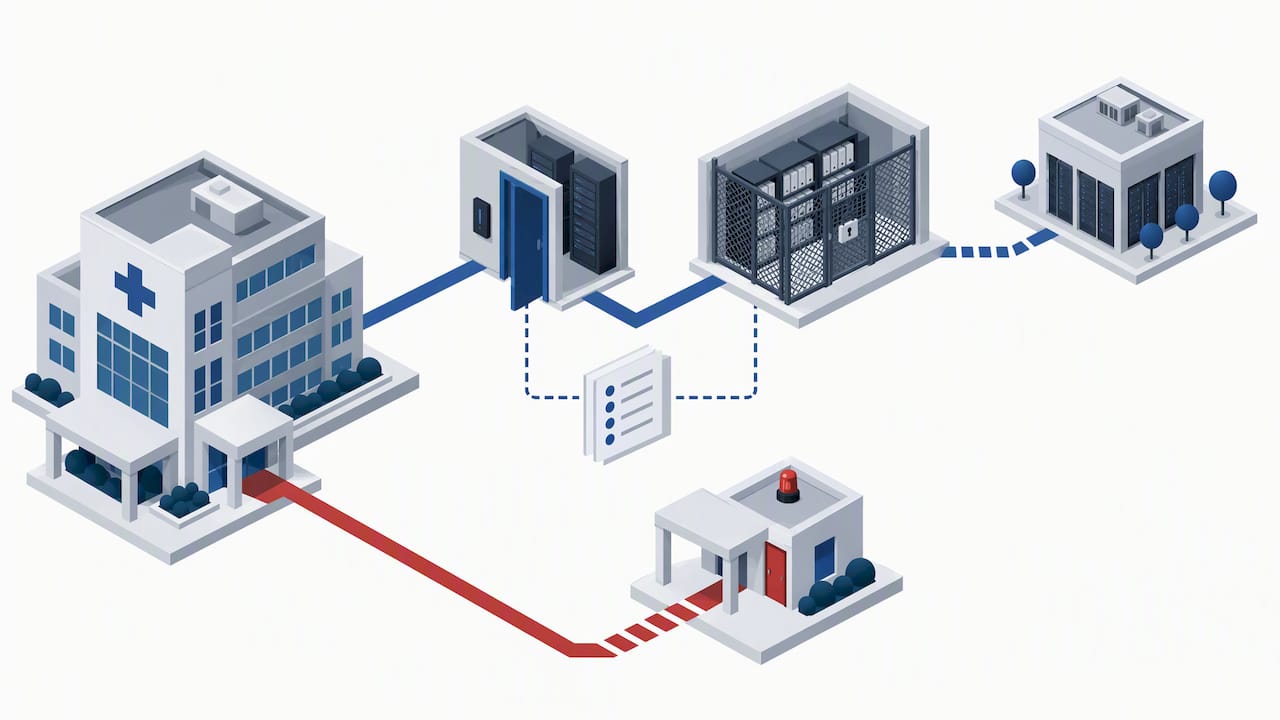
Physical security and IT safeguards intersect directly in server rooms, device carts, and discarded media. A locked server room with its own access log is a physical control doing a technical safeguard’s job. Continuity planning, including offsite backups and a tested emergency access procedure, keeps records reachable even when the primary system or building access is disrupted.
10. A 90-day implementation checklist and the evidence to collect
The first 90 days should produce visible progress, not just a plan on paper.
- Weeks 1 to 4: Complete a facility-wide risk assessment and stand up the multidisciplinary committee.
- Weeks 5 to 8: Test mass notification across all channels, launch staff training, and fix the highest-risk physical gaps identified in the assessment.
- Weeks 9 to 12: Run a full CCTV triage against the risk assessment, complete the first incident review board meeting, and document every milestone.
| Evidence to collect | Purpose |
|---|---|
| Signed walkthrough notes | Shows physical hazards identified and resolved |
| Committee meeting minutes | Demonstrates multidisciplinary governance |
| Training rosters | Confirms staff completed required sessions |
| Alarm and notification test logs | Proves systems function and are maintained |
Each item on this list should map back to an authoritative anchor, such as OSHA’s workplace violence roadmap, IAHSS guidelines, or the HIPAA Security Rule, so an accreditation reviewer can trace every control back to its source.
Deciding between onsite guards and remote monitoring often comes down to coverage gaps rather than an either-or choice. Overnight hours and secondary entrances frequently suit a remote monitoring model, while high-traffic daytime zones like the ED benefit from a visible onsite presence.
Security as a people-first program
A camera system or a badge reader never stops an incident on its own. What actually protects a hospital is the culture behind the hardware: a multidisciplinary committee that keeps meeting, a reporting pathway staff actually trust, and controls tailored to how a specific unit really operates rather than copied from a generic checklist.
Hospital leaders who treat security as a people program first and a technology purchase second tend to see fewer incidents, because staff feel safe enough to report the small warning signs before they become large ones. That balance, protecting staff without making patients feel surveilled, is the harder and more important job.
— Alston
How we support hospitals putting these practices in place
We build hospital security plans around the same layered approach this article describes: a site risk assessment first, then a prioritized set of fixes your team can act on within 90 days.

A typical engagement with our team starts with a walkthrough of your facility, followed by a written plan covering staffing recommendations, camera coverage gaps, and access-control priorities. From there, we can deploy guard services staffed by personnel with law enforcement and military backgrounds, extend coverage overnight through our Virtual Guard remote monitoring, and handle CCTV integration for systems that need a refresh.
- Site risk assessment with a written, prioritized action plan.
- Guard services and roving patrols sized to your highest-risk units.
- Threat assessments for specific patients, visitors, or locations of concern.
- Training programs covering de-escalation and role-based response.
Reach out through our guard services page to schedule a site assessment and get a prioritized plan built around your facility.
FAQ
What are the 5 C’s in security?
Different organizations define the 5 C’s slightly differently, so there is no single hospital-wide standard. In practice, hospital security programs are better anchored to OSHA’s five building blocks: management commitment, worksite analysis, hazard control, training, and recordkeeping.
What are three responsibilities of a hospital security guard?
Hospital security officers typically patrol high-risk units on a set schedule, respond to duress alarms and escalating patient or visitor behavior, and maintain access control at entrances and restricted zones. Responsibilities vary by facility size and the specific role structure a hospital adopts, as outlined in IAHSS’s industry guidelines.
What is the 3-day rule in hospitals?
This term is not a recognized security or regulatory standard, and its meaning varies depending on context, such as billing or clinical admission rules unrelated to physical security. We recommend confirming the specific policy a given hospital or payer means by this phrase before acting on it.
What’s a code 7 in a hospital?
Hospital overhead codes are not standardized nationally, so “code 7” means different things at different facilities, from a security assist to an internal operational signal. Every hospital should publish its own code list clearly and train all staff, including non-clinical roles, to recognize it.
How often should hospitals test their emergency notification systems?
Emergency notification systems should be tested regularly on a fixed, documented schedule, covering every channel including paging, mass notification, and backup communication methods. CISA’s physical security guidance recommends facility-wide alert systems as a core preparedness measure, and test records should be kept for audit review.
Sources
- Preventing Workplace Violence: A Roadmap for Healthcare Facilities
- HIPAA Security Series #4 – Technical Safeguards
- Physical Security Considerations for Healthcare Facilities | CISA
- Healthcare Security Industry Guidelines (IAHSS)