
A use-of-force continuum is a policy and training framework that organizes force options, from officer presence through verbal commands, physical control, less-lethal tools, and deadly force, so that a response matches the threat in front of an officer. Models vary across agencies, and officers are not required to climb each rung in order if conditions demand otherwise. The framework exists to preserve life, keep force proportional, and build in accountability at every step.
TL;DR:
- Over 80% of agencies use some form of use-of-force continuum, but no single model has achieved universal acceptance, leading to diverse training approaches.
- Legal standards in the U.S. are anchored in the objective-reasonableness test and restrictions on deadly force against non-threatening suspects, shaping policy limits.
- Most agencies now emphasize de-escalation and communication, yet evidence shows inconsistent impacts on reducing use-of-force incidents.
- Training programs focus on scenario-based decision making and measurable behaviors, including medical aid and reporting, to improve officer judgment under stress.
- Continuous assessment and oversight are crucial, allowing officers to adapt actions dynamically, document rationale, and intervene when colleagues use excessive force.
Table of Contents
- Linear and Dynamic Models of the Force Continuum
- Legal and Human Rights Principles Behind Use-of-Force Policy
- The Five Levels of Force and What Each Looks Like in Practice
- De-Escalation Training and What the Evidence Actually Shows
- How Officers Apply Continuous Assessment on the Ground
- Jurisdictional Standards and the Case Law That Shapes Them
- Applying the Continuum in Training and Private Security Operations
- Why Policy, Training, and Oversight Have to Move Together
- FAQ
- Sources
Linear and Dynamic Models of the Force Continuum
Agencies have never agreed on a single design for the continuum, and that variation matters for how officers are trained and judged. The classic approach is a linear ladder: officer presence at the bottom, then verbal commands, empty-hand control, less-lethal weapons, and deadly force at the top, each step assumed to follow the one before it. Critics argue this structure can suggest a rigid sequence that does not match the chaos of real encounters, where a threat can escalate in seconds.
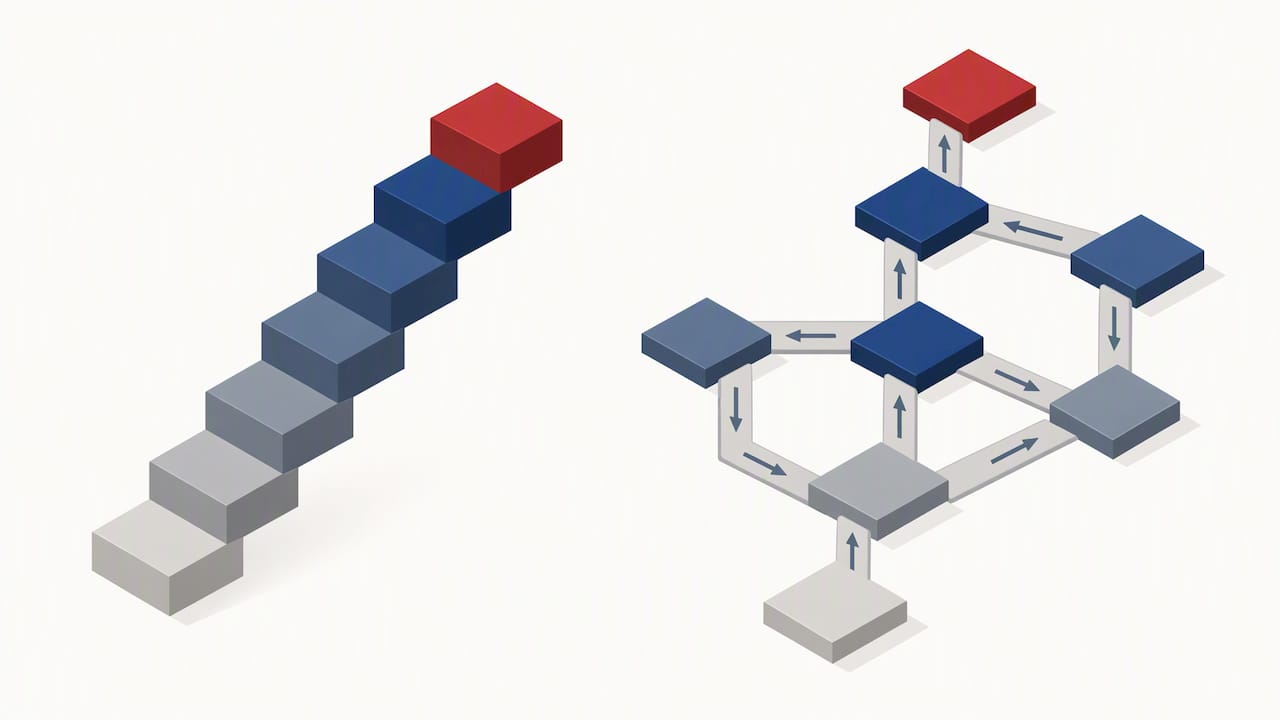
A growing number of agencies instead teach a dynamic, circular model built around a continuous assess, plan, act, and reassess cycle. This framing treats force options as overlapping choices rather than fixed steps, which better reflects how trained officers actually make decisions under pressure.
According to the National Institute of Justice, more than 80% of agencies in a national study used some form of continuum, but no single model was universally accepted among practitioners. That split explains why training programs differ so widely from one jurisdiction to the next:
- Linear ladder models offer simplicity for training and public explanation.
- Dynamic assess-plan-act models better match the fluid nature of real confrontations.
- Both approaches share the same underlying goal: match force to the threat actually presented.
Legal and Human Rights Principles Behind Use-of-Force Policy
Every credible use-of-force policy rests on a small set of principles that constrain what an officer or security professional can do, regardless of which model the agency teaches.
- Legality: force must have a lawful basis tied to a legitimate law enforcement or protective purpose.
- Necessity: force is used only when no reasonable alternative will achieve the lawful objective.
- Proportionality: the level of force must correspond to the severity of the threat, not exceed it.
- Precaution: officers plan and act to minimize risk and injury before force becomes necessary.
- Accountability: every use of force is documented, reviewed, and subject to oversight.
International guidance reinforces these same principles. The OHCHR Basic Principles on the Use of Force and Firearms require that lethal force be used only when strictly unavoidable to protect life, and that officers minimize injury and provide medical assistance once force is no longer necessary.
A decade ago, only a minority of agencies had required de-escalation in their policies, a figure that has since shifted dramatically according to the Stanford 2025 policy review, underscoring how fast this area of policy is moving. U.S. constitutional standards operate alongside these international norms, often setting a narrower legal floor than the human rights framework describes.
The Five Levels of Force and What Each Looks Like in Practice
Most continuum models group force options into recognizable categories, even when the diagram connecting them differs. Understanding what each level looks like in the field helps explain why training time is spent where it is.
- Officer presence: a uniformed officer or visible security presence that deters conflict before it starts, often paired with calm, clear verbal commands.
- Verbalization and de-escalation: specific, direct instructions and negotiation techniques intended to resolve a situation without physical contact.
- Empty-hand control: soft techniques like grips and holds, escalating to hard techniques like strikes, used to gain compliance or restrain a resisting subject.
- Less-lethal tools: batons, chemical irritants, and conducted energy devices (CEDs) that create distance or incapacitate briefly, carrying real risk of injury despite the “less-lethal” label.
- Deadly force: reserved for situations involving an imminent threat of death or serious bodily harm, governed by strict necessity and imminence requirements.
Security professionals and law enforcement officers alike train across every level, since a credible response depends on readiness to move fluidly between them rather than defaulting to the highest option available.
De-Escalation Training and What the Evidence Actually Shows
Modern use-of-force training rarely stops at physical technique. A well-built curriculum covers legal standards, scenario-based decision drills, communication and de-escalation skills, hands-on control tactics, medical aid, and the reporting steps that follow any use of force. The FLETC use-of-force training program combines legal instruction with classroom and scenario-based exercises so officers rehearse decisions under realistic pressure, not just in isolated drills.
De-escalation itself has become a policy standard faster than the evidence on its effects has caught up. The Stanford 2025 policy review found that de-escalation requirements grew from about 31% of analyzed policies in 2015-16 to 79% by the review’s data, yet definitions and outcome measures remain inconsistent across agencies. Experimental evaluations have shown improved communication skills without a clear, consistent drop in use-of-force incidents.
- Legal standards anchor every scenario to a defensible decision.
- Scenario-based drills build muscle memory for split-second judgment calls.
- Communication and control tactics are rehearsed together, not separately.
- Medical aid and reporting close the loop after any force event.
Pro Tip: Define de-escalation as a set of observable behaviors, like creating distance or slowing verbal pace, and rehearse those specific actions rather than treating “de-escalation” as a vague mindset.
How Officers Apply Continuous Assessment on the Ground
A use-of-force continuum only works as a living decision tool when officers treat it as a cycle rather than a checklist. The assess, plan, act, and reassess sequence repeats continuously throughout an encounter, and an officer can legitimately skip levels when a threat escalates faster than a step-by-step response would allow.
Documentation turns that judgment call into something reviewable after the fact. A solid report captures:
- The specific facts that supported the force level chosen, not just the outcome.
- Why lower-force alternatives were considered and ruled out as unsafe or ineffective.
- The subject’s behavior and any changes in threat level during the encounter.
- Medical attention provided and the timeline of events.
Every officer present also carries a duty to intervene if a colleague’s use of force exceeds what the situation requires, and most agencies now build multi-layered review into policy so no single use-of-force decision escapes oversight.
Jurisdictional Standards and the Case Law That Shapes Them
Legal standards for force differ by country, and even within the United States, domestic case law sets a different bar than international human rights guidance. Two cases anchor the American legal framework.
- Graham v. Connor established the objective-reasonableness test under the Fourth Amendment, judging an officer’s force against what a reasonable officer would have done given the totality of circumstances, not the officer’s actual intent.
- Tennessee v. Garner restricts deadly force against a fleeing suspect unless that suspect poses a significant threat of death or serious injury to the officer or others.
Agency policy frequently sets a higher bar than either case requires, since constitutional minimums describe what is legally permitted, not what a well-run organization considers acceptable. That gap between the legal floor and internal policy is where most meaningful reform actually happens.
Applying the Continuum in Training and Private Security Operations
Private security operations face the same proportionality and necessity questions that law enforcement does, just without the same constitutional framework governing every decision. Scenario-based training reduces cognitive overload during real incidents by giving personnel rehearsed decision patterns instead of forcing them to reason from scratch under stress.
- Repetition in realistic scenarios builds the judgment needed to select the right force option quickly.
- Medical aftercare and clear articulation of why a force level was chosen matter as much as the physical response itself.
- Reporting discipline protects both the client and the security professional when an incident is reviewed later.
Our executive protection training programs and broader global solutions training build these same assess-plan-act habits into the guard and protective teams we deploy, pairing legal grounding with the communication and control skills a real confrontation demands. For practical scripts on de-escalating a live confrontation, de-escalation techniques from reality-based training programs offer a useful complement to formal policy language.
Why Policy, Training, and Oversight Have to Move Together
A continuum on paper means little without measurable training and real oversight behind it. Policy has to specify observable behaviors, training has to rehearse them until they hold up under stress, and review has to be independent enough to catch failures before they repeat. Every update to that cycle should be driven by one question: does this change protect life and strengthen accountability.
— Alston
This article is general information, not a substitute for advice from a qualified lawyer. Consult a qualified legal professional about your own circumstances before acting on anything here.
FAQ
What is a use-of-force continuum in simple terms?
A use-of-force continuum is a policy and training framework that lines up force options, from officer presence to deadly force, so a response can be matched to the threat level an officer faces. Models vary by agency, and officers are trained to move fluidly between levels rather than follow a fixed sequence, according to the National Institute of Justice.
What are the five levels of the use-of-force continuum?
Most models group force into officer presence, verbalization, empty-hand control, less-lethal tools, and deadly force. Each level has its own training requirements and legal threshold, with deadly force reserved for an imminent threat of death or serious bodily harm.
What legal standard governs police use of force in the United States?
U.S. courts apply the objective-reasonableness test from Graham v. Connor, judging force against what a reasonable officer would do given the full circumstances. Tennessee v. Garner further restricts deadly force against fleeing suspects who do not pose a significant threat.
Does de-escalation training actually reduce use-of-force incidents?
Policy adoption of de-escalation requirements rose sharply, reaching 79% of analyzed policies according to the Stanford 2025 policy review, but the evidence on incident reduction remains mixed. Training that defines specific, measurable behaviors tends to perform better than programs that treat de-escalation as a general mindset.
Does Global Security provide use-of-force training for security personnel?
Yes, our executive protection training and firearm training programs build legal grounding, scenario-based decision-making, and control tactics into how our guard and protective teams respond on the job. These programs apply assess-plan-act principles covered throughout formal use-of-force policy.
Sources
- The Use-of-Force Continuum – National Institute of Justice
- Basic Principles on the Use of Force and Firearms by Law Enforcement Officials
- Graham v. Connor — Justia Supreme Court Center
- Police use-of-force policies across America — Stanford policy review (2025)
- FLETC use-of-force training program