
Layered physical security means stacking independent protective measures, perimeter, access control, detection, delay, response, and administrative controls, so that no single failure exposes an asset. The operational rule that governs every layer is simple: detection must happen before delay engages, and delay must hold long enough for response to arrive and act. Every design decision, from fence placement to guard deployment, gets tested against that one timeline.
TL;DR:
- Perimeter security should integrate sensors with the assessment system to trigger simultaneous alerts for fence cuts and intrusion detection.
- Access control decisions depend on whether credentials require frequent updates or detailed visitor tracking, with electronic systems favored for high-turnover sites.
- Surveillance systems must be chosen based on their assessment capability, with analytic tools flagging anomalies rather than replacing human judgment.
- Delay measures should be proportional to asset value and designed to withstand maintenance issues, with hardening focused on the most critical areas first.
- Response strategies should balance on-site, patrol, and remote options, with protocols tracking both communication and deployment times for effectiveness.
Table of Contents
- Perimeter Security: Goals and Practical Measures
- Access Control: Mechanical, Electronic and Procedural Layers
- Surveillance and Detection: Designing Assessment-Ready Sensor Networks
- Delay and Hardening: Increasing Adversary Task Time
- Response: On-Site Forces, Remote Monitoring and Coordinated Interventions
- Administrative Controls: Policies, Vetting, Training and Procedures
- Design and Evaluation Principles: Graded Approach, Balance and Timelines
- Implementation Checklist and Quick Wins for Facility Assessments
- Practitioner View: How Experienced Teams Deliver Layered Protection
- Author Perspective on Leadership Trade-Offs in Layered Security
- How Global Security Can Help
- FAQ
- Sources
Perimeter Security: Goals and Practical Measures
The perimeter’s job is to deter casual intrusion, define the protected boundary, and buy the time needed to detect an approach before it reaches the next layer. Vehicle barriers and standoff distance matter as much as the fence line itself, since a vehicle-borne threat can close distance faster than a person on foot.
- Fencing and gates should form a continuous barrier with no unmonitored gaps or blind corners.
- Lighting needs even coverage at entry points and along fence lines, not just bright spots near cameras.
- Vehicle barriers create standoff distance and should be rated for the threat the site actually faces.
- CPTED landscaping keeps sightlines open and removes cover near the fence line.
Redundancy matters here too: tie perimeter sensors into the same assessment system as cameras so a cut fence and a triggered alarm reach an operator together, not as separate, unconnected alerts.
Pro Tip: Walk the perimeter at night before finalizing lighting plans; daytime walkthroughs miss most of the blind spots that matter after dark.
Access Control: Mechanical, Electronic and Procedural Layers
Mechanical locks still make sense for low-traffic doors and backup hardware, but electronic access control earns its cost wherever you need an audit trail, scheduled permissions, or fast revocation. The decision usually comes down to how often credentials change and how much visibility you need into who went where.
- Mechanical locks work well for storage rooms, utility closets, and spaces with infrequent turnover.
- Electronic credentials fit high-traffic entries and any door where revocation speed matters.
- Key control audits should run on a fixed schedule, not only after an incident.
- Visitor management and escort policies close the gap that badges and locks cannot, since a stolen or borrowed credential still passes the reader.
Credential lifecycle discipline, issuance, periodic review, and immediate revocation on termination, does more to reduce insider risk than any single piece of hardware.
Surveillance and Detection: Designing Assessment-Ready Sensor Networks
Cameras and sensors exist to let a human or algorithm assess an alarm fast enough for delay and response to matter. Camera selection should start with the assessment task, not the spec sheet: resolution and frame rate only help if they let an operator confirm a threat at the distance and lighting conditions the site actually presents.
- Perimeter sensors detect approach early and should feed the same console as interior cameras.
- Interior sensors confirm presence once an outer layer has already been breached.
- Analytics should flag anomalies for a person to review, not replace human assessment entirely.
- Alarm confirmation workflows need a second data point, a camera, a motion sensor, before dispatch, to cut wasted responses.
Nuisance and false alarm rates are a real design constraint: poorly tuned systems that overwhelm operators with unnecessary alerts reduce the probability that a genuine intrusion gets caught in time, according to research on multi-layered security systems. Cyber-physical modeling work also suggests that critical sensors like fence detectors and cameras should sit in separate security zones so a single compromise cannot blind multiple channels at once, per Sandia’s 2026 cyber-physical architecture analysis. Facilities evaluating CCTV integration should weigh this zoning principle alongside camera placement.
Delay and Hardening: Increasing Adversary Task Time
Delay measures exist to buy the seconds or minutes that response forces need once detection has already confirmed a threat. The strongest designs work from the target outward: the vault, cage, or server room gets the heaviest hardening, while outer layers get proportionally less.
- Hardened doors and frames should match the asset’s criticality, not a blanket standard across the building.
- Window grills and ballistic film slow forced entry at points a fence cannot cover.
- Vaults and cages protect the highest-value assets and should be rated for a specific time-to-defeat.
- Vehicle standoff adds delay against ram-raid or vehicle-borne approaches.
Time-to-defeat is the metric that matters, paired against maintenance cost, since a barrier that is too costly to inspect regularly tends to degrade exactly where it counts.
Response: On-Site Forces, Remote Monitoring and Coordinated Interventions
Response closes the loop that detection and delay opened, and the choice between on-site guards, roving patrols, and remote monitoring comes down to deployment speed versus cost. On-site guard services give the fastest physical response time, while remote monitoring through a service like Virtual Guard extends coverage affordably across sites that cannot justify a full-time post.
- On-site guards offer immediate physical presence for sites with continuous risk exposure.
- Roving vehicle patrols provide a visible deterrent across multiple properties without the cost of a fixed post.
- Remote monitoring scales coverage for sites with lower continuous risk but still needs a fast escalation path.
- Police liaison and automated notifications shorten the gap between assessed alarm and arriving response.
Pro Tip: Track communicate time and deployment time separately. A fast dispatch call means little if the responding unit still takes ten minutes to arrive.
Administrative Controls: Policies, Vetting, Training and Procedures
Hardware and electronics only work as well as the people and procedures around them. Modern defense-in-depth treats administrative controls, staff vetting, visitor protocols, training, as a layer in its own right rather than an afterthought, according to Palo Alto Networks’ breakdown of defense-in-depth.
- Staff vetting and background checks reduce the risk a credentialed insider becomes the threat.
- Role-based access and segregation of duties limit how much damage any one compromised account can do.
- Visitor escorting and contractor change management close gaps that technology alone cannot.
- Scheduled drills and incident playbooks keep the response plan from existing only on paper.
Training that covers executive protection protocols or general security procedures should run on a recurring cycle, not a single onboarding session.
Design and Evaluation Principles: Graded Approach, Balance and Timelines
Every layer above only works if it is sized to an actual threat and tested against a real timeline, which is why the graded approach matters: protection should scale with asset criticality and a defined design-basis threat, not a one-size-fits-all standard, per the IAEA’s handbook on physical protection system design. Balanced protection means no single path into the facility is dramatically weaker than the others, since adversaries probe for the softest point, not the average one.
- Graded protection ties the strength of each layer to the value of what it protects.
- Redundancy prevents one failed sensor or door from compromising the whole system.
- Balanced paths close the gap an attacker would otherwise exploit around a hardened front door.
CISA’s facility security guidance frames this as applying multiple, balanced layers of detection and delay across every possible approach path, not concentrating resources on the one everyone assumes an intruder will use.
Detection must occur early enough, and delay must hold long enough, that response forces arrive and act before the adversary completes the task.
That single sentence, drawn from Sandia’s physical protection systems guidance, is the test every layer above should pass.
Implementation Checklist and Quick Wins for Facility Assessments
A short, disciplined review beats a long one that never gets finished. Start at the asset and work outward, since fixes closest to the target usually matter more than another coat of paint on the perimeter.
- Walk the site target-outward, starting at the most critical asset and noting every gap in delay and detection around it.
- Check lighting and camera fields for blind spots at entry points and fence lines.
- Audit credentials and keys against current staff rosters and revoke anything tied to former employees.
- Confirm alarm assessment workflows actually route to a person who can verify and escalate quickly.
- Schedule a drill within thirty days to test the response timeline under real conditions.
Short-term fixes, lighting, credential cleanup, cost little and close obvious gaps fast. Medium-term work, hardened delay points, sensor zoning, takes budget planning but closes the gaps that matter most.
Pro Tip: Track nuisance alarm rate and detection-to-response time after every change; a layer that looks stronger on paper but slows operator response has made the system weaker, not better.
Practitioner View: How Experienced Teams Deliver Layered Protection
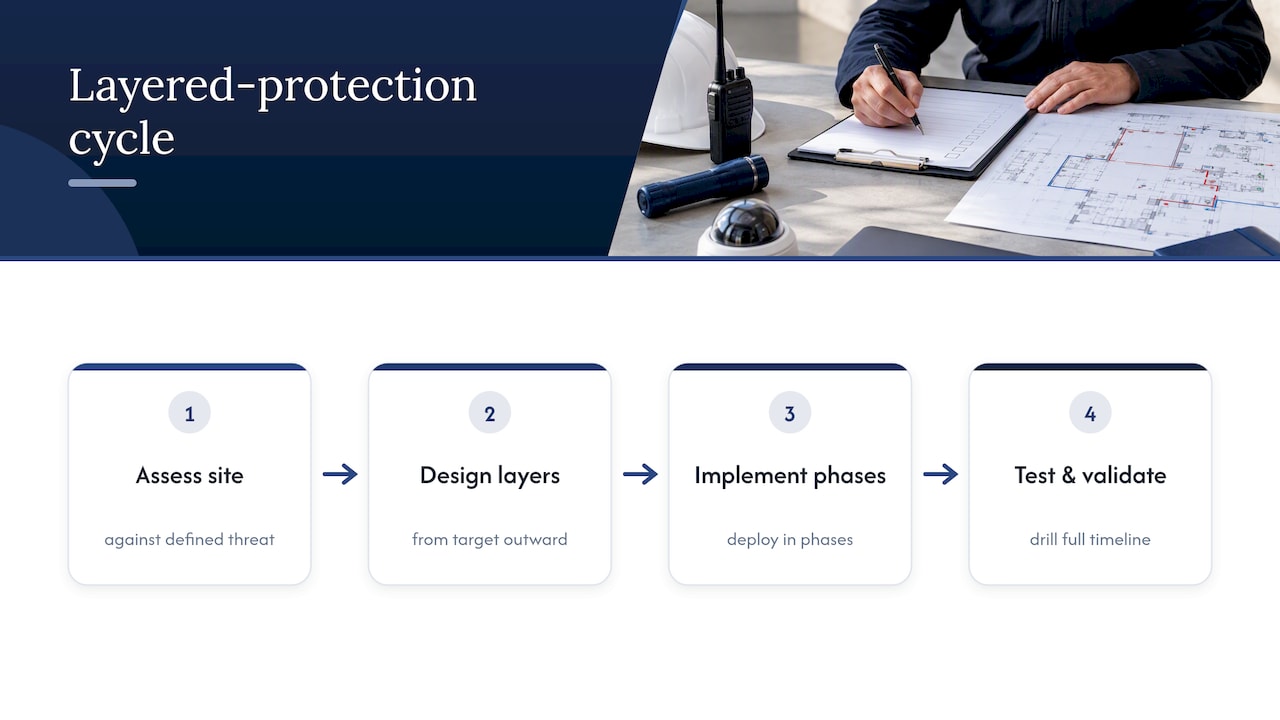
Teams that run guard services, roving patrols, Virtual Guard monitoring, and CCTV integration day to day tend to follow the same cycle: assess the site against a defined threat, design layers around the target outward, implement in phases, then test the whole timeline under drill conditions rather than assuming paper specs hold up. That testing step is where most assumed protection gets corrected before it matters.
Author Perspective on Leadership Trade-Offs in Layered Security
My honest read after years around this material: facilities overspend on hardware and underspend on people. A hardened door with no trained operator watching the feed behind it is a false sense of security. When presenting budgets to leadership, lead with the timeline, detection speed, delay duration, response time, not a list of equipment. Procurement that buys barriers before building the staffing and training to back them up is buying the wrong layer first.
— Alston
How Global Security Can Help
We design layered protection the way this article describes: target outward, tested against real timelines. Guard services, roving vehicle patrols, and remote monitoring cover the response layer, while CCTV integration work can tie detection into one assessment-ready system instead of disconnected cameras.

- Guard services and roving patrols give you visible, on-site response where continuous risk justifies it.
- Virtual Guard remote monitoring extends coverage to sites that cannot support a full-time post.
- Threat assessments identify exactly where your current layers fall short before you spend on fixes.
For readers who want vendor-level detail on camera and barrier installation, commercial security installation guidance covers the technical side well. For a layered plan built around your site, request a threat assessment and we will walk the property with you.
FAQ
What are the layers of physical security?
The common layers are perimeter security, building or site access control, surveillance and intrusion detection, delay and hardening measures, response forces, and administrative controls, as outlined in Wikipedia’s overview of physical security. Each layer buys time or reduces risk so the next layer has a better chance of stopping an intrusion before it reaches the target.
What are the 7 layers of security?
Practitioners often break the same framework into seven parts: deterrence, perimeter, access control, surveillance, intrusion detection, response, and administrative controls. The exact count varies by source, since some frameworks combine detection and surveillance into one layer, but the underlying detect-delay-respond structure stays consistent.
Why must detection happen before delay?
Delay measures only help once a credible assessment confirms a real threat is underway, so detection has to trigger first for delay to have any value, according to Sandia’s physical protection systems guidance. A hardened door that nobody is watching buys no real time at all.
How does Virtual Guard fit into a layered security plan?
Virtual Guard provides remote video monitoring that extends the response layer to sites that cannot support a full-time guard post. We offer it as part of a broader plan that also includes on-site guard services and roving patrols, available through our services overview.
What is the graded approach in physical security design?
The graded approach sizes each protective layer to the value of the asset it defends and the threat it faces, rather than applying one standard everywhere, per the IAEA’s handbook on physical protection system design. It keeps budgets focused on the assets that actually need the strongest layers.
Sources
Readers building or auditing a layered security program should consult the primary technical sources directly rather than relying on summaries. These cover design-basis threat methodology, performance-based protection system design, and evaluation metrics like nuisance alarm rate and detection timelines.
- Handbook on the Design of Physical Protection Systems for Nuclear Material and Nuclear Facilities (IAEA)
- CISA: Detect, Delay, Respond (facility security guidance)
- Defensive Cybersecurity Architecture Design using Cyber-Physical Modeling (Sandia, 2026)
- What is defense-in-depth? (Palo Alto Networks)