
Before any trip, confirm current destination risk by checking official travel advisories, secure required vaccines and medical or evacuation insurance, lock down devices with encryption and multi-factor authentication, and record emergency contacts including your company’s 24/7 line and the nearest embassy. These steps, grounded in guidance from the State Department, the CDC, and the IRS, form the foundation every business traveler and travel manager should confirm before departure.
TL;DR:
- Travelers should record all emergency contacts, confirm insurance coverage, and ensure documents like passports and visas are valid before departure.
- During transit, use tamper-evident locks, verified transportation, and limit time in open terminal areas to reduce theft and logistical risks.
- At destinations, choose secure hotels, avoid walking alone at night, and hide valuables to mitigate local risk factors and scams.
- Users should carry a fully encrypted device, avoid public Wi-Fi for sensitive tasks, and always report suspicious contacts or device issues promptly.
- In emergencies, prioritize personal safety, contact local authorities first, and follow escalation protocols to ensure a coordinated response.
Table of Contents
- Before you go: planning, documentation, and employer duty of care
- Airport and in-transit safety: baggage, screening, and transport choices
- At your destination: hotel safety, local movement, and situational awareness
- Health, vaccinations, and medical readiness for business trips
- Corporate travel safety programs: duty of care, tracking, and response plans
- Device and data security on the road
- If something goes wrong: immediate actions, consular help, and escalation
- After return: reporting, expenses, and lessons learned
- Why layered, employer-integrated travel safety works
- How Global Security supports corporate travel safety
- Sources
- FAQ
Before you go: planning, documentation, and employer duty of care
Preparation determines how a trip unfolds long before the plane leaves the ground. Every traveler should check the State Department’s Travel Advisory system, which rates destinations on a four-level scale from “exercise normal precautions” to “do not travel.” A Level 4 rating signals life-threatening risk and warns that consular assistance may be severely limited, so evacuation insurance and independent security planning matter more than usual in those locations.
Travel managers carry parallel responsibilities. Basic destination risk assessments, shared itineraries, and a reachable 24/7 contact are not optional extras. They are the backbone of duty of care.
- Enroll travelers in the State Department’s Smart Traveler Enrollment Program, or a corporate equivalent.
- Confirm passport validity, visa requirements, and keep both digital and hard copies of key documents.
- Schedule pre-travel health consultations and confirm employer coverage of recommended vaccines.
- Purchase supplemental travel and medical-evacuation insurance before departure, not after arrival.
Airport and in-transit safety: baggage, screening, and transport choices
Transit days carry the highest concentration of theft and logistical risk in any trip, largely because travelers are distracted, tired, and surrounded by strangers. A few habits reduce exposure without adding meaningful time to your day.
- Use tamper-evident locks and a luggage tracker, and keep passports, laptops, and cash in carry-on bags rather than checked luggage.
- Prebook airport transfers or use a verified ride-hailing service rather than hailing an unmarked vehicle curbside.
- Confirm the driver’s name and vehicle details against the app before getting in, and share your route and estimated arrival time with a colleague or family member.
- Limit time spent waiting in open terminal areas, especially during late hours, by timing arrivals to match your transport booking.
At your destination: hotel safety, local movement, and situational awareness
Where you stay and how you move through a city shapes your daily risk far more than any single dramatic event. Choose hotels with visible security staff, controlled entry, and solid guest reviews, and request a room above the ground floor but below upper floors to balance accessibility for emergency responders against street-level break-ins.
- Use the room’s secondary deadbolt or swing bar immediately on arrival and report any obvious lock or window defects to the front desk right away.
- Store passports, extra cash, and electronics in the in-room safe rather than luggage.
- Avoid walking alone during hours of darkness, and ask hotel staff or colleagues which neighborhoods and transport routes are considered safe.
- Skip visible displays of expensive jewelry, watches, or electronics, and avoid posting live location details on social media until after you have left a venue.
Scams targeting business travelers often start with a friendly stranger offering directions, a “special deal,” or unsolicited help with luggage. Politely decline and move on.
Pro Tip: Always test the secondary lock and scan the room for security gaps within the first five minutes of check-in, before you unpack.
Health, vaccinations, and medical readiness for business trips
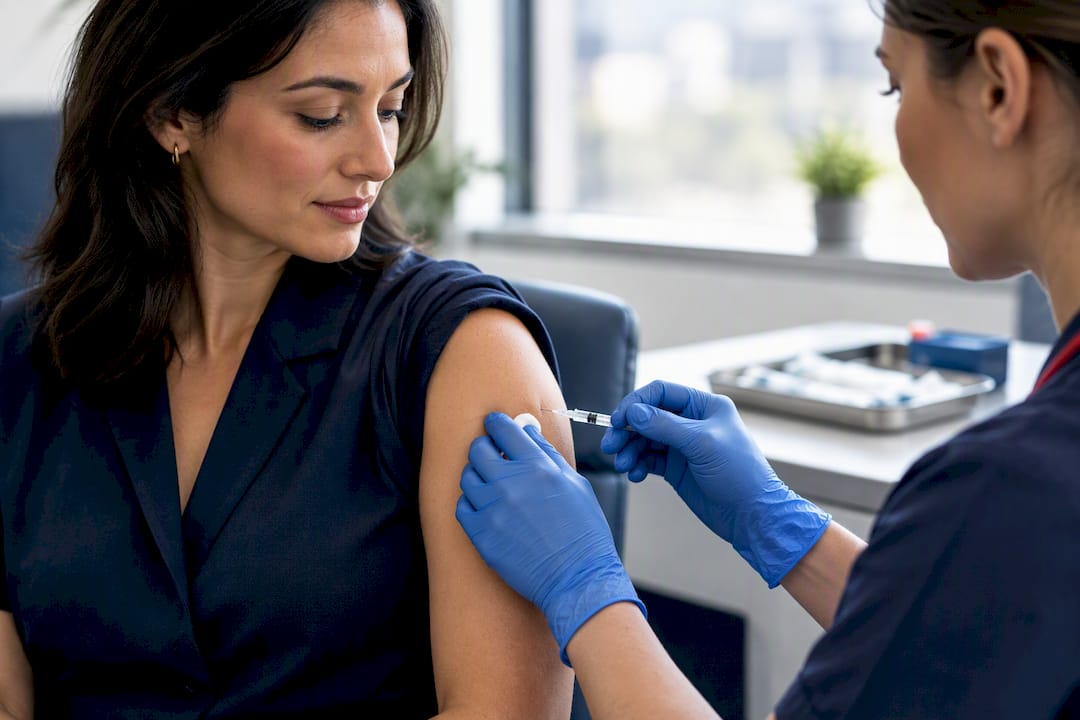
Health readiness is a business continuity issue, not a personal errand. The CDC Yellow Book recommends that employers cover vaccinations and prophylaxis for international business travelers, including routine shots like influenza and measles alongside destination-specific options such as yellow fever, Japanese encephalitis, or rabies depending on the itinerary.
Frequent travelers face cumulative exposure, and travel-medicine guidance suggests treating vaccination schedules as an ongoing program rather than a one-time task, since risk builds with repeated short trips even when a single trip would not otherwise warrant a full vaccine series.
- Carry a travel health kit along with extra doses of any prescription medication in original packaging.
- Plan medication dosing schedules around time zone changes before you leave, not after you land.
- Buy supplemental travel and medical-evacuation insurance and identify the nearest reputable medical facility at your destination in advance.
Corporate travel safety programs: duty of care, tracking, and response plans
A duty-of-care program only works if it is operational, not aspirational. Travel managers should maintain live itineraries with real-time location tracking and a staffed 24/7 emergency escalation number that travelers can reach from anywhere. Guidance on corporate travel safety emphasizes exactly this combination: visibility into where employees are, paired with a fast path to help.
- Standardize pre-travel briefings covering destination risks, local laws, and emergency procedures.
- Vet transport, lodging, and security suppliers before travelers arrive, not during a crisis.
- Require post-trip incident reporting, even for minor issues, to build an accurate risk picture over time.
- Integrate the travel policy with HR, insurance, and security teams so a single incident triggers one coordinated response instead of three disconnected ones.
Device and data security on the road
Business travel puts corporate data outside the office firewall, and that shift deserves the same seriousness as physical safety. The FBI’s guidance for business professionals traveling abroad outlines concrete steps for protecting devices and reporting suspicious contacts, particularly for travelers headed to high-risk regions.
- Require full-disk encryption, current operating system patches, and active antivirus on any device that leaves the office.
- Avoid public Wi-Fi for sensitive work; use a company VPN or a personal hotspot instead.
- For high-risk trips, carrying a temporary device loaded only with what the trip requires limits exposure if it is lost, seized, or tampered with.
- Never plug an unfamiliar USB drive into a company laptop, even one handed out at a conference.
Pro Tip: Treat hotel room Wi-Fi and business-center computers as public networks, never as private ones, regardless of how the property markets them.
If something goes wrong: immediate actions, consular help, and escalation
When a situation turns dangerous, the sequence of decisions in the first few minutes matters more than any plan made in advance.
- Prioritize personal safety above possessions. In a violent robbery, official safety guidance recommends surrendering valuables rather than resisting, since resistance raises the risk of injury.
- Contact local emergency services first, then your company’s emergency line, then the nearest embassy or consulate, using your Smart Traveler Enrollment Program registration if you have one.
- Follow your insurer’s and employer’s escalation protocol exactly, since evacuation coverage often depends on notification within a specific window.
- Document what happened as soon as it is safe to do so, since insurers and legal counsel will need a clear record.
After return: reporting, expenses, and lessons learned
The trip is not over when the traveler lands. A short debrief with HR or the security team turns one person’s experience into an update for the whole travel program, and any illness exposure deserves a follow-up medical check rather than a wait-and-see approach.
- Report incidents, near-misses, and health exposures promptly to improve overall travel safety, even if no harm occurred.
- Preserve receipts, mileage logs, and itineraries, since IRS Publication 463 requires documentation to substantiate deductible transportation, lodging, and meal expenses, particularly when a trip mixed business and personal time.
- Schedule any vaccine catch-ups and device security checks before the next trip is booked.
Why layered, employer-integrated travel safety works
Travel risk rarely announces itself in advance, which is why the strongest programs combine planning with real-world response capability rather than relying on either alone. Security firms led by former law enforcement and military professionals combine on-the-ground personnel with technology like virtual monitoring to provide both a plan and personnel to execute it.
— Alston
How Global Security supports corporate travel safety
Most companies build a strong pre-trip checklist and still have a gap when a trip carries elevated risk: a high-profile executive, an unstable destination, or a delegation too large for a single travel manager to track alone. Global Security’s executive protection services, threat assessments, and guard services are built for exactly that gap, complementing an in-house duty-of-care program rather than replacing it.

For VIP travel, remote monitoring through Virtual Guard, or on-the-ground protection in higher-risk destinations, visit Global Security’s protective solutions to discuss what a layered plan looks like for your next trip.
This article is general information, not a substitute for advice from a qualified doctor. Consult a qualified healthcare professional about your own circumstances before acting on anything here.
Sources
- Travel Advisory: Haiti — U.S. Department of State
- Publication 463 (Travel, Gift, and Car Expenses) — IRS
- Safety and Security for the Business Professional Traveling Abroad — FBI
FAQ
What are the IRS rules for business travel expenses?
The IRS allows deductions for ordinary and necessary business travel costs, including transportation, lodging, and non-entertainment meals. Trips that mix business and personal time require maintaining detailed logs and receipts to substantiate deductible expenses.
Where should US citizens not travel right now?
The State Department assigns destinations a Level 4 “do not travel” rating when risks are life-threatening and consular help is severely limited, as is currently the case for Haiti. Check the current advisory for any destination before booking, since ratings change over time.
How far can an employer make you travel?
Travel expectations depend on the employment agreement, job role, and local labor law, so there is no single universal rule. Employers generally carry duty-of-care obligations regardless of distance, which include risk assessment, health coverage, and emergency support for the trip.
What are 10 tips for traveling safely?
Core habits include checking travel advisories, securing required vaccines and insurance, protecting devices with encryption and multi-factor authentication, and avoiding unmarked transport. Add situational awareness in public spaces, secondary locks in hotel rooms, limited valuables on display, a shared itinerary with a trusted contact, and a clear emergency escalation plan through your employer or insurer.
Should companies hire outside security for business travel?
Outside security makes the most sense for high-profile executives, unstable destinations, or trips too complex for an internal team to monitor alone. Services like executive protection and threat assessments work alongside an existing travel policy rather than replacing it.