
A warehouse security plan is a written, risk-based program that layers perimeter controls, access restrictions, surveillance, and staff procedures directly into daily receiving, staging, and shipping work. It works only when those controls are built into the job, not treated as separate security tasks. The sections below walk through each layer and end with a copy-ready checklist you can adapt today.
TL;DR:
- High-value goods like electronics and pharmaceuticals require tighter controls, with risk assessments prioritizing threats based on impact and likelihood.
- Perimeter fencing and lighting need regular inspections and testing, especially after dark, to identify vulnerabilities and dead zones that could aid intruders.
- Dock security improvements such as short staging windows, two-person sign-offs, and rigorous trailer seal management significantly reduce theft opportunities.
- Implementing role-based access zones, strict key control, and consistent log audits are essential for preventing internal theft and unauthorized entry.
- A comprehensive security plan must include vendor contract clauses, staff training, cyber safeguards, and clear incident response procedures to ensure effective, ongoing protection.
Table of Contents
- What Belongs in a Warehouse Risk Assessment?
- How Do You Secure a Warehouse Perimeter and Yard?
- What Dock Controls Actually Reduce Theft?
- How Should Access Control and Interior Zones Work?
- What Should a Warehouse Surveillance System Cover?
- How Do You Protect High-Value Inventory From Internal Theft?
- What Security Clauses Belong in Vendor and 3PL Contracts?
- Why Do Hiring and Training Matter as Much as Hardware?
- How Does Cybersecurity Fit Into Physical Warehouse Security?
- How Do You Turn All This Into a Written Plan?
- Getting Security and Operations to Actually Work Together
- How Global Security Turns This Plan Into Daily Coverage
- Standards Worth Keeping on File
- Sources
- FAQ
What Belongs in a Warehouse Risk Assessment?
Every warehouse security plan starts with a formal risk assessment, not a shopping list of cameras and locks. Skip this step and you end up buying equipment for threats you haven’t actually confirmed exist.
Start by mapping your assets: which SKUs carry the highest resale value, which dock doors see the most traffic, and where your inventory protection plan currently has gaps. Electronics, pharmaceuticals, and apparel with resale value routinely top the list of targeted goods, and those items deserve tighter controls than bulk or low-value freight.
A workable assessment follows a simple sequence:
- Inventory your assets and threat vectors. List high-value SKUs, cash-handling areas, IT/OT systems, and points where outsiders or vendors interact with the facility.
- Assign ownership. Name a security lead (often the facility manager or operations director) and pull in loss prevention, HR, and IT for a quarterly review cycle.
- Score each risk by impact times likelihood. A dock-door theft scenario with high frequency and moderate loss often outranks a rare but catastrophic event, at least for budget priority.
- Set metrics. Track shrink rate, incident count, and time-to-resolution so the plan’s effect is measurable, not anecdotal.
ASIS guidance on securing the modern warehouse makes a point worth repeating: security works as a business control woven into logistics, not a bolt-on function operations routinely bypasses. That framing should shape every decision from here forward.
How Do You Secure a Warehouse Perimeter and Yard?
Perimeter and yard security sets the first line of delay, and delay is the point. No fence stops a determined intruder forever, but a well-designed one buys time for a response.
Fencing should sit far enough from the building to eliminate hiding spots, with clear sightlines maintained along the entire run. CTPAT program materials call for fencing, lighting, and controlled gates as baseline requirements for any facility handling cargo, and that standard is a reasonable floor even for warehouses outside the CTPAT program.
Keep gate count to a minimum. Every additional entry point is another spot someone has to staff, monitor, or lock. A gatehouse with logged entry and, where volume justifies it, license-plate recognition cuts down on the “who let that truck in” problem that plagues busy yards.
- Walk the perimeter fence line weekly for cuts, gaps, or sagging sections.
- Test all yard and dock lighting monthly, replacing fixtures before they fail.
- Confirm gate logs match scheduled appointments daily.
- Lock or cage dumpsters and utility access points; both are common concealment spots for stolen goods.
Pro Tip: Walk your own perimeter after dark at least once a quarter. Lighting that looks adequate on a site plan often leaves dead zones you won’t spot until you’re standing in one.
What Dock Controls Actually Reduce Theft?

The loading dock is where most warehouse theft prevention efforts either succeed or quietly fail, because it’s the one place inventory legitimately leaves the building every day.
Scheduled appointments, using advance shipping and arrival notices, cut the number of trailers idling in your yard with no clear owner. An idle, unscheduled trailer is exactly the kind of gap collusion exploits, since nobody’s watching the clock on it.
- Shorten staging windows. Cisco-Eagle’s loss-prevention research identifies short dwell time and immediate palletization as high-impact interventions that reduce theft opportunity.
- Require two-person sign-offs. No single employee should verify a load count and release it alone; collusion is far harder when two people have to agree on what left the building.
- Manage seals rigorously. Log seal numbers at both ends of a trip, and flag any mismatch immediately rather than at month-end reconciliation.
- Verify trailers and plates against the appointment. A trailer that doesn’t match the scheduled carrier is worth a five-minute delay to confirm.
- Use scissor gates and locked staging cages for freight waiting more than a shift, and stretch-wrap pallets as soon as they’re built rather than after they sit exposed.
These are process fixes more than capital investments, which makes them some of the fastest wins in the whole plan.
How Should Access Control and Interior Zones Work?
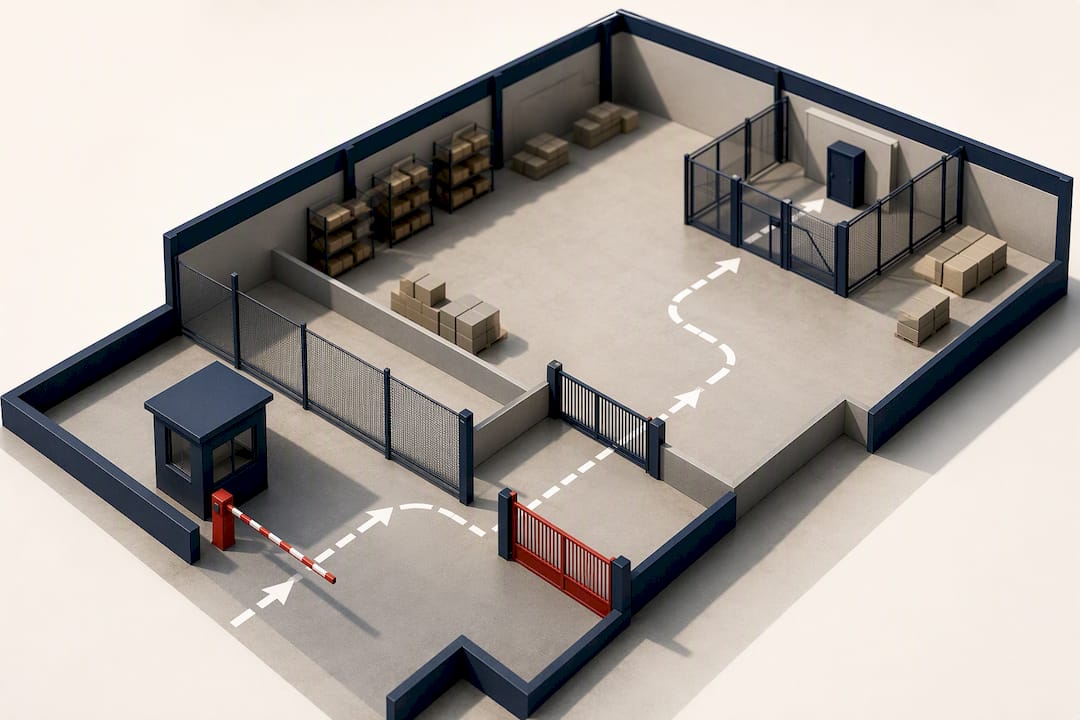
Not every employee needs access to every part of your building, and treating the warehouse as one big open zone is how sensitive inventory ends up walking out the front door.
Segment the facility into zones: general floor, high-value storage, IT/server rooms, and executive or office areas. Role-based credentials should match each zone to the people who actually need to be there for their job, nothing more.
- Issue temporary badges for visitors and contractors, and require an escort in any zone above general floor access.
- Set up anti-tailgating measures at sensitive doors. Even a simple mantrap or a badge-plus-PIN combo stops the “hold the door” habit that defeats most card systems.
- Audit access logs monthly, looking for after-hours entries or badge use that doesn’t match a shift schedule.
- Maintain strict key control. Master keys should be numbered, logged, and re-keyed whenever an employee with access leaves the company.
Warehouse access control only works if it’s enforced consistently. A system that’s ignored during a rush shipment is a system that doesn’t exist when it matters.
What Should a Warehouse Surveillance System Cover?
A camera pointed at an empty aisle tells you nothing useful. Coverage should concentrate on the areas where loss actually happens: dock doors, staging lanes, high-value cages, and any point where product changes custody.
Blind spots are the enemy here. Walk your floor plan and mark every angle a camera can’t see, then ask whether that gap sits near a high-value zone or a dock door. If it does, it needs a fix.
- Cover every dock door, staging lane, and high-value storage cage with overlapping camera angles.
- Deploy analytics for perimeter intrusion, unusual vehicle dwell time, and after-hours motion in restricted zones.
- Decide deliberately between in-house monitoring and outsourced remote monitoring; staffing a 24/7 monitoring desk in-house is expensive, which is why many mid-size operations shift that function to a monitored service instead.
- Maintain a documented chain of custody for any footage pulled for an investigation, including who accessed it and when.
Camera Coverage Reality Check: Loss prevention practitioners consistently flag staging lanes and dock doors as the areas most often left with gaps in camera coverage, precisely because those zones change layout day to day as freight moves through. A fixed camera plan needs a periodic walk-through to confirm it still matches how the floor is actually being used.
How Do You Protect High-Value Inventory From Internal Theft?
Internal theft frequently outweighs external break-ins as a source of shrink, and research on distribution center crime points to targeted controls, area-coded badges, restricted parking near high-value zones, monitored CCTV, and audits of high-risk roles, as the measures that actually move the needle.
- Store high-value or easily resold SKUs in lockable cages or secure racks with a single, monitored entry point.
- Consider automated storage and retrieval systems (AS/RS) or goods-to-person automation for the highest-value categories; these systems inherently limit who can physically reach the product.
- Run cycle counts on high-value inventory weekly rather than relying solely on annual physical counts.
- Flag exception reports, unusual adjustments, repeated shrink on the same SKU, and unscheduled inventory moves, for same-week review rather than quarterly cleanup.
A single-entry cage with a logged access history turns “we think someone’s been taking product” into a short list of suspects instead of a building-wide mystery.
What Security Clauses Belong in Vendor and 3PL Contracts?
Your warehouse security plan is only as strong as the weakest vendor with a key to your dock. Third-party logistics providers, cleaning crews, and maintenance contractors all touch your facility, and contracts need to say so explicitly.
- Require notification-of-incident clauses with specified reporting expectations rather than vague timing language.
- Set minimum-security criteria vendors must meet, and require documented evidence rather than a verbal assurance.
- Reference CTPAT-style Minimum Security Criteria language even if your facility isn’t formally enrolled; CBP’s CTPAT program requires annual security profile reviews and validations for partners, a cadence worth borrowing regardless of enrollment status.
- Build in annual vendor reviews and spot validations, not just a one-time onboarding checklist that never gets revisited.
- Tie service-level agreements to measurable security performance, not just delivery timelines.
Why Do Hiring and Training Matter as Much as Hardware?
Cameras and gates don’t stop the person who already has a badge and decides to abuse it. That’s why human factors sit at the center of any serious inventory protection plan.
- Screen for high-risk roles. Dock supervisors, inventory clerks, and anyone with unsupervised access to high-value cages warrant periodic background checks, not just a pre-hire check that’s never revisited.
- Train on warehouse safety procedures and security together. Employees who understand why a seal check matters are far more likely to actually perform it under time pressure.
- Build a reporting channel with real non-retaliation protection. Most internal theft gets caught because a coworker noticed something, and they won’t say anything if they fear blowback.
- Run drills, not just policies. Tabletop exercises and live drills involving local law enforcement expose the gaps a written plan can’t reveal on paper. OSHA’s workplace security guidance recommends exactly this kind of recurring, documented practice rather than a one-time training session.
Pro Tip: Run your first tabletop drill around a scenario your team has actually seen before, a missing pallet, a seal mismatch, rather than a dramatic worst-case break-in. Realistic scenarios expose real gaps faster.
How Does Cybersecurity Fit Into Physical Warehouse Security?
Your access control system, cameras, and inventory software all run on networks now, which means a cyber incident can disable physical security just as effectively as a cut fence.
CISA’s common baseline guidance recommends segmenting IT and OT networks so a compromised office laptop can’t reach the systems controlling your dock doors or HMI panels. Log and monitor every cross-segment connection, and limit who can access control-room systems physically, not just digitally.
- Require vendors managing your security systems to commit to defined incident and vulnerability notification timelines.
- Test backups and restore procedures on a real schedule, not just when something breaks.
- Patch access-control software and camera firmware on a set cadence rather than an ad hoc basis.
Facilities running automated equipment on shared networks face a related exposure worth a closer look; guidance on integrating automation systems securely covers similar segmentation principles for connected industrial equipment.
How Do You Turn All This Into a Written Plan?
A checklist without a written plan behind it tends to fade after the first busy quarter. Structure your document with these sections: scope and objectives, governance and ownership, physical and procedural controls, training requirements, incident response and chain-of-custody steps, metrics, and a review schedule.
- Define scope: which facilities, shifts, and inventory categories the plan covers.
- Name governance: who owns the plan and how often it’s reviewed (quarterly is a reasonable baseline).
- List controls by layer: perimeter, dock, access, surveillance, inventory, cyber.
- Attach vendor and 3PL contract language as an appendix, not a side agreement.
- Document incident response steps, including who to call and how evidence is preserved.
- Set a review and drill schedule, and put it on the calendar, not just in the document.
Here’s a priority-scored starting checklist you can adapt for your own building:
| Control area | Sample action | Priority |
|---|---|---|
| Perimeter | Weekly fence and lighting inspection | High |
| Dock | Two-person sign-off on every outbound load | High |
| Access control | Role-based badge zones with monthly audit | High |
| Surveillance | Close camera blind spots at staging lanes | High |
| Inventory | Weekly cycle counts on high-value SKUs | Medium |
| Vendor/3PL | Incident-notification clause in all contracts | Medium |
| Cyber | IT/OT network segmentation | Medium |
| Human factors | Quarterly tabletop drill | Medium |
| Governance | Quarterly plan review with metrics | High |
Roll out the high-priority items first. Most of them, seal checks, sign-offs, badge audits, cost-process discipline rather than capital, and they close the gaps that generate the fastest losses.
Getting Security and Operations to Actually Work Together
The plans that hold up under pressure are the ones operations staff barely notice, because the checks are built into their normal workflow instead of layered on top of it. Start with process fixes at the dock before committing capital to hardware; that sequencing produces faster, cheaper wins. Watch shrink rate and investigation time to prove the plan is working, not just that it exists on paper.
— Alston
How Global Security Turns This Plan Into Daily Coverage
A written plan only holds up with people and systems executing it every shift, which is where a dedicated security partner earns its place. Global Security builds its plans around law enforcement and military expertise, matching each control in this article to a service you can actually deploy: guard presence and roving patrols for perimeter and dock deterrence, threat assessments to prioritize your risk map, and CCTV integration to close the blind spots your camera plan identified.

If your facility is scaling, adding shifts, or preparing for a formal security audit, that’s usually the signal to bring in a provider rather than stretch internal staff further. Global Security’s Guard Services cover on-site personnel and threat assessments, while Virtual Guard offers remote monitoring for facilities that need coverage without staffing a monitoring desk around the clock. Reach out through the guard services page to scope a plan built around your dock schedule, your zones, and your actual risk profile, not a generic template.
Standards Worth Keeping on File
- OSHA’s National Emphasis Program for warehousing guides compliance and inspection readiness.
- CISA’s common baseline informs network segmentation for security systems.
- CBP’s cargo security standards shape vendor clauses and perimeter design.
- ASIS guidance frames operational integration and incident response planning.
Sources
- OSHA directive: National Emphasis Program for Warehousing and Distribution Center Operations
- ASIS: How to secure the modern warehouse
- CISA Common Baseline controls list
FAQ
What Should Be Included in a Security Plan?
A warehouse security plan should cover risk assessment, perimeter and dock controls, access control, surveillance, inventory protection, vendor security clauses, staff training, and incident response procedures. CBP’s cargo security standards require written plans covering perimeter, lighting, and vendor requirements as a baseline. Governance and a set review schedule tie the whole document together.
What Are the 7 Principles of Warehousing?
Definitions vary across sources, but warehousing principles commonly cited include maximizing space use, minimizing handling, ensuring accessibility, maintaining accurate inventory tracking, optimizing flow, ensuring safety compliance, and controlling costs. Security threads through nearly all of these, since theft and loss directly undercut inventory accuracy and cost control.
What Does “Warehouse Security” Mean?
Warehouse security means the combination of physical, procedural, and technological controls that protect inventory, equipment, and staff from theft, damage, and unauthorized access. It spans everything from perimeter fencing to dock procedures to access credentials, and it works best when embedded into daily logistics workflows rather than run as a separate function.
Do I Need a Security Provider or Can I Handle This In-House?
Smaller facilities often manage basic warehouse safety procedures internally, but scaling shifts, high-value inventory, or a 24/7 operation usually calls for professional support. Global Security’s guard services and threat assessments are designed for facilities that need trained personnel or remote monitoring beyond what an internal team can staff.
How Often Should a Warehouse Risk Assessment Be Updated?
A quarterly review cycle is a reasonable baseline for most facilities, with a full reassessment after any major incident, layout change, or shift in inventory value. TAPA’s FSR standard emphasizes periodic reassessment as part of a layered defense strategy, not a one-time exercise.