
Concealed carry means keeping your firearm hidden from view, prioritizing discretion; open carry means wearing it visibly, prioritizing immediate access. Most permit holders choose concealed carry because it avoids public attention and reduces theft risk, while open carry suits specific work or rural settings where visibility matters more than discretion. Every state treats the two differently under its own statutes, so verify your local law before you decide.
TL;DR:
- Most states differentiate clearly between concealed and open carry, with restrictions and legality that vary widely by jurisdiction.
- Open carry offers faster draw access but increases theft risk and can provoke unwanted social reactions, while concealed carry limits visibility but requires careful wardrobe choices.
- Training focused on safe handling, retention, and legal use is essential, as a permit alone does not ensure competence or readiness under stress.
- Reciprocity agreements are inconsistent, so carriers should verify permit recognition, vehicle rules, and sensitive location restrictions before traveling between states.
- There is no conclusive evidence that either carry method reliably deters crime, so decisions should focus on legal permission, personal safety, and thorough training rather than speculation.
Table of Contents
- Concealed vs Open Carry: Weighing the Everyday Tradeoffs
- How Do Open Carry and Concealed Carry Laws Differ?
- What Safety and Training Steps Matter Most?
- What Should You Check Before Traveling With a Firearm?
- Does Carrying a Gun Actually Deter Crime?
- How Do You Decide Between Concealed and Open Carry?
- What Myths Should You Stop Believing About Carrying?
- How Does Carry Method Affect Encounters With Police?
- Why Legal Literacy Matters as Much as the Gun Itself
- Get Trained Before You Carry, Not After a Mistake
- Sources
- FAQ
Concealed vs Open Carry: Weighing the Everyday Tradeoffs
Both methods put a firearm within reach, but they create very different daily experiences. Concealed carry keeps your weapon private, which limits your draw speed slightly but avoids signaling to anyone nearby that you’re armed. Open carry offers a faster, unobstructed draw and can act as a visible deterrent, but it also announces your firearm to everyone in the room, including someone who might want to take it from you.
The practical differences show up fast once you start comparing them side by side:
- Draw speed: Open carry typically allows a quicker, more direct draw since there’s no cover garment to clear.
- Visibility and theft risk: A holstered firearm in open carry can become a target for grab attempts or opportunistic theft, a concern echoed across tactical safety resources.
- Wardrobe and printing: Concealed carry demands the right holster, belt, and clothing combination to avoid “printing,” where the gun’s outline becomes visible anyway.
- Retention differences: Concealed holsters benefit from body contact and clothing coverage; open holsters need stronger mechanical retention since the firearm is exposed to grabs.
- Social reaction: Open carry in public spaces can draw stares, nervous 911 calls, or unwanted confrontation, even where it’s fully legal.
Neither approach is inherently safer on its own. The right choice depends on your build, your wardrobe, your daily environment, and how much you value staying unnoticed.
How Do Open Carry and Concealed Carry Laws Differ?
There is no single national rule for carrying a firearm in public. States fall into a handful of categories, and knowing which one governs your location changes everything about how you carry.
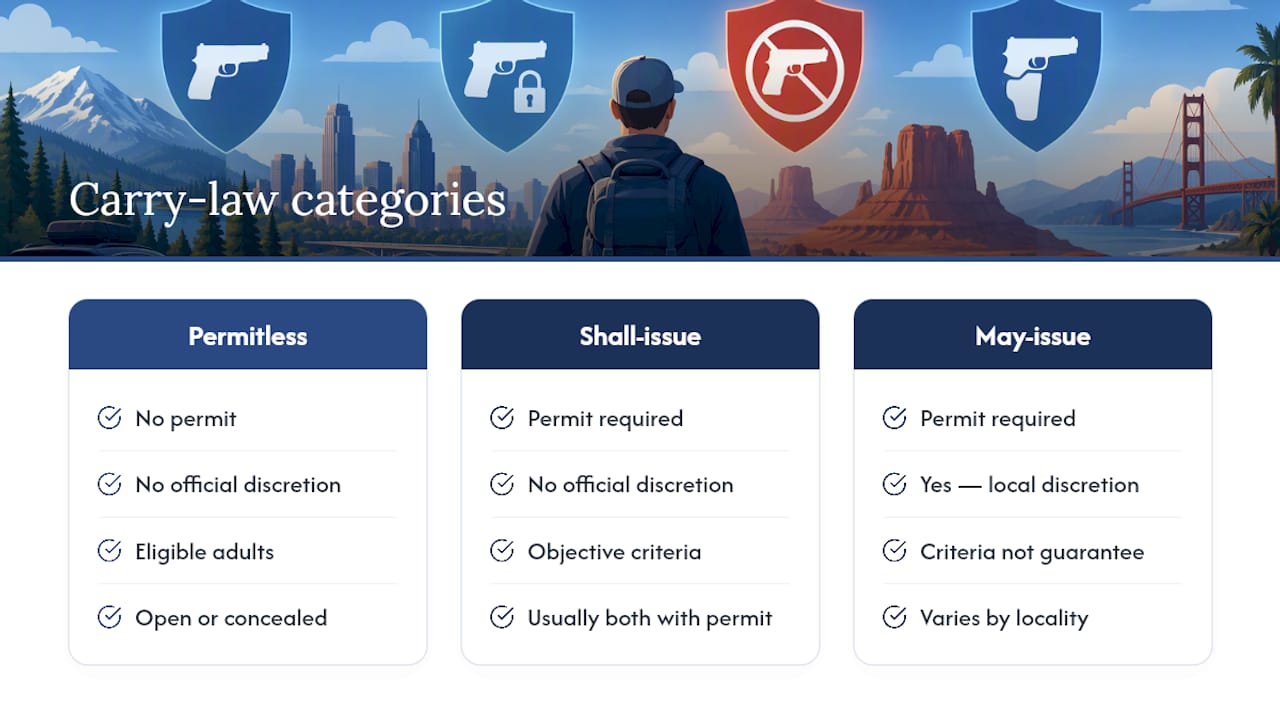
Permitless (constitutional) carry states let eligible adults carry a concealed or open firearm without a government-issued permit. Shall-issue states require a permit but must issue one to any applicant who meets objective criteria, like passing a background check. May-issue states give local officials discretion to deny a permit even when an applicant meets the baseline requirements, which creates far more variability from one jurisdiction to the next.
The Supreme Court’s 2022 decision in New York State Rifle & Pistol Association v. Bruen held that the Second and Fourteenth Amendments protect an ordinary, law-abiding person’s right to carry a handgun in public for self-defense. That ruling struck down “proper cause” requirements in states like New York, but it did not create one uniform carry procedure. States still regulate licensing, training requirements, and what counts as a “sensitive place,” and litigation continues to reshape those boundaries in the years since. A state attorney general’s overview of Bruen makes clear that carriers still need to check current statutes, since court rulings and legislative changes can shift the practical rules even when the constitutional framework stays the same.
Rules on sensitive places (schools, courthouses, polling stations), vehicle transport, and private property vary by state and sometimes by city. Florida, for instance, distinguishes concealed and open carry sharply, and generally makes open carry unlawful outside narrow exceptions. Because carry laws differ state by state, always confirm your rights against the actual statute or your state’s official guidance, not a summary map or a forum post.
What Safety and Training Steps Matter Most?
A permit tells you what’s legal. It doesn’t tell you whether your gear works or whether you’ll perform under stress. Both concealed and open carriers need the same baseline of competence.
Start with the holster. It should hold the firearm securely through normal movement, bending, and running, and it should release cleanly on the draw every time. A simple check professionals recommend is the upside-down test: hold the empty holster by its attachment points and shake it upside down. If the gun would fall free, the holster fails the basic retention standard.
Beyond gear, prioritize:
- Repetition-based draw practice under realistic conditions, not just a single range session.
- Formal instruction covering legal use-of-force standards, not just marksmanship.
- Clear storage and transport habits, especially in vehicles, where many states impose separate rules from open carry on foot.
- A calm, direct response if an officer asks about your weapon: state that you’re armed and licensed, keep your hands visible, and follow instructions.
Pro Tip: Know how your state treats brief, accidental exposure of a concealed firearm versus intentional open display. In Florida, the two are handled very differently under the same statute, and that distinction can decide whether an incident becomes a citation or a defense.
Formal courses like concealed carry training build these habits faster than solo practice, particularly the decision-making component that range time alone can’t teach.
What Should You Check Before Traveling With a Firearm?
Reciprocity agreements only cover concealed carry permits, and even then, coverage is inconsistent. A permit valid in your home state might be worthless the moment you cross into a neighboring one. Vehicle transport rules and sensitive-place restrictions can also shift at the state line, catching even experienced carriers off guard when they assume the rules travel with them.
Before any trip, work through this sequence:
- Check whether your destination state recognizes your permit, and confirm the specific reciprocity terms rather than relying on a generic map.
- Review that state’s vehicle transport statute, since “in the car” rules differ from “on the body” rules almost everywhere.
- Identify sensitive places and private-property signage requirements specific to that state.
- Call the relevant state agency directly if anything is ambiguous, rather than guessing.
Florida again illustrates why definitions matter: its statute separates concealed and open carry with specific language, so a firearm that’s legally carried one way in your home state might not translate cleanly once you cross a border.
Does Carrying a Gun Actually Deter Crime?
The honest answer is that nobody knows for certain, and the RAND Corporation’s research synthesis on gun policy makes that explicit. RAND’s review found the evidence on carry laws and public-safety outcomes to be limited and often inconclusive. There’s no solid data showing that either concealed or open carry produces a broad deterrent effect on crime.
That gap matters because plenty of arguments on both sides treat deterrence as settled fact. It isn’t. RAND cautions against treating carry policy as a proven public-safety solution, and recommends evaluating specific outcomes rather than sweeping assumptions. Much of the research suffers from small sample sizes, inconsistent state-level reporting, and difficulty isolating carry laws from other variables like local policing or economic conditions.
The practical takeaway: base your decision to carry, and how you carry, on legal permission, personal risk assessment, and training readiness rather than on assumptions about crime deterrence that the evidence doesn’t actually support.
How Do You Decide Between Concealed and Open Carry?
Work through these steps in order, and don’t skip the legal check even if you’re confident you already know the answer.
- Confirm your home jurisdiction’s category. Permitless, shall-issue, and may-issue states each carry different obligations before you carry at all.
- Assess your environment. Urban settings, workplaces, and family situations often favor concealed carry for reduced attention; rural or occupational settings may make open carry more practical.
- Test your equipment. Confirm holster retention, consistent draw mechanics, and a wardrobe that avoids printing if you’re going concealed.
- Map your travel patterns. If you cross state lines regularly, reciprocity limits should weigh heavily in your decision.
- Get trained or get legal advice. A consult with an attorney or a pistol training course beats guessing, especially in may-issue states with unclear discretion standards.
What Myths Should You Stop Believing About Carrying?
Misconceptions about concealed and open carry spread faster than the statutes themselves, and several of them lead people into real legal trouble.
Myth: Open carry is always legal if concealed carry is legal. Not true. Some states permit concealed carry under a shall-issue system while restricting or banning open carry outright, and Florida is a clear example of that split.
Myth: A concealed carry permit works the same everywhere. Reciprocity is inconsistent and permit-specific. Assuming your home-state permit travels with you is one of the most common ways carriers end up violating another state’s law without realizing it.
Myth: Open carry guarantees a deterrent effect. As RAND’s synthesis shows, there’s no established evidence that visible carry reliably deters crime. Visibility can just as easily draw unwanted attention or a theft attempt.
Myth: Printing a concealed firearm is automatically illegal. In most states, incidental printing through clothing isn’t the same as unlawful open display, though the specific wording of your state’s statute determines where that line sits.
Myth: If you’re licensed, you don’t need training. A permit confirms legal eligibility. It says nothing about your ability to draw safely under stress, maintain retention in a physical confrontation, or make a sound legal judgment in the moment. Training closes that gap, and it’s the difference most permit courses don’t require but should.
How Does Carry Method Affect Encounters With Police?
The mode you choose changes how an encounter with law enforcement typically unfolds. Officers approaching someone who is openly carrying already know a firearm is present, which can shift their posture and questions from the outset. Concealed carry, by contrast, usually stays invisible to police unless you volunteer the information or a state’s law requires disclosure during a stop.
Some states legally require you to inform an officer that you’re armed during a traffic stop or other interaction; others don’t. Either way, the safest approach is consistent: keep your hands visible, avoid sudden movements toward the firearm or holster, and calmly state that you are carrying and licensed if the situation calls for it. Reaching for a wallet or phone near a holstered weapon without warning is a common trigger for escalated tension, regardless of whether you’re carrying openly or concealed.

Open carry can sometimes prompt more immediate scrutiny simply because the firearm is visible before any conversation starts, occasionally leading to welfare checks or citizen reports that bring police to the scene even when nothing unlawful is happening. Concealed carriers face a different risk profile: an unexpected discovery of a firearm during a search or a mishandled disclosure can create confusion or suspicion that a calm, upfront statement usually prevents.
In both cases, the outcome hinges less on carry method and more on how clearly and calmly you communicate. Training that includes scenario-based practice for law enforcement encounters, not just marksmanship, prepares you for that moment far better than any statute alone.
Why Legal Literacy Matters as Much as the Gun Itself
Carrying a firearm responsibly means treating the legal side with the same seriousness as the physical one. Statutes shift, court rulings like Bruen redraw boundaries, and a permit alone doesn’t teach you how to think clearly under pressure. Programs such as executive protection training exist precisely because professional-grade situational awareness and legal judgment separate a prepared carrier from a liability waiting to happen. Lawful carry, trained carry, and informed carry are really the same standard stated three ways.
— Alston
Get Trained Before You Carry, Not After a Mistake
Reading about carry law gets you informed. Formal instruction gets you prepared, and that gap is exactly what causes most legal trouble for otherwise responsible gun owners. Training programs built by experienced professionals teach the legal judgment and physical retention skills that a permit test never covers.

Options include a concealed carry class covering legal use-of-force standards and daily carry practice, pistol training focused on draw mechanics and retention drills, and executive protection training for readers who want professional-level situational awareness. Formal training reduces both legal exposure and the odds of a fumbled real-world encounter, since it replaces guesswork with practiced habit. If you’re ready to move past reading and into practical skill, visit Gsgicorp’s training pages to review course dates and enroll.
This article is general information, not a substitute for advice from a qualified lawyer. Consult a qualified legal professional about your own circumstances before acting on anything here.
Sources
- Open Carry Laws by State – FindLaw
- New York State Rifle & Pistol Association v. Bruen (opinion)
- RAND gun policy research and analyses
- Florida Statutes §790.053 (Open carrying of weapons) — 2026
FAQ
Which States Have Banned Open Carry?
Several states restrict or effectively prohibit open carry of handguns in public, including places like New York, California, and Florida, though the specific rules and exceptions vary by statute. Always confirm current status directly through your state’s carry law summary, since legislative changes can shift a state’s category from one year to the next.
Is North Carolina an Open Carry or Concealed Carry State?
North Carolina permits both. Open carry generally doesn’t require a permit for eligible adults, while concealed carry requires a separate permit issued under the state’s shall-issue system.
Is Open Carry Allowed in Virginia?
Yes, Virginia allows open carry for most eligible adults without a permit in the majority of public locations, though certain sensitive places and local restrictions still apply. Concealed carry in Virginia requires a separate permit.
Can You Open Carry in Georgia?
Yes, Georgia allows open carry for individuals who hold a valid Georgia weapons carry license, and the state also permits certain carry without a license under its permitless carry provisions. As with any state, confirm current sensitive-place and vehicle rules before carrying, since state statutes get updated periodically.
Does a Concealed Carry Permit Automatically Work in Every State?
No. Reciprocity between states is inconsistent, and some states don’t recognize out-of-state permits at all. Check the specific reciprocity terms for your destination before traveling, rather than assuming your home-state permit applies everywhere.