
Situational awareness training teaches people to systematically read their surroundings, spot anomalies early, and act before a threat fully develops. The core benefit is time: the earlier you detect a problem, the more options you have to avoid, de-escalate, or respond to it. Individuals build the skill through daily habits and drills; organizations build it through structured programs that pair training with leadership support, and often with professional guard services or monitoring technology.
TL;DR:
- Daily drills like the 20/20 rule and entry scans help embed awareness habits, but professional instruction is essential for high-risk situations.
- Building a program requires role-specific objectives, leadership support, measurable outcomes, and integration of technology and physical drills.
- Basic awareness courses last 60 to 90 minutes, while advanced programs with scenario work can extend to multiple days and include certification.
- Professional training enhances judgment under pressure and is crucial for executive travel, high-profile events, or facilities with serious security concerns.
- Combining self-practice with periodic professional instruction offers the most effective approach to developing sustained situational awareness.
Table of Contents
- What Frameworks Does Situational Awareness Training Teach?
- What Exercises Build Situational Awareness Skills?
- How Do You Build a Situational Awareness Program for Organizations?
- How Long Does Situational Awareness Training Take?
- How Do Professional Teams Apply Situational Awareness on the Job?
- When Should You Hire Instructors Instead of Self-Training?
- Where to Find Instructor-Led Training and Integrated Security Support
- Sources
- FAQ
What Frameworks Does Situational Awareness Training Teach?
Every credible course rests on the same cognitive backbone: Perception, Comprehension, Projection. This peer-reviewed three-level framework describes how trainees move from simply noticing data to understanding what it means and predicting what happens next. A novice sees a person loitering near a doorway. A trained observer sees the loitering, connects it to the time of day and the person’s clothing versus the weather, and projects whether that person is waiting for a ride or casing an entrance.
Two other models show up constantly in course material:
- OODA (Observe, Orient, Decide, Act), a decision cycle borrowed from military aviation and now standard in tactical training, teaches trainees to compress their reaction time by moving through the loop faster than a threat can adapt.
- SLAM (Stop, Look, Assess, Manage) is a simpler field checklist often used in workplace safety training for quick hazard checks.
Here is how the models stack in a real scenario: walking into a parking lot at night, perception means noticing which cars have people in them; comprehension means recognizing that a running engine with lights off is unusual; projection means deciding to change your walking path before you’re within arm’s reach of that vehicle. That whole sequence, done well, takes under three seconds.
What Exercises Build Situational Awareness Skills?
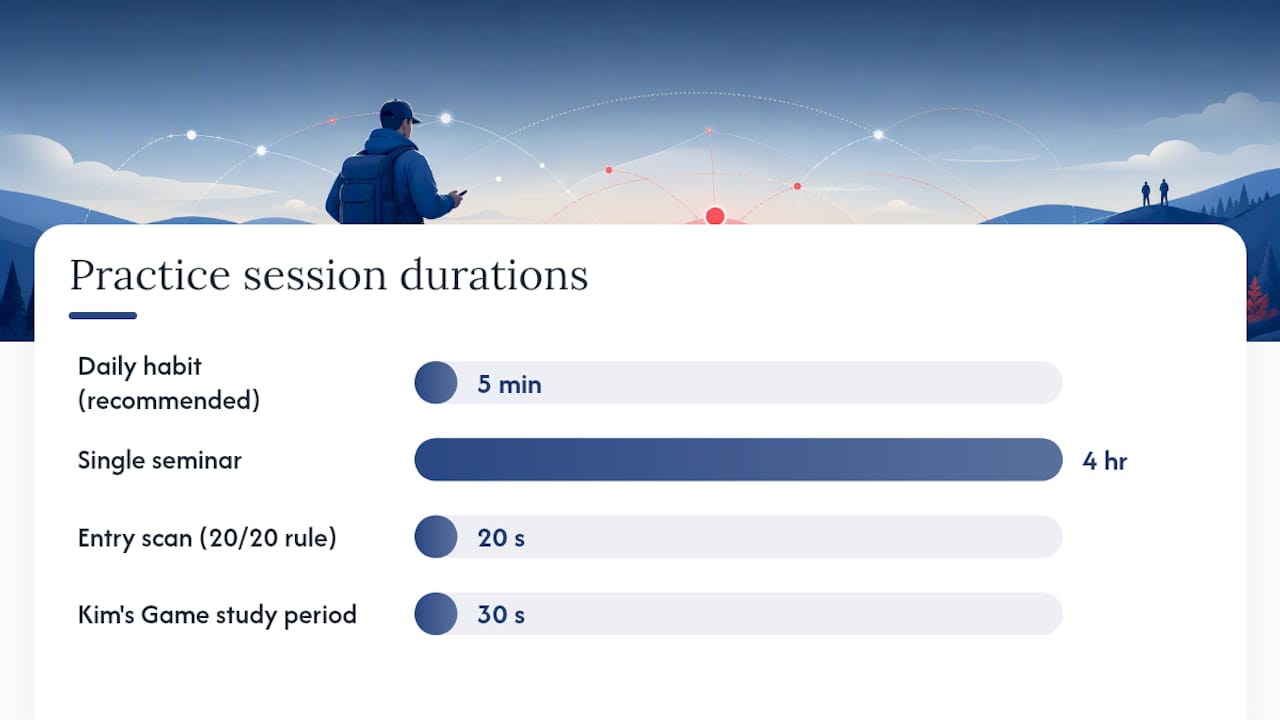
Skill here comes from repetition, not intensity. A five minute daily habit beats a single four hour seminar, according to guidance from workplace safety training resources, because awareness has to become automatic rather than effortful.
Start with these core drills:
- The 20/20 rule. On entering any new space, spend about 20 seconds scanning a 20 foot radius around you, noting exits, people, and anything that looks out of place.
- Entry scan. As you walk through a doorway, sweep your eyes right to left, then note one anomaly (an unlocked door, an unusual crowd, a car idling with no driver visible).
- Hand check. When assessing a person nearby, glance at their hands first. Hands signal intent faster than facial expressions do.
- Condition Yellow. Named after the Cooper Color Code, this is a relaxed but alert baseline state, as opposed to burying your face in a phone (Condition White). Distraction is the single biggest reason people become easy targets for opportunistic crime.
- Kim’s Game and observation scavenger hunts. Study a tray of objects for 30 seconds, cover it, and recall as many items as possible. It’s an old military memory drill that trains detail retention under time pressure.
Run the 20/20 rule and entry scan daily wherever you go. Add a weekly Kim’s Game or scavenger hunt session with a partner who can check your accuracy.
Pro Tip: Pair every drill with a specific trigger, like doorways or parking lots, rather than trying to be “aware” all day. A trigger turns awareness from a vague intention into an automatic reflex.
How Do You Build a Situational Awareness Program for Organizations?
A program only works when it has an owner, a cadence, and a way to measure whether it’s working. Start with role-based objectives: a receptionist needs different skills than a warehouse supervisor or an executive’s driver. Columbia University’s public safety training model is a useful reference for how institutions structure this kind of rollout across departments with different risk profiles.
From there, build the delivery mix:
- Microlearning modules (5 to 10 minutes) for onboarding and refreshers
- Quarterly tabletop exercises that walk teams through a hypothetical incident step by step
- Scenario-based physical drills for higher-risk roles, run at least twice a year
- Technology support, like access control logs or camera footage, used in after-action reviews
None of this works without visible leadership buy-in. If managers skip the training or treat it as a checkbox, employees notice and disengage. Programs also need a reporting mechanism so near-misses actually get logged instead of forgotten.
Well-designed programs that combine training with technology and engaged employees tend to see fewer incidents and lower safety-related costs over time, according to industry program guides. Track near-miss reports, incident rates before and after rollout, and simple confidence surveys asking employees how prepared they feel to notice and respond to a problem. For governance structure and reporting responsibilities, a resource like this enterprise security compliance checklist is worth reviewing alongside your training plan.
How Long Does Situational Awareness Training Take?
Course length depends entirely on what the training needs to accomplish. A short awareness session, often 60 to 90 minutes, covers the basics: the Perception, Comprehension, Projection model, a few drills, and general habit-building. These usually end with an attendance certificate, not a credential.
A 2 to 4 hour practical course adds hands-on scenario work, like practicing entry scans in a real building or running tabletop exercises as a group. Full-day and multi-day programs go further still, layering in stress inoculation, role-play with feedback, and after-action review, the kind of format workplace guides recommend for teams facing elevated risk.
Formal certification, as opposed to a simple attendance certificate, generally requires:
- A multi-day format with tested competencies, not just seat time
- Instructor evaluation of hands-on performance, not a written quiz alone
- Documented scenario drills with pass/fail criteria
Instructor background matters more here than in almost any other corporate training category. A course taught by someone with law enforcement or military experience brings judgment under real stress that a generic corporate trainer usually can’t replicate, particularly for high-threat contexts like executive travel or event security.
How Do Professional Teams Apply Situational Awareness on the Job?
DIY practice builds a foundation. Professional training builds judgment under pressure, the kind that only comes from scenario realism, live instructor feedback, and structured after-action review, as outlined in Columbia’s public safety training approach. That distinction shows up clearly in how integrated security teams work.
Trained personnel rarely operate in isolation. A guard walking a roving patrol is applying the same entry scan and baseline/anomaly thinking taught in a beginner course, but backed by radio communication, CCTV integration, and remote monitoring like Virtual Guard, which extends a trained set of eyes across a property without adding headcount.
The gap between someone who took a weekend course and someone who trains for a living isn’t motivation. It’s repetition under realistic pressure, with a qualified instructor correcting the small errors that never show up until something actually happens.
Training programs that include executive protection training, pistol training, and custom solutions are built around this same idea: individual skill only holds up when it’s reinforced by structured practice and measurable outcomes, not a one-time class.
- Executive protection training focuses on high-exposure roles where missed cues carry real consequences.
- Global Solutions Training tailors content and delivery format to an organization’s specific risk profile rather than a generic template.
When Should You Hire Instructors Instead of Self-Training?
Daily habits like the 20/20 rule and Condition Yellow cover most everyday situations. Professional instruction earns its cost when exposure rises: executive travel, public events, high-value facilities, or any role where a missed cue has serious consequences. The strongest approach blends both. Practice the basics yourself every day, then bring in professional instructors periodically to stress-test what you’ve built and correct blind spots you can’t see on your own. If your role or organization touches any of those higher-risk categories, that’s the signal to stop treating this as a self-improvement project and start treating it as a training investment.
— Alston
Where to Find Instructor-Led Training and Integrated Security Support
Daily drills only go so far when your exposure includes executive travel, public events, or a facility that needs continuous coverage. Gsgicorp’s training and security services are designed and delivered by professionals with law enforcement and military backgrounds, giving organizations a way to move past self-taught habits into instructor-led programs built around their actual risk profile.

The Executive Protection Training program covers close-protection fundamentals for teams responsible for high-profile individuals, while Global Solutions Training builds custom curricula for organizations that need a program tailored to their own facilities, staff roles, and threat landscape. Both can run on-site, virtually, or in a blended format depending on your team’s schedule and location. For organizations that also need ongoing physical coverage rather than training alone, Gsgicorp’s guard services and threat assessment options extend trained personnel into daily operations. Request a quote through Gsgicorp’s site to schedule a course or discuss a custom training plan for your team.
Sources
For readers who want to go deeper into the research and program design behind this article, these sources are worth your time.
- Perception–Comprehension–Projection framework (peer-reviewed)
- Why situational awareness is core to workplace safety
- How to develop situational awareness — practical habits
FAQ
How Do You Train for Situational Awareness?
Train through short, repeatable drills like the 20/20 rule, entry scans, and hand checks, practiced daily until they become automatic rather than effortful. Organizations add tabletop exercises, scenario drills, and scheduled refreshers to build the same skill across teams.
What Is the 20/20 Rule for Situational Awareness?
The 20/20 rule means spending roughly 20 seconds scanning a 20 foot radius whenever you enter a new space, noting exits, people, and anything unusual. It’s a simple habit that turns passive walking into active observation.
What Are the Four Stages of Situational Awareness?
Most training programs teach a three-stage model, Perception, Comprehension, and Projection, sometimes expanded into a fourth stage of action or decision, similar to the Decide and Act steps in the OODA loop. Different courses label the stages slightly differently, but the underlying sequence, notice, understand, predict, act, stays consistent.
What Are the Five Elements of Situational Awareness?
Definitions vary by course and industry, so there’s no single agreed-upon list of five elements. Most programs anchor instead on the three-level Perception, Comprehension, Projection framework and layer in decision models like OODA or SLAM depending on the audience.
Does Gsgicorp Offer Situational Awareness Training for Organizations?
Yes. Gsgicorp offers Executive Protection Training and Global Solutions Training, both delivered by instructors with law enforcement or military backgrounds and tailored to an organization’s specific risk profile. Pricing is available on request through the Gsgicorp site.