
Thermal security cameras detect heat signatures to reveal people, vehicles, and hot equipment through darkness, smoke, and glare. They belong wherever detection matters more than visual identification: unlit perimeters, remote yards, and equipment rooms where a heat spike is the earliest warning sign of trouble. Most security programs pair them with visible or infrared cameras rather than relying on thermal alone.
TL;DR:
- Thermal cameras excel in detecting heat anomalies across unlit or smoke-filled areas, making them ideal for perimeter security and early fire detection.
- They should be paired with visible cameras or verification processes to reduce false alarms and confirm threats before dispatching security responses.
- Key specs like NETD below 25 millikelvin and higher resolution extend detection range and sensitivity, but actual performance depends on lens choice and environmental factors.
- Detection distances vary with setup, but under optimal conditions, they can identify individuals at about 65 meters and vehicles at 144 meters, requiring precise calculation.
- The most cost-effective use cases include unlit perimeters and critical equipment monitoring, with handheld units suitable for spot checks rather than continuous surveillance.
Table of Contents
- How Thermal Cameras Security Systems Detect What Other Cameras Miss
- Thermal vs. Infrared Cameras: What Security Teams Confuse Most
- Thermal Camera Specs That Actually Matter for Security
- Deploying Thermal Cameras for Security Without Drowning in False Alarms
- How Thermal Detection Feeds Guard Response in the Field
- Where Thermal Coverage Deserves Priority Budget
- Get Thermal Systems Specified, Installed, and Monitored by Global Security
- Sources
- FAQ
How Thermal Cameras Security Systems Detect What Other Cameras Miss
A thermal sensor reads radiated heat, not reflected light. That single distinction explains most of what makes thermal cameras security systems valuable on a perimeter: they keep working when there is no light source at all, and they see through smoke, fog, and glare that blind a standard lens. A microbolometer inside the camera converts subtle temperature differences into a visible image, which is why a person walking through a dark field or a hot bearing on an idle conveyor both show up clearly against a cooler background.
That capability translates into several concrete use cases:
- Perimeter intrusion detection across unlit fence lines, lots, and rooftops, where thermal video analytics catch movement that visible cameras miss entirely.
- Continuous condition monitoring on transformers, motors, and electrical panels, where a fixed thermal camera learns each asset’s normal temperature baseline and flags drift before it becomes a predictive maintenance failure or a fire.
- Early fire detection in warehouses, cold-chain facilities, and industrial sites, where a rising hotspot can be caught long before smoke triggers a conventional alarm.
- Privacy-conscious monitoring in areas where recognizable imagery raises legal or policy concerns, since thermal footage shows a heat outline rather than an identifiable face.
Pro Tip: Run thermal detection alongside a verification step, whether that is a visible camera, a Virtual Guard operator, or an analytics rule that filters known heat sources. Detection tells you something is there; verification tells you what to do about it.
Thermal vs. Infrared Cameras: What Security Teams Confuse Most
Thermal and infrared get lumped together constantly, and the mix-up leads to bad procurement decisions. A thermal camera generates its own image from heat energy the scene emits. An infrared or “night vision” camera depends on an IR illuminator, either built in or external, bouncing light off a surface and capturing the reflection, much like a standard camera working in a spectrum the human eye cannot see. That difference matters most in conditions like smoke, dense fog, or heavy glare, where IR illumination scatters and fails while thermal keeps producing a usable image.
The tradeoff runs the other direction for identification. Thermal footage shows a warm shape moving through a dark yard; it does not resolve a face or a license plate the way an infrared or visible camera can. Choose based on the job, not the buzzword.
| Factor | Thermal | Infrared/visible |
|---|---|---|
| Best use case | Perimeter detection, long-range early warning | Identification, evidence, facial or plate recognition |
| Detection environment | Total darkness, smoke, fog, glare | Requires ambient or IR-supplied light; degraded by heavy smoke/fog |
| Spec tradeoff | Higher sensitivity to heat, lower visual detail | Higher visual detail, limited range in low light |
Procurement adds another wrinkle. Some thermal camera lines ship in a lower frame-rate variant, often around 8.3 frames per second, specifically to satisfy export-control regulations that govern higher-performance thermal exports. A 30 fps version usually costs more and may face licensing restrictions depending on the buyer’s location and end use.
Thermal Camera Specs That Actually Matter for Security
Spec sheets for thermal cameras look intimidating until you know which four numbers drive real-world performance.
NETD (thermal sensitivity). Noise Equivalent Temperature Difference measures how small a temperature change the sensor can resolve. A camera rated below 50 millikelvin performs well for general detection; under 25 mK is closer to ideal for catching subtle heat drift on equipment before it becomes visible to the naked eye.
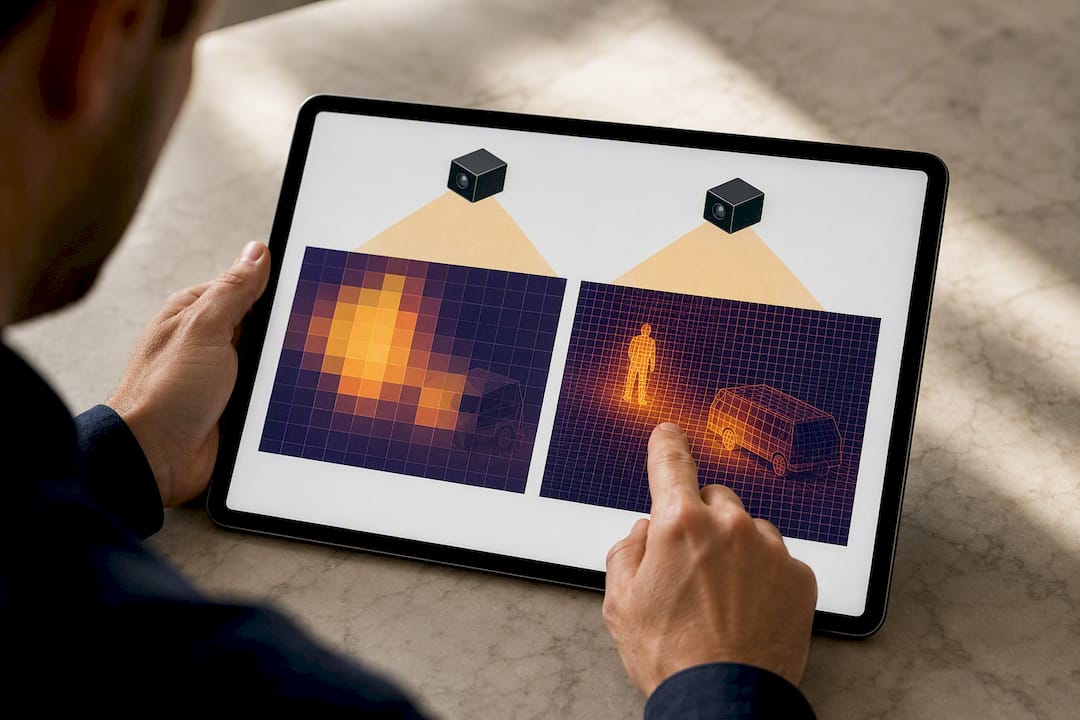
Resolution. More pixels across the thermal sensor means more pixels land on a distant target, which directly extends the range at which the camera can reliably detect a person or vehicle versus just seeing a warm blur.
Frame rate. Static perimeter monitoring works fine at lower frame rates. Tracking a moving target, feeding a PTZ handoff, or supporting smooth analytics tracking usually needs something closer to 30 fps, and that requirement should get flagged early since it intersects with the export-compliance frame-rate variants covered above.
Lens and field of view. Wider lenses cover more ground but shorten detection range; narrower lenses extend range at the cost of coverage width. Mounting height and FOV need to be planned together, not treated as separate decisions.
Beyond optics, a few infrastructure questions belong on every procurement checklist:
- Power delivery: PoE simplifies cabling runs; some outdoor or high-draw units still need dedicated DC or AC power.
- Environmental rating: look for IP66 or IP67 sealing and an impact rating (IK) suited to the mounting location.
- Cybersecurity posture: firmware update support and network hardening matter as much on a thermal unit as on any IP camera.
Vendor demonstrations report detection distances in the range of 65 meters for a person and 144 meters for a vehicle under specific optics and sensitivity conditions, but treat marketing range figures as a starting point. Actual detection range depends on pixel size, NETD, lens choice, and the temperature contrast between the target and its background, which is why serious deployments run detection-range calculations rather than trusting a headline number.
Deploying Thermal Cameras for Security Without Drowning in False Alarms
A thermal camera generates value only if the alerts it produces are worth acting on. Four practices separate a well-run thermal deployment from one that gets ignored after week one:
- Pair thermal with an RGB camera. Multispectral setups overlay a heat map on a normal video image, so an operator sees both the temperature anomaly and its visual cause in one glance, whether that is a person at the fence or an overheating cold-chain unit.
- Use on-camera analytics and baseline learning. Fixed industrial thermal units that learn an asset’s normal operating temperature can filter routine heat sources, like forklifts or welding equipment, cutting nuisance alarms sharply while staying sensitive to genuine anomalies.
- Maintain the hardware. Sunshields protect against solar loading that skews readings, and periodic flat-field correction keeps the sensor’s temperature readings uniform across the image, a maintenance step that gets skipped far too often.
Pro Tip: Treat your CCTV integration plan and your thermal analytics plan as one project, not two. A thermal camera that alerts into a monitoring platform nobody watches is just an expensive space heater with a lens.
How Thermal Detection Feeds Guard Response in the Field
Thermal cameras earn their budget line when the alert they generate leads to a fast, correct response instead of a guessing game. In a typical Virtual Guard workflow, a thermal sensor flags heat movement along a fence line at 2 a.m., a remote operator pulls the paired visible feed to confirm it is a person and not a stray animal, and only then dispatches a roving patrol or notifies the client.
That sequence, thermal detection, remote verification, physical response, cuts wasted trips and keeps guards focused on real events rather than every motion trigger a sensor produces. It also gives facility managers a documented chain of evidence: the heat signature, the verification footage, and the response log all tie together for after-action review.
- Thermal detection narrows attention to genuine heat anomalies before a human ever looks at a feed.
- Remote verification confirms intent before a guard is sent, saving cost and response time.
- Escalation paths connect straight into guard dispatch for physical follow-up when a threat is confirmed.
Where Thermal Coverage Deserves Priority Budget
Fixed thermal coverage earns its cost fastest on unlit perimeters, fuel and battery storage areas, and critical plant equipment, where a missed detection or an unnoticed heat drift carries real financial or safety consequences. Handheld thermal inspections still have a place for periodic spot checks on assets that do not justify permanent coverage. When building the business case, frame the spend around detection value, catching the event early, rather than forensic image quality, which thermal was never designed to deliver.
— Alston
Get Thermal Systems Specified, Installed, and Monitored by Global Security
Reading the specs is one thing. Getting NETD, resolution, and frame rate matched to your actual perimeter, and then wired into a monitoring plan someone actually watches, is another. Gsgicorp handles that full path: system design and CCTV integration for the hardware side, Virtual Guard remote monitoring to verify thermal alerts before anyone gets dispatched, and roving patrol or guard response when a confirmed event needs a physical presence on-site.

That combination matters because a thermal camera without a monitored response plan just generates alerts nobody reviews at 3 a.m. Experienced security teams, often staffed by former law enforcement and military professionals, build the monitoring and dispatch layer around the hardware instead of treating the camera as the finish line. If your facility has unlit perimeters, equipment rooms, or storage areas that need this kind of layered coverage, request a site assessment through Gsgicorp’s guard services team to get a system design and monitoring plan built around your specific property.
Sources
For deeper technical detail beyond this guide, consult manufacturer datasheets directly:
- Infrared vs thermal cameras: key differences
- How industry uses predictive maintenance with thermal imaging
- Sentinel Thermal – fire & cold-chain temperature monitoring
FAQ
Can thermal imaging cameras be used for security?
Yes. Thermal cameras are widely used for perimeter intrusion detection, long-range covert monitoring, and early fire or equipment-failure warning, especially in darkness, smoke, or fog where standard cameras struggle.
What is the difference between an infrared camera and a thermal camera?
A thermal camera generates an image from heat the scene itself emits, while an infrared camera relies on an IR light source and captures reflected infrared light, which means IR performance drops in heavy smoke or fog where thermal keeps working.
How far away can a thermal camera see?
Range depends on the camera’s NETD, resolution, and lens, but vendor demonstrations report person detection around 65 meters and vehicle detection around 144 meters under specific optical conditions. Actual range should be calculated for your specific hardware rather than assumed from marketing figures.
What are the disadvantages of thermal cameras?
Thermal footage lacks the visual detail needed for facial recognition or license-plate reading, and export-controlled frame-rate variants can limit performance on some models. Thermal is best treated as a detection layer paired with a visible or infrared camera for identification and evidence.