
Choose dome cameras for vandal-prone or high-traffic indoor spaces where discreet coverage and tamper resistance matter most. Choose turret cameras for perimeters, driveways, and low-light areas where sharper night footage and easy re-aiming matter more. Neither wins outright. The right call depends on your site’s exposure, lighting, and how often you need to adjust the shot.
TL;DR:
- Choose turret cameras for outdoor perimeter areas where night clarity and quick re-aiming are essential, especially in low-light conditions.
- Opt for dome cameras in high-traffic or vandal-prone indoor spaces where impact resistance and discreet surveillance are priorities.
- Ensure turret cameras are mounted at least nine feet high to prevent tampering, and verify IK10 and IP66/IP67 ratings for outdoor durability.
- Confirm dome cameras have anti-fingerprint coatings on their bubbles to maintain image quality over time in public spaces.
- Use a layered security approach, combining camera types based on specific site risks, lighting, and access points, with professional assessment recommended before purchase.
Table of Contents
- Turret vs Dome Camera at a Glance
- What Is a Turret Camera and When Should You Use One?
- What Is a Dome Camera and When Should You Use One?
- The Technical Differences That Actually Affect Your Footage
- How to Choose Between Turret and Dome Cameras
- How a Professional Security Integrator Applies This in the Field
- Fast Rules of Thumb for Camera Selection
- Get a Professional Assessment Before You Buy a Single Camera
- Sources
Turret vs Dome Camera at a Glance
Here’s the quick shortlist before you dig into specs and installer questions.
- Design and visibility: Domes sit flush and look discreet; turrets protrude and are visibly directional, which can itself deter would-be intruders.
- Night performance: Turret cameras generally produce clearer low-light images because the open-face design avoids IR bounce-back inside a bubble.
- Vandal and weather resistance: Dome housings often carry IK10 vandal-resistance ratings that turrets typically lack.
- Installation and aiming: Turret lenses swivel by hand in seconds; domes usually need the housing removed to redirect the lens.
- Use cases and cost: Turrets suit exposed outdoor points; domes suit ceilings and lobbies. Both come in budget and premium tiers depending on resolution and IR range.
What Is a Turret Camera and When Should You Use One?
A turret camera, sometimes called a “bullet ball” or “eyeball” camera, mounts on a ball-and-socket base with the lens fully exposed to open air. There’s no plastic bubble between the sensor and the scene. That single design choice explains most of what makes turrets useful, and most of what makes them vulnerable.
Because the lens sits in open air, turret cameras avoid the internal IR reflection that domes can suffer, which is why Johnson Controls notes turrets tend to produce crisper night images than comparable dome units. Cleaning is simpler too. There’s no bubble to unscrew and wipe down, so maintenance crews can clean the lens directly in seconds. Many models are also priced lower than IK10-rated domes at the same resolution.
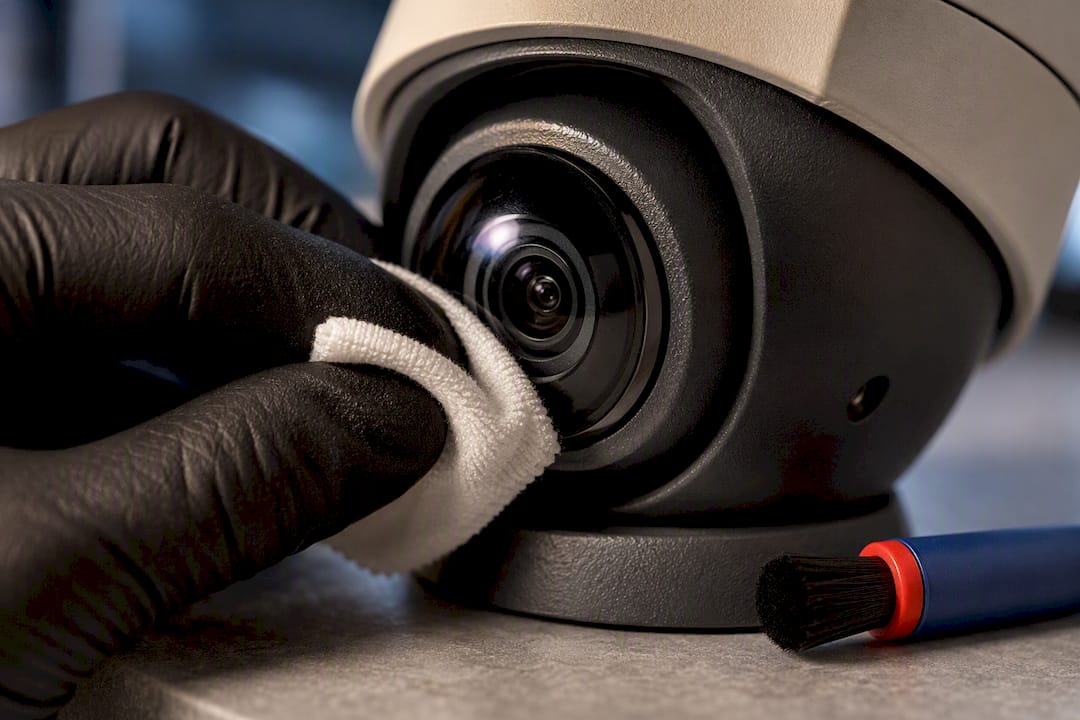
The tradeoff is exposure. An open lens is easier to smudge, spray, or knock out of alignment than one sealed behind polycarbonate. Higher-end turrets counter this with IP66 or IP67 weatherproofing and, in professional-grade models, locking mounts that resist casual tampering. Mounting height still matters more for turrets than for domes.
Turrets tend to earn their spot at:
- Perimeter fence lines and driveways
- Loading docks and parking areas
- Temporary installations or pop-up retail displays
- Refrigerated or cold-storage rooms, where dome condensation is a bigger risk
Pro Tip: Mount turret cameras at least 9 to 10 feet up in any spot with public foot traffic. The open lens is the easiest part of the camera to damage, and height is your cheapest defense against it.
What Is a Dome Camera and When Should You Use One?
A dome camera houses its lens inside a rounded polycarbonate shell, sometimes tinted or smoked to hide which direction the lens is pointed. That shell does double duty: it protects the internal optics from impact, and it makes the camera’s field of view harder to read at a glance.
The biggest selling point is durability. IK10-rated dome housings withstand impacts up to 50 joules, roughly the force of a hammer strike, which makes them the default choice anywhere someone might try to disable a camera by hand. The low profile also blends into a ceiling or soffit better than a protruding turret, useful in spaces where a heavy security presence would feel unwelcome.
Domes carry real tradeoffs, though. The bubble can trap and reflect infrared light back into the lens, a known cause of washed-out night footage, especially when the housing is scratched or dusty. Condensation and water droplets on the interior of the bubble degrade image quality too, and installation-related smudges or poor seals are a common source of avoidable image problems. Re-aiming usually means popping the housing open rather than a quick manual nudge.
Domes make the most sense at:
- Retail ceilings and checkout areas
- Lobbies, elevators, and hallways
- Schools and other spaces with heavy foot traffic
- Corridors where a visible camera might invite vandalism
Pro Tip: If you’re specifying domes for a public-facing space, ask the installer about the bubble’s anti-fingerprint coating. A smudge on installation day can quietly hurt your night footage for months before anyone notices.
The Technical Differences That Actually Affect Your Footage
The dome bubble is the whole story here. Light passing through curved polycarbonate refracts slightly and can bounce IR light back toward the sensor, a problem the open optical path on a turret simply doesn’t have. That’s the mechanical reason turrets often out-resolve domes in the exact same lighting conditions after dark.
Ratings tell the rest of the story. IK10 measures impact resistance; IP66/IP67 measures dust and water resistance. A camera can carry one without the other, so check both if the unit will sit outdoors and within arm’s reach of the public.
By the numbers: An IK10 rating means a housing can absorb a 50-joule impact, roughly equivalent to a 5-kilogram object dropped from a meter, without exposing internal components.
Installation height and angle matter differently for each type:
- Turrets need height primarily to protect the exposed lens from tampering.
- Domes need height less for protection and more for field-of-view coverage.
- Both need a stable mount; loose brackets cause more blurry footage complaints than lens quality ever does.
- Cold-storage and kitchen environments favor turrets, since domes are more prone to condensation and grease buildup on the bubble.
How to Choose Between Turret and Dome Cameras
Work through this before you sign off on any camera order:
- Assess the mounting height and reachability. Anything within arm’s reach of the public needs either a high IK rating or a mount well out of range.
- Rate the vandal risk of the location. A back alley loading dock has different risk than a monitored retail floor.
- Check the lighting at night, not during the day. A location that looks fine at 2 PM can be nearly unusable for a dome camera’s IR at 2 AM.
- Decide fixed lens vs varifocal. Matching field-of-view to your actual coverage goal matters more than form factor alone.
- Confirm maintenance access. If nobody can reach the camera easily, don’t choose a design that needs frequent cleaning or re-aiming.
Ask any vendor these five questions before you buy:
- What is the exact IK and IP rating, and is it tested or just marketed?
- What is the minimum lux rating and IR range in feet?
- What’s the warranty period and who handles repairs?
- Is there a maintenance or cleaning plan included?
- Can the lens angle be adjusted remotely, or does it require a technician visit?
Red flags worth walking away from: no published IK or IP number, vague marketing language like “night vision capable” with no lux figure, and no mention of an ongoing service plan.
Quick pairings that tend to work:
- Warehouse loading dock → turret, mounted high, IP67 rated
- Retail checkout ceiling → dome, IK10 rated
- Apartment complex perimeter → turret for night clarity
- School hallway → dome for discreet tamper resistance
How a Professional Security Integrator Applies This in the Field
Camera selection is only half the job. At Global Security, form-factor decisions get paired with Virtual Guard remote monitoring and on-site patrol coverage, so a camera choice is never made in isolation from how the footage actually gets watched and acted on.
A retail client with a high-traffic ceiling grid typically gets dome cameras for tamper resistance, while the same property’s loading dock and perimeter fence line get turrets for clearer night detail and faster re-aiming when a patrol officer flags a blind spot.
That layered approach, cameras plus guard services plus monitoring, is what turns a camera spec sheet into an actual customized security strategy.
Fast Rules of Thumb for Camera Selection
When in doubt, default to dome wherever hands or vandalism are a real risk, and turret wherever night clarity or frequent re-aiming matters more. Combine both on any property with mixed exposure. Most well-secured commercial sites end up using both types, not one exclusively, matched zone by zone rather than picked once for the whole building.
— Alston
Get a Professional Assessment Before You Buy a Single Camera
Guessing at IK ratings and IR ranges from a spec sheet is how businesses end up with cameras that fail at exactly the moment they’re needed. Global Security’s team, built from law enforcement and military backgrounds, evaluates your property’s actual risk points, lighting, and traffic patterns before recommending turret, dome, or a mixed layout, then backs the install with CCTV integration and ongoing maintenance.

A site walkthrough typically covers mounting heights, blind spots, existing wiring, and whether continuous Virtual Guard monitoring makes sense alongside recorded footage. If you want cameras and a response plan working together instead of a camera system sitting on its own, request a security assessment and quote and get a layout built around your actual property, not a generic package.
Sources
Always confirm model-level specs against the manufacturer’s datasheet before ordering.