
Unarmed security guards typically bill between $22 and $35 an hour, while armed guards run $32 to $50 an hour, according to industry pricing benchmarks. Executive protection and short-notice event work push well past that, sometimes reaching $100 an hour or more.
Here’s your fastest sanity check: any quote priced under roughly $18 to $20 an hour for an unarmed guard almost certainly cannot cover legal wages, payroll taxes, workers’ comp, and liability insurance. That’s not a bargain. That’s a company cutting corners somewhere you can’t see.
- Unarmed static post: $22–$35/hour
- Armed static post: $32–$50/hour
- Consumer-facing average across service types: $45–$60/hour
Treat every number here as a starting point, not a final answer. Local labor markets, licensing costs, and insurance requirements shift enough by ZIP code that a live location-based quote is the only way to know your real number.
Key Takeaways
Security guard cost is driven by loaded labor and bill-rate multipliers, not guesswork, and any quote that ignores that math transfers hidden risk to the client.
| Point | Details |
|---|---|
| National rate bands | Unarmed guards run $22–$35/hour and armed guards run $32–$50/hour depending on region and service type. |
| Loaded labor is the floor | Wage times roughly 1.35 covers payroll taxes and insurance; quotes below that floor are a red flag. |
| Bill rate multiplier | A realistic bill rate lands around 1.6 to 1.8 times the base wage once overhead and margin are added. |
| Monthly math scales fast | A 24/7 unarmed post typically runs $8,000–$12,800 per month, so small hourly gaps compound quickly. |
| Technology lowers effective cost | Global Security’s Virtual Guard and mobile patrol options cut billable hours while preserving documented response. |
Table of Contents
- Security Guard Rates by Service Type
- How Much Does 24/7 Security Coverage Cost Per Month?
- What Affects the Cost of Hiring a Security Guard?
- How Do Agencies Calculate Bill Rate vs. Guard Pay?
- Cheaper Ways to Cover the Same Risk
- Questions to Ask Before You Sign a Security Contract
- Why Cheap Guards Usually Cost More Later
- Get a Real Quote Instead of a Guess
- Sources
Security Guard Rates by Service Type
The rate you pay depends heavily on what kind of coverage you’re buying, and buyers who don’t separate these categories end up comparing apples to armored trucks.
Unarmed guards are the baseline. Expect $22 to $35 an hour nationally, with West Coast and Northeast metros often landing at $28 to $42 an hour and Southeast or South Central markets running several dollars lower, per regional pricing data. A retail overnight post or a construction site checkpoint typically sits at the lower end of that band.
That premium covers firearms certification, additional insurance coverage, and often a higher pay floor to retain qualified personnel. Off-duty police officers working armed posts push toward the top of the range or above it, since agencies pay a scheduling premium to secure sworn officers.
Mobile patrol services bill differently since you’re paying for coverage across a route rather than a fixed post, which usually makes the effective hourly cost lower than a stationary guard covering the same footprint.
Event security for one-off bookings often runs higher per hour than recurring contracts because agencies can’t fill that slot with other work and need to compensate guards for unpredictable scheduling.
Executive protection is its own category entirely. Bodyguard services for high-profile individuals typically range from $65 to $200 an hour, reflecting specialized training, advance work, and the liability of protecting a named client rather than a property.
- Unarmed: $22–$35/hour
- Armed: $32–$50/hour
- Executive protection: $65–$200/hour
A small retail store needing a single unarmed overnight guard should expect quotes near the low-to-mid range. A corporate headquarters wanting an armed lobby presence with a uniformed, licensed officer should expect the upper half of the armed band.
How Much Does 24/7 Security Coverage Cost Per Month?
Hourly rates only tell part of the story. What matters for budgeting is the monthly or per-post total, because that’s the number that actually hits your accounts payable.
A single guard covering a 12-hour shift works out to an average number of hours per month. A 24/7 post requires multiple guards rotating shifts to cover all 168 hours a week, which typically lands around 730 hours a month once you account for coverage gaps and rotation.
- Multiply your negotiated hourly bill rate by the monthly hours required for your coverage pattern.
- Add any recurring fees (vehicle use, equipment, administrative surcharges) that aren’t baked into the hourly number.
- Compare the resulting monthly figure against reference post-cost ranges for your service type before signing.
Recurring, longer-term contracts almost always lower your effective hourly cost compared to booking the same hours one shift at a time, since agencies can schedule guards more efficiently and avoid the premiums tied to unpredictable, one-off bookings.
What Affects the Cost of Hiring a Security Guard?
Two buyers in different cities requesting the same “unarmed guard, 12-hour shift” can receive wildly different quotes, and it’s rarely because one company is padding its margin. Several concrete variables move the number.
- Location. State and local wage floors, driven partly by rules like those tracked by California’s Department of Industrial Relations, set a hard floor under every quote in that market.
- Shift length and notice. Short-notice bookings and single-shift event coverage carry a premium because agencies can’t backfill that slot easily.
- Time of coverage. Nights, weekends, and holidays typically carry a differential above standard daytime rates.
- Experience and certification. A guard with executive protection training or specialized certifications commands a higher rate than an entry-level unarmed post.
- Insurance and licensing overhead. Agencies carrying full liability coverage and proper state licensing build that cost into every hour billed.
Watch for add-on fees that show up after the initial quote: vehicle and fuel charges for mobile patrol, equipment rental for radios or surveillance gear, and administrative surcharges tacked onto invoices. None of these are automatically unreasonable, but they should be disclosed upfront, not discovered on your first bill.
Pro Tip: Ask every bidder to quote an all-in rate that includes vehicle, equipment, and administrative fees. A quote that looks cheapest before fees often isn’t the cheapest once the invoice arrives.
How Do Agencies Calculate Bill Rate vs. Guard Pay?
The gap between what a guard earns and what you pay isn’t padding. It’s a structural stack, and understanding it is the single best way to spot a quote that’s too good to be true.
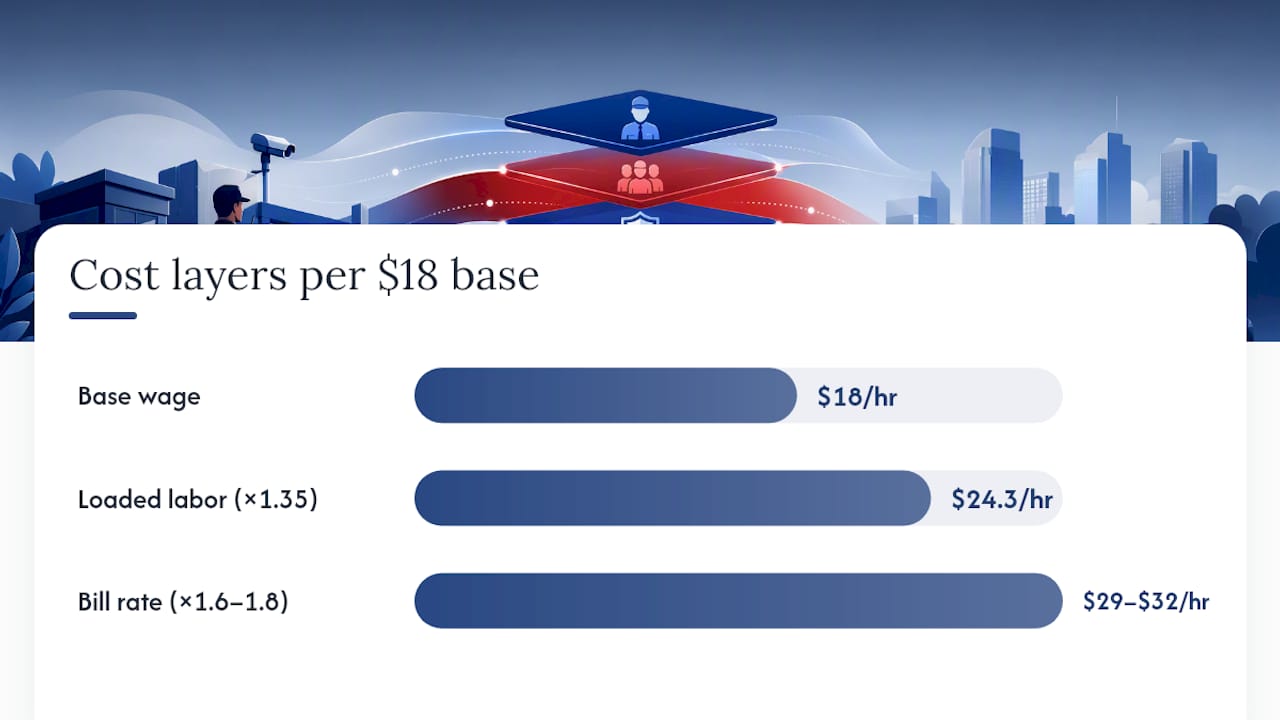
- Base wage. The median security guard wage sits around $17.82 an hour, with a mean of $19.44 and a 90th percentile near $27.60 for more experienced or specialized guards.
- Loaded labor. Add payroll taxes, workers’ compensation, and mandatory benefits, and agencies typically multiply the base wage by roughly 1.35 to reach the true cost of employing that guard.
- Bill rate. Layer on overhead, liability insurance, supervision, and margin, and the final bill rate usually lands at 1.6 to 1.8 times the base wage.
Two examples make this concrete. A guard earning $18 an hour for a one-off event shift should generate a bill rate somewhere near $29 to $32 an hour once loaded labor and event-premium overhead are factored in. A guard staffing a recurring 24/7 post at the same $18 wage should land closer to $28 to $32 an hour too, though the recurring contract often trims the margin slightly since scheduling risk is lower.
A quote that undercuts the 1.35x loaded-labor floor isn’t a deal. It usually means someone isn’t paying payroll taxes, carrying real insurance, or both.
Cheaper Ways to Cover the Same Risk
Cutting guard hours isn’t the only lever available, and for many properties it isn’t even the smartest one.
Remote video monitoring replaces a portion of static guard hours with camera-based oversight and live response, and it’s a legitimate substitute for lower-traffic sites like parking structures, warehouses, or after-hours retail. Virtual guard programs, including Global Security’s own approach, typically cost a fraction of a full-time onsite post while maintaining recorded evidence and real-time incident response.
Mobile patrol trades constant presence for scheduled visibility across multiple properties, which works well for parking lots, gated communities, and construction sites that need deterrence more than a fixed guard.
Recurring contracts consistently price lower per hour than one-off bookings, since agencies can staff them predictably instead of scrambling for last-minute coverage.
- Remote monitoring: lowest cost, best for lower-traffic sites
- Mobile patrol: mid-cost, best for multi-property or perimeter coverage
- Recurring static post: highest cost per hour saved, best where constant presence is non-negotiable
Pro Tip: Ask any provider whether your site is a candidate for hybrid coverage, a mix of scheduled patrol and remote monitoring backed by a smaller number of live guard hours. It’s often the fastest way to cut spend without cutting protection.
Questions to Ask Before You Sign a Security Contract
A quote is only useful if you can verify what’s behind it. Before accepting any bid, get direct answers to these questions.
- What are your general liability and workers’ compensation coverage limits?
- What’s your state security license number, and can I verify it independently?
- What percentage of the bill rate goes to guard pay versus overhead and margin?
- How is overtime handled, and is it built into the quoted rate?
- What training do guards receive before deployment to my site?
Request a certificate of insurance, a copy of the company’s state security license, and a written staffing plan that names shift patterns and backup coverage. Automated guard-response and procurement tools, like those covered by BeyondSensor, are increasingly part of how agencies document and standardize this kind of reporting for clients.
- A quote well below the loaded-labor floor with no explanation
- Reluctance to provide a certificate of insurance
- No clear answer on pay rate versus bill rate breakdown
Any of these should slow you down before you sign.
Why Cheap Guards Usually Cost More Later
Price matters, but the gap between a $20 an hour guard and a $28 an hour guard rarely shows up in the invoice. It shows up in the incident report, or the lack of one. A guard who’s undertrained, uninsured, or stretched across too many properties doesn’t just do a worse job. They create liability exposure that dwarfs the hourly savings.
Technology changes that math without requiring you to overpay for presence alone. Pairing a smaller number of onsite hours with Virtual Guard monitoring lets a property maintain real coverage and documented response without staffing a full-time post around the clock. The right question isn’t “what’s the cheapest guard.” It’s “what’s the cheapest way to close this specific risk.”
— Alston
Get a Real Quote Instead of a Guess
Global Security prices guard services around your actual site, not a generic hourly number pulled from a rate card. That means armed and unarmed guard services, roving vehicle patrols, and executive protection scoped to your property’s real risk, backed by a team built from law enforcement and military leadership rather than a call center.

What sets this apart from a bare-bones guard agency is the technology layered underneath it. Virtual Guard remote monitoring lets you cut billable onsite hours without cutting documented coverage, which is exactly the kind of hybrid math discussed above. If you’re weighing a quote right now and want to know whether it holds up, request a quote for guard services and get a rate built around your address, your schedule, and your actual risk instead of a national average.
Sources
- BLS — Occupational Employment and Wages, May 2023: 33-9032 Security Guards
- How to Price Security Guard Contracts | Novagems
- Security Guard Bill Rate vs. Pay Rate: What the Markup Really Covers | HireSecurityNow
- Security Guard Prices 2026 — Cost by Service | HireSecurityNow
- Security Guard Cost — Calvis