
The most effective parking lot security strategy combines three layers: environmental design that removes hiding spots, AI-enabled detection that catches threats in real time, and a monitored response with a defined dispatch path. No single camera or gate arm does this job alone. The FBI’s crime data and insurance industry trend reports both confirm parking areas remain a persistent target for theft and violent crime. Here’s what to fix first:
- Fix lighting and sightlines so cameras and human eyes can actually see trouble developing.
- Add AI-powered analytics and license plate recognition (LPR) to existing cameras, or deploy mobile surveillance trailers where coverage gaps exist.
- Define alert routing and response SLAs so every detection reaches a named responder, on-site or virtual, within minutes.
Key Takeaways
A layered parking lot security program combining environmental design, AI-enabled detection, and monitored response reduces both incident rates and liability exposure more reliably than any single security measure alone.
| Point | Details |
|---|---|
| Fix lighting first | Eliminate shadow pockets and light to at least 30 feet of detection range before adding hardware. |
| Layer technology and response | Combine LPR, behavioral analytics, and monitoring so alerts reach a named responder every time. |
| Match deployment to timeline | Use fixed installs for long-term coverage and mobile trailers for events, gaps, or seasonal spikes. |
| Vet vendors on integration | Prioritize systems that run on existing cameras and offer documented response SLAs. |
| Global Security offers layered assessment | Gsgicorp pairs site risk assessments with Virtual Guard monitoring and CCTV integration for a monitored, phased rollout. |
Table of Contents
- What Are the Core Components of Parking Lot Security?
- Which Cameras and Sensors Actually Reduce Parking Lot Theft?
- How Should Cameras and Lighting Be Placed for Maximum Deterrence?
- What Should Monitoring and Response Protocols Look Like?
- Fixed Installation, Mobile Trailers, or a Hybrid Approach?
- What Drives Parking Lot Security Costs and ROI?
- How Do You Vet a Parking Lot Security Vendor?
- Why Layered Technology and Human Response Both Matter
- When Does a Rental or Rapid-Deployment Trailer Make Sense?
- What Separates a Trustworthy Security Vendor From the Rest?
- How Do You Plan, Install, and Maintain a Security System?
- How Do Real Properties Measure ROI From Security Upgrades?
- Common Mistakes Property Managers Make (and How to Fix Them)
- How Global Security Helps You Build a Monitored, Layered System
- Frequently Asked Questions
- Sources
What Are the Core Components of Parking Lot Security?
A parking lot security program stands on a handful of non-negotiable pillars. Skip one and the rest underperform, no matter how much you spent on cameras.
- Environmental design (CPTED): Maximize natural surveillance, control access points, and reinforce a sense of ownership over the space, following CPTED principles from the Office of Justice Programs.
- Lighting: Bright, even illumination with no shadow pockets near entrances, stairwells, or elevator lobbies.
- Physical access control: Gates, bollards, and controlled entries that funnel traffic through monitored chokepoints.
- Video and analytics: Cameras paired with behavioral detection and LPR, not just passive recording.
- Monitoring and response: A live or virtual operator who verifies alerts and dispatches help.
- Operations: Regular patrols, working signage, and scheduled maintenance so nothing degrades silently.
Score your current lot on four questions: Can you see every corner from at least one camera? Is lighting bright enough for facial recognition at 30 feet? Do cameras cover every chokepoint, not just entrances? Is there a documented path from alert to human response? Visibility, monitoring, and response drive the fastest risk reduction, since a layered approach outperforms any single measure property managers might rely on instead.
Which Cameras and Sensors Actually Reduce Parking Lot Theft?
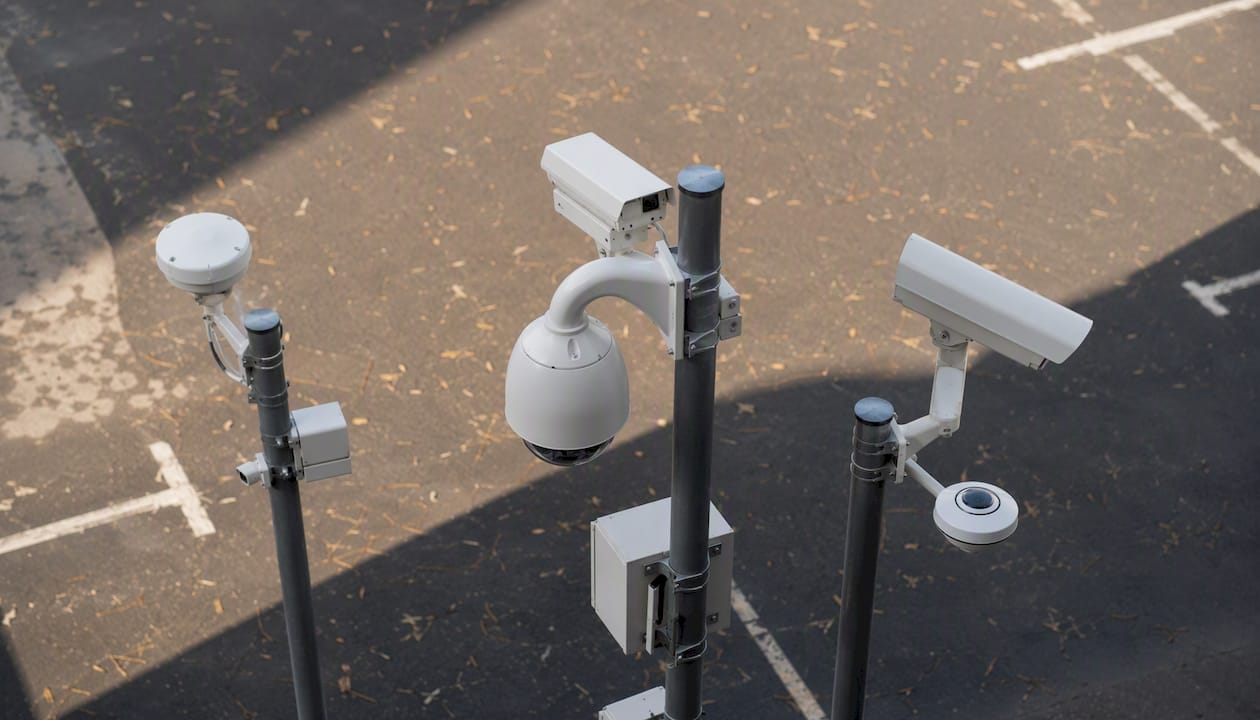
Building the right technology stack starts with matching device types to the threats they’re meant to catch. Fixed pole cameras cover long sightlines along drive aisles. PTZ (pan-tilt-zoom) units let an operator zoom in on a suspicious vehicle or plate in real time. Panoramic and fisheye cameras cover wide areas like open lots with fewer total units. LPR cameras read and log plates against watchlists automatically. Thermal and infrared cameras keep detection working after dark, when most parking lot crime happens. Acoustic sensors that detect gunshots or breaking glass add a layer cameras alone can’t provide.
Before buying anything new, demand a specification checklist from any vendor: minimum resolution for plate-level detail (1080p is a floor, not a target), infrared range sufficient for full-lot coverage at night, an IP66 or higher ingress-protection rating for weather resistance, and an IK10 vandal-resistance rating for housings in publicly accessible areas. Bandwidth and power matter just as much as image quality. Ask whether the system runs on existing PoE wiring, needs a cellular backhaul, or can run off solar and battery for lots without nearby power.
AI-powered cameras change what these systems can do. Behavioral analytics flag loitering, unusual movement patterns, or a person following another to their car, generating a real-time alert instead of forty hours of footage that gets reviewed only after an incident. This shifts systems that traditionally just recorded evidence into ones that enable real-time detection of loitering, intrusion, and weapons without relying on facial recognition. LPR feeds those same watchlists automatically, flagging a vehicle tied to a prior incident the moment it enters the lot.
Pro Tip: Audit your existing cameras for frame rate, lighting conditions, and wiring before buying new hardware. Analytics software often runs directly on current IP feeds, and you may only need a licensing upgrade rather than a full camera swap.
Reports tracking catalytic converter thefts documented spikes from low triple digits to over 1,000 incidents per month in 2020, a trend that built the business case for LPR and analytics investment across the industry.
How Should Cameras and Lighting Be Placed for Maximum Deterrence?
Camera placement fails most often at the same five spots: elevators, stairwells, ramps, entrances and exits, and pedestrian walkways between parking spaces and building doors. Each needs dedicated coverage with overlap between adjacent cameras, so no single blind spot exists between zones.
- Cover elevator lobbies and stairwell landings with bright, direct lighting and a dedicated camera at head height.
- Aim cameras at pay stations and pedestrian chokepoints where foot traffic concentrates.
- Eliminate shadow pockets under awnings, behind landscaping, and inside stairwell alcoves.
- Add signage marking camera coverage and emergency callbox locations at every level.
Lighting guidance is specific for a reason. Facilities should use LED white light at 4,000K or brighter, since white light sources at this range increase perceived illuminance by more than 30 percent when paired with reflective paint on structural surfaces. Detection should extend out to at least 30 feet from any point in the lot, per industry lighting standards for parking facilities. A quick fix for most properties: walk the lot at night with a light meter and mark every spot where a person’s face becomes indistinguishable at 30 feet. Those are your blind spots, and they usually cluster in the same three locations, under stairwells, behind trimmed hedges, and at the far corners farthest from building entrances.
What Should Monitoring and Response Protocols Look Like?
A camera that records but alerts no one is a filing cabinet, not a security system. The operational value comes from what happens between detection and response.
- Detection triggers an automated alert when analytics flag loitering, an unauthorized vehicle, or a breach at a controlled access point.
- An operator verifies the alert within a defined window, typically 30 to 90 seconds, ruling out false positives like a stray cat or wind-blown debris.
- Dispatch follows immediately, whether that means a live audio warning through an on-site speaker, an automated deterrent like a siren or spotlight, or a patrol response targeting arrival within 2 to 5 minutes.
- Evidence is retained according to a documented policy, usually 30 to 90 days, so footage supports investigations or insurance claims later.
Remote monitoring, sometimes called Virtual Guard service, works well for lots with moderate foot traffic and budget constraints, since a trained operator watches multiple properties simultaneously and dispatches guard services only when verified. Higher-risk properties, like garages with a history of violent incidents, often need local patrols on top of remote monitoring rather than instead of it.
Pro Tip: Map every single alert type to one named responder, whether that’s a security desk, an on-call patrol team, or a third-party remote operations center. Gaps happen when three parties each assume someone else is watching.
Fixed Installation, Mobile Trailers, or a Hybrid Approach?
Choosing between a permanent install and a rapid-deployment solution comes down to how long you need coverage and how fast you need it running.
| Deployment type | Best for | Trade-off |
|---|---|---|
| Fixed installation | Long-term coverage of a stable property | Higher upfront cost, longer install timeline |
| Mobile surveillance trailer | Event coverage, seasonal spikes, gap-filling during construction | Higher per-month cost for short durations, needs repositioning |
| Hybrid model | Phased rollouts or proof-of-concept trials before full investment | Requires coordinating two systems during transition |
A typical deployment moves through five stages: site survey, scope definition, install or rental logistics, system integration with existing infrastructure, and testing before handover. Mobile trailers solve a real problem fixed systems can’t: a construction site, a seasonal parking overflow lot, or a property waiting on permits for permanent poles all need coverage now, not in eight weeks.
What Drives Parking Lot Security Costs and ROI?
Budgeting for a security upgrade means pricing out several distinct cost centers, not just camera units.
- Hardware: Camera units, poles and mounts, housings rated for weather and vandalism.
- Infrastructure: Cabling, conduit, and network backhaul, whether fiber, cellular, or a hybrid connection.
- Power: AC wiring, Power over Ethernet (PoE), or solar and battery systems for lots without nearby utility access.
- Software: Analytics licensing fees, typically billed per camera or per site annually.
- Monitoring: Live or virtual monitoring fees, billed monthly or per incident depending on the provider.
- Maintenance: Scheduled inspections, lens cleaning, and firmware updates that keep detection accurate.
ROI on parking lot security shows up in four measurable places: the change in incident rate over time (benchmarked against crime trend data), average claim costs avoided, deterrence value reflected in fewer attempted break-ins, and operational savings from needing fewer patrol hours once analytics handle routine monitoring. Purchasing hardware outright means higher upfront capital expense but full ownership and no recurring rental fees. Renting or leasing trailers keeps capital free and offers faster coverage, but costs more over a multi-year horizon if the need turns out to be permanent.
How Do You Vet a Parking Lot Security Vendor?
Not every integrator or monitoring provider delivers what their sales deck promises. Work through this checklist before signing anything.
- Does the system integrate with your existing cameras, or does it require a full hardware replacement?
- Is the analytics platform proprietary or open, meaning can you switch monitoring providers later without losing your camera investment?
- Does the vendor offer LPR capability, and can it be configured to a custom watchlist for your property?
- What are the actual response SLAs, in writing, for alert verification and dispatch times?
- Can they provide monitoring-center credentials and evidence-export processes for law enforcement or insurance use?
- Do they have references or documented case studies from similar properties?
Watch for red flags: vendors offering vague SLAs instead of specific time windows, systems locked to one analytics provider with no export path, or a refusal to run a proof-of-concept on your actual site before contract signing. A credible integrator will scope a pilot with clear deliverables and phased pricing rather than pushing a single all-or-nothing package.
Why Layered Technology and Human Response Both Matter
Security experts across the industry converge on the same point: a layered strategy combining visibility, access control, cameras, analytics, and patrols consistently outperforms any single measure on its own. Analytics without a defined responder produce nothing but stored footage.
Technology only reaches its potential when tied to a clearly defined response protocol. An alert that reaches no one is just evidence collection, not prevention.
Global Security’s approach reflects this directly. Its Virtual Guard remote monitoring service pairs live operators with client camera feeds, its guard teams provide roving patrol response when a verified alert demands a physical presence, and its CCTV integration work brings analytics onto systems clients already own. The pattern that separates functioning security programs from expensive camera installations is simple:
- Detection triggers a response, not just a recording.
- Response times are measured and reported, not assumed.
- Coverage adapts to risk level rather than a one-size install.
When Does a Rental or Rapid-Deployment Trailer Make Sense?
Not every property needs a permanent installation on day one, and treating rental options as a stopgap undersells what they actually solve. Mobile surveillance trailers deploy within days rather than the weeks a fixed install typically requires, since they arrive pre-wired with solar power, cellular backhaul, and cameras already mounted.
Short-term rentals fit specific, time-boxed needs: a retail property bracing for a holiday shopping surge, a construction site protecting equipment for the length of a project, or an event venue needing coverage for a single weekend. Long-term rentals suit a different case, a property owner who wants full coverage now but isn’t ready to commit capital to permanent poles and trenching, perhaps because a lease is up for renewal or a redevelopment is pending. Renting buys time without locking in infrastructure decisions.
Rapid deployment also solves a problem fixed systems can’t touch: gap coverage during a transition. If a permanent system is being upgraded, or new poles are waiting on a permitting process, a trailer keeps a lot monitored during the vulnerable window when it would otherwise sit exposed. Property managers dealing with a recent spike in break-ins, the kind of trend tracked in national theft data, often deploy a trailer within days of an incident rather than waiting on a full installation timeline.
The trade-off is cost per month versus cost over years. A trailer rented for three months costs more per day than a comparable fixed camera amortized over five years, but for a defined, time-limited need, that premium buys speed and flexibility a permanent build can’t match.
What Separates a Trustworthy Security Vendor From the Rest?
Reputation matters more in this industry than almost any other, because a vendor’s product is trust, not just hardware. Ask for documented case studies showing measurable incident reduction, not just marketing claims. A provider unwilling to share before-and-after data on a comparable property is telling you something.
Customer support quality shows up fastest during an actual incident, not during the sales process. Ask specifically how support requests get routed after hours and what the escalation path looks like when an on-site issue needs immediate attention. Integration capability determines whether you’re locked into one vendor’s ecosystem or free to add analytics, swap monitoring providers, or expand coverage without ripping out existing hardware.
Scalability matters for any property expecting growth, additional lots, added buildings, or seasonal expansion. A system that only works at its current size becomes a liability the moment a portfolio grows. Ask vendors directly how their pricing and infrastructure scale from one lot to ten.
Compliance with privacy regulations deserves specific attention given how analytics platforms handle recorded data. Behavioral detection systems that flag loitering, falls, or weapons without relying on facial recognition reduce privacy exposure while still delivering actionable alerts, an approach worth prioritizing over identity-based tracking systems that carry heavier regulatory and liability burdens. Ask vendors directly what data they store, for how long, and who can access it.
How Do You Plan, Install, and Maintain a Security System?
Building a parking lot security program in the right sequence prevents the most common failure: buying hardware before understanding the actual risk profile of the property.
Start with a site risk assessment. Walk the property at different times of day, map every blind spot, and review any incident history for the location. This step alone often reveals that lighting fixes cost less and deliver more immediate risk reduction than any camera purchase.
Define scope before requesting quotes. Decide which zones need fixed cameras, which need PTZ coverage for active monitoring, and where LPR should sit relative to entry and exit points. A vague scope invites vendors to sell more hardware than the property needs.
Select a deployment model. Match the choice, fixed install, mobile trailer, or hybrid, to the actual timeline and budget rather than defaulting to whatever a vendor pitches first.
Install and integrate. Confirm new equipment ties into existing network infrastructure and that analytics run correctly against real lighting conditions on site, not just in a vendor demo.
Test before full handover. Run the system through a full week of operation, checking alert accuracy, verification timing, and dispatch response before considering the system live.
Maintain on a schedule. Lenses need cleaning, firmware needs updates, and lighting needs periodic inspection since a single burned-out fixture can recreate a blind spot that took months to eliminate.
How Do Real Properties Measure ROI From Security Upgrades?
Properties that add layered technology typically track four metrics before and after deployment: total incident count, average police or security response time, insurance claim frequency, and patrol labor hours needed once analytics handle routine monitoring.

A retail center adding LPR alongside existing cameras, for example, can cross-reference plates against a watchlist the moment a flagged vehicle enters the lot, catching repeat offenders before an incident occurs rather than reviewing footage afterward. A property replacing passive recording with behavioral analytics typically sees fewer false alarms reaching human operators, since the system filters out routine motion like blowing debris or passing wildlife and only escalates genuine anomalies.
The strongest ROI case comes from combining reduced incident counts with fewer patrol labor hours. When monitoring center operators verify alerts before dispatch, on-site patrol teams respond only to confirmed threats rather than patrolling continuously on a fixed schedule, cutting labor costs while improving response accuracy at the same time. Properties with a documented history of catalytic converter theft or vehicle break-ins, a trend tracked closely by insurance industry groups, often see the fastest payback period once LPR and analytics go live, since the deterrent effect alone reduces repeat targeting within the first few months.
Common Mistakes Property Managers Make (and How to Fix Them)
Three mistakes show up constantly during initial site assessments. Cameras that record but never alert anyone, treated as if footage alone deters crime. Lighting that was installed correctly but never maintained, so half the fixtures burn out silently over two years. Alert routing left undefined, so a detection reaches three different people who each assume someone else will respond.
Global Security’s assessments typically catch all three in the first site visit, usually before discussing any hardware upgrade. My advice for the next 72 hours: walk your lot at night and log every dead light. Ask your current camera vendor whether analytics can run on your existing feeds. And write down, in one sentence, who responds to an alert at 2 a.m.
How Global Security Helps You Build a Monitored, Layered System
Gsgicorp built its parking lot security approach around the same layered model this article has laid out: environmental design review, technology integration, and a monitored response with defined SLAs, not just camera installation.

Where many security vendors stop at selling hardware, Gsgicorp starts with a site risk assessment that identifies lighting gaps, camera blind spots, and response gaps before recommending equipment. From there, clients can pursue a proof-of-concept analytics trial on existing cameras, a hybrid package combining Virtual Guard remote monitoring with roving patrol response, or full CCTV integration for properties replacing aging systems. Monitoring operations are staffed by a team with law enforcement and military backgrounds, giving clients verified dispatch protocols rather than vague response promises. Property managers ready to move past passive cameras can schedule a no-obligation site survey through Gsgicorp’s services page to scope a plan specific to their lot’s risk profile and budget.
Frequently Asked Questions
What is the difference between parking lot security and parking garage security?
Parking lot security typically deals with open-air coverage where lighting and camera placement account for weather exposure and longer sightlines. Parking garage security adds structural challenges: multiple levels, stairwells, elevator lobbies, and enclosed areas that need brighter lighting and denser camera coverage to eliminate blind spots.
How many security cameras does a parking lot need?
The right number depends on lot size and chokepoints, not a fixed ratio. Every entrance, exit, pay station, and pedestrian walkway needs dedicated coverage with overlap between adjacent cameras, so a small lot might need six cameras while a large garage needs several dozen.
Can AI analytics work with cameras I already own?
Often, yes. Many analytics platforms run directly on existing IP camera feeds without requiring new hardware, provided the current cameras meet minimum resolution and lighting requirements. An audit of your current system usually reveals whether an upgrade or a software license is the faster path.
Is remote video monitoring as effective as an on-site guard?
Remote monitoring, or Virtual Guard service, works well for verified alert response and deters most opportunistic crime at a lower cost than full-time on-site staffing. Higher-risk properties or those with a history of violent incidents typically benefit from combining remote monitoring with periodic or on-call patrol response.
How much does a parking lot security system cost?
Costs vary by lot size, camera count, and whether the property chooses purchase or rental. Major cost drivers include camera hardware, network backhaul, power infrastructure, analytics licensing, and monthly monitoring fees, so a full budget requires a site-specific assessment rather than a flat estimate.
Sources
Property managers building requirements or preparing an RFP can lean on a handful of primary sources. The Office of Justice Programs’ CPTED guidance defines the design principles behind natural surveillance and access control. The IFPO’s parking security guidelines set lighting and visibility benchmarks referenced throughout this article. Crime Data Explorer provides trend data for benchmarking incident rates before and after a security upgrade. IEEE’s public safety technology coverage tracks how AI analytics and LPR are evolving industry-wide, and NICB’s theft trend reports supply the data behind vehicle crime spikes cited in ROI calculations.
- Parking Garage/Parking Lot Security (IFPO)
- Crime Prevention Through Environmental Design (CPTED) guidance (OJP)
- How to protect your parking structures (Campus Safety Magazine)
- Catalytic converter thefts surge (NICB)